 A Space for Thoughtful

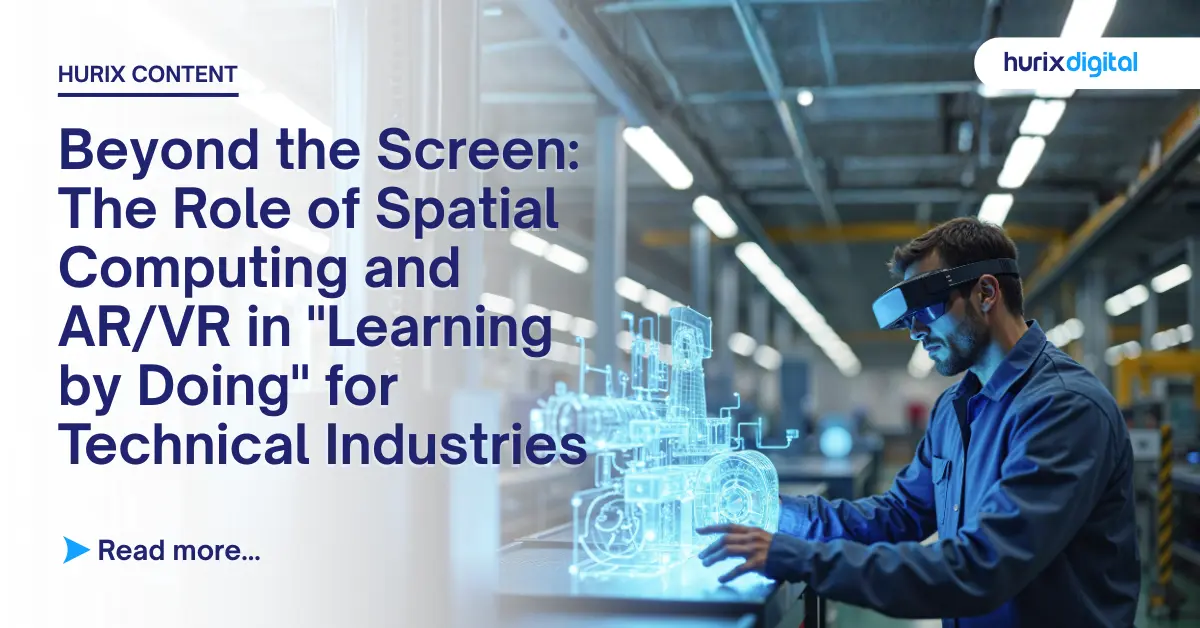
Beyond the Screen: The Role of Spatial Computing and AR/VR in “Learning by Doing” for Technical Industries
Summarize with:
Technical training is in a weird spot. We’ve got billion-dollar machinery being maintained by people who, in many cases, were trained using a 200-page binder and a prayer. It’s a massive gap. You can’t read your way into being a master technician. You have to touch the equipment. But what happens when the equipment is too dangerous, too expensive, or halfway across the world?
That’s where the “screen” stops being helpful and starts being a wall. We’re finally seeing a shift toward Immersive Learning that actually feels like the job itself. Spatial computing and AR/VR aren’t just fancy ways to view 3D models; they are the bridge that lets a rookie get their hands dirty without the risk of a multi-million-dollar mistake.
Table of Contents:
- What is the Core Value of Immersive Learning in Heavy Industry?
- 7 Reasons Spatial Computing is Overhauling the Shop Floor
- How Does AR/VR Cut Down on Workplace Accidents?
- 5 Types of Tools That Are Actually Moving the Needle
- FAQs
What is the Core Value of Immersive Learning in Heavy Industry?
The value isn’t just “better visuals.” It’s the death of the “oops” factor. In technical fields, a mistake during training on a live turbine or a chemical line isn’t just a point off a test—it’s a safety disaster.
Immersive Learning flips the script by creating a consequence-heavy environment without the actual danger. When a trainee wears a headset, they aren’t just watching a video of a repair. They are reaching out, grabbing a virtual wrench, and feeling the pressure of the sequence. If they mess up, the system doesn’t just show a red “X.” It can simulate the actual failure. That kind of “oh no” moment sticks in the brain way longer than a bullet point on a slide ever could.
7 Reasons Spatial Computing is Overhauling the Shop Floor
1. Muscle memory over memorization
You don’t want a tech thinking about “Step A” or “Step B.” You want their hands moving automatically.
2. The “X-Ray” vision effect
AR lets you look at a solid pump and see the digital fluid flow inside. It makes the invisible visible.
3. Zero-cost resets
Blew up the virtual transformer? No problem. Hit the reset button and try again. That would cost $500k in the real world.
4. No more travel fatigue
Why fly a team to a specialized center in Germany when you can deploy the lab’s digital twin to their local office?
5. Expert on your shoulder
With Mixed Reality, a senior engineer in another country can literally draw on your field of vision to show you which wire to cut.
6. Instant data loops
We can see if a trainee’s hands are shaking or if they are looking in the wrong place during a safety check.
7. Standardized excellence
It ensures every single person gets the “perfect” version of the training, every single time, regardless of who the instructor is.
How Does AR/VR Cut Down on Workplace Accidents?
Most accidents happen because of a lapse in situational awareness, not a lack of knowledge. You can know the safety manual by heart and still trip over a pipe you didn’t notice.
By using Immersive Learning, companies are putting workers into high-stress scenarios before they ever set foot on a dangerous site. We’re talking about “pre-loading” the brain. If you’ve already navigated a virtual fire on an oil rig ten times, your brain doesn’t panic when the alarm goes off for real. It just goes into execution mode. You’re moving the “first-time jitters” into a digital space where they can’t hurt anyone.
5 Types of Tools That Are Actually Moving the Needle
1. Guided AR Work Instructions
No more tablets. The instructions float over the hardware, highlighting the exact bolt you need to turn.
2. High-Fidelity VR Sims
These are for the “scary” stuff. Think nuclear decommissioning or high-altitude repairs where you need total focus.
3. Collaborative MR Spaces
Multiple people in different cities are working on the same virtual engine simultaneously.
4. Digital Twin Integrations
Using real-time sensor data from a factory to power a VR model that shows exactly how a machine is vibrating right now.
5. Haptic Feedback Gear
Vests or gloves that let you actually “feel” the resistance of a valve or the vibration of a failing motor.
Why the “Learning by Doing” Model is Non-Negotiable Now!
The talent gap is real. We’re losing senior experts to retirement faster than we can train new ones. We don’t have the luxury of five-year apprenticeships anymore. We need people to be “good enough” in months, and “experts” in a year.
Immersive Learning is the only way to compress that timeline. It forces the brain to treat digital practice as real-world experience. When you move beyond the screen, you’re not just teaching someone how to do a job; you’re giving them the confidence to do it right when the stakes are real.
In Conclusion
The shift toward spatial computing isn’t just another tech trend to slap onto a slide deck; it’s a fundamental change in how we hand off expertise. We’re finally killing the “I told you how” model and replacing it with “You’ve already done it.”
When you leverage Immersive Learning, you aren’t just checking a box for HR—you’re building a workforce that is faster, safer, and significantly more confident. The screen used to be our window into information, but now, the information is moving into our world. It’s time to stop watching and start doing.
At Hurix Digital, we’re bored with traditional e-learning, too. That’s why we build Workforce Learning and Higher Education Solutions that actually use this tech to solve real problems. Whether you’re looking to overhaul your Mobile Learning or need some serious Content Modernization, we’re ready to help.
Frequently Asked Questions(FAQs)
Q1: Is the hardware actually durable enough for a dirty factory floor?
Standard consumer headsets aren’t, but industrial-grade AR glasses are built to fit onto hard hats and survive drops, dust, and even some moisture. They’re tools, not toys.
Q2: How do we stop people from getting “VR sickness”?
It’s all about the frame rate and how you design the movement. If you keep the user’s feet “grounded” and avoid artificial camera swings, most people handle it just fine.
Q3:Can we use this for soft skills, like safety leadership?
Actually, yes. High-stakes communication training in VR—such as handling a disgruntled worker or conducting a safety stand-down—is incredibly effective because it captures the emotional tension.
Q4:Does this mean we can stop buying physical training equipment?
Not entirely, but you can buy a lot less of it. You use Immersive Learning for the first 80% of the training and save the expensive “iron” for the final certification.
Q5: How long does it take to build a custom AR training module?
It depends on the complexity of the machine, but with modern “digital twin” tech, we can often turn a CAD file into a functional training environment in a matter of weeks, not months.
Summarize with:

Vice President – Delivery at Hurix Digital,
With over 20 years of experience in the digital learning and interactive systems industry. She specializes in operational excellence and end-to-end project delivery, overseeing complex learning solutions from conception to execution. With a strong background in practice leadership and delivery strategy, Reena focuses on driving efficiency and high-quality outcomes for global clients in the corporate and digital education space.