 A Space for Thoughtful


11 Trends in Education Technology That Will Have a Major Impact in 2026
Summarize with:
Thanks to EdTech, education has transformed. Technology integration provides students with vast resources, enhancing learning. Looking ahead to 2026, EdTech trends will reshape education.
What are the key EdTech trends for 2026, and how will they impact students and educators?
In this article, we’ll explore some of the major emerging trends in education technology that are expected to impact the education sector in 2026. We’ll discuss the rise of artificial intelligence, the increasing use of digital resources, and how technology is changing how we learn.
Table of Contents:
- Is 2026 a Year of Promise for Education?
- What are the Challenges to Navigate in EdTech Solutions?
- 11 Emerging Trends in Education Technology
- What are the Top 10 AI Trends in Education Technology?
- Adaptive Learning
- Automated Graded Assessments
- Augmented Reality and Virtual Reality in Education
- Natural Language Processing (NLP) For Language Learning
- ChatGPT
- Intelligent Tutoring Systems Driven by AI
- AI in Gamification of Learning
- AI-Powered Personalized Education
- AI-Powered Proctoring in Smart Classrooms
- AI-Powered Technologies for Increased Accessibility
- The End Note
- FAQS
Is 2026 a Year of Promise for Education?
The coming year will witness significant changes in the educational sector, driven by the collective benefits of technological advancements. You will be able to see the peak of change and note the key trends in education technology, helping students stay focused and motivated to study with engaging tools and techniques.
One such methodology is online or digital learning.
It’s remarkable to observe the growth of the eLearning market, with revenue forecast to reach 462.6 billion dollars in 2027. The natural integration of technology into the field of education has opened doors to new possibilities like massive open online courses (MOOCs) and remote learning, as students benefit from a wide variety of resources available at their fingertips.
More than innovations, it’s about the access and equitable nature of education that are necessary to equip students with the skills of tomorrow. Educational institutions are moving away from traditional modes of teaching and have taken leaps and bounds with online learning platforms, support tools, and assistants that can facilitate learning on the go.
What are the Challenges to Navigate in EdTech Solutions?
While EdTech enhances classroom learning, educators face challenges in 2026. What are the main challenges and solutions defining EdTech’s future?
We explore the impacts of these trends and offer solutions to EdTech’s problems, helping educators navigate the evolving landscape.
1. Bridging the Digital Divide
Digital inequality remains a major EdTech challenge. Many lack reliable internet, devices, or technical skills. How can we bridge this digital divide in 2026? Addressing this is crucial for equitable access. Initiatives include affordable devices, expanded internet, and digital skills training.
It can involve initiatives like providing affordable devices, expanding internet access in underserved communities, and offering training programs to bridge the digital skills gap. Equitable access to EdTech tools is essential for ensuring that the benefits of this revolution reach all learners, regardless of their background.
For 2026 and beyond, governments and corporate players are creating worldwide alliances to solve digital inequalities. Programs like “One Tablet per Child” and free Wi-Fi zones in rural regions are gaining popularity to close this disparity even more.
2. Data Privacy and Security Concerns
Data privacy and security take center stage as more student information is collected and stored online. In 2026, developing robust data security policies and explicit data privacy rules will be especially crucial to guarantee the protection of student data.
Additionally, fostering digital literacy and educating students about online safety will be crucial for navigating the digital learning landscape responsibly.
Blockchain’s arrival in EdTech presents interesting choices for safe data management. To provide more openness and control over private data, institutions are looking into distributed data storage.
3. Teacher Training and Reskilling
EdTech enhances learning, but skilled teachers are essential. How can we ensure teachers are ready to integrate technology in 2026? Teacher training and reskilling initiatives are crucial. This includes training on EdTech platforms, developing tech-enhanced lessons, and adapting teaching styles.
Peer-led teacher communities are emerging as valuable spaces for sharing best practices and learning collaboratively. These groups use digital tools to schedule live Q&A sessions, webinars, and workshops.
4. Ethical Dilemma of AI
While AI-powered tools offer incredible potential for personalization and assessment, their use also raises ethical concerns.
Discussions on algorithms’ biases, over-reliance on technology, and the need for human-centered design will be crucial in 2026. Maximizing the advantages of artificial intelligence in education will depend on ensuring responsible and ethical development and application of it, hence reducing possible negative effects.
11 Emerging Trends in Education Technology
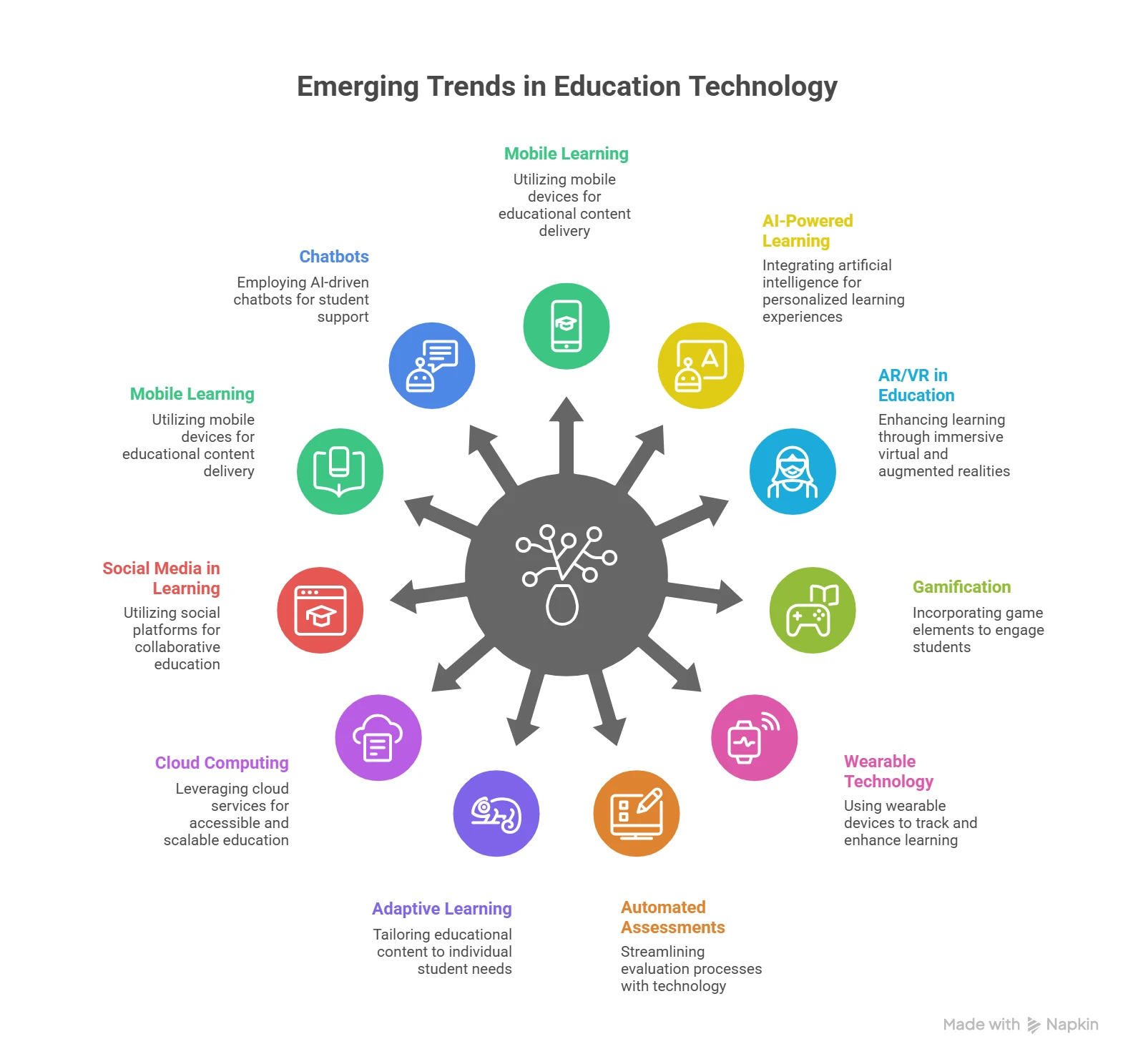
Education technology is changing the way mentors and students interact with each other. More powerful and useful trends in the education technology space will inevitably emerge in the coming years, leading to more comprehensive and effective learning environments.
1. Mobile Learning and Digital Content Platforms
eLearning platforms have become more popular after the COVID-19 pandemic hit the world. The platforms provide access to impactful educational content and expert instructors from anywhere in the world.
Furthermore, these digital content platforms are an extensive hub of learning resources. As their popularity continues to grow, their impact on how students learn and interact with educational content will witness a significant paradigm shift.
2. AI-Powered Learning Environments
The global AI marketplace for education is growing rapidly between 2025 and 2031. How are AI-powered tools revolutionizing education in 2026? AI technologies like facial recognition, NLP, and machine learning are making learning easier and more engaging in classrooms.
AI-powered learning environments help teachers to customize lessons for improved retention.
3. Augmented Reality (AR) and Virtual Reality (VR)
AR and VR can help to create immersive and engaging learning experiences, regardless of the environment. This allows students to:
- Explore virtual worlds
- Practice tasks in real-world scenarios
- Engage in simulations tailored to their individual needs
The educational sector’s AR and VR market size is estimated to reach USD 14.2 billion in 2028. As both technologies become more commonplace, their impact on education will be hard to ignore.
4. Gamification of Learning
The gamification market was projected to be worth USD 15.43 billion in 2024 which expanded at a compound annual growth rate (CAGR) of 25.85% which will further reach USD 48.72 billion by 2029. What are some examples of gamification in education?
Some examples of gamification in an education setting include: earning virtual points for completing tasks, a virtual leaderboard to compete with peers, etc. By turning learning into an interactive and engaging experience, students are able to retain more information and build skills in a fun and engaging way. How can educators effectively implement gamification?
5. Wearable Technology
As wearable technologies become more widespread, their impact on learning spaces will be prolific. Wearable technology can help:
- Track progress
- Provide performance feedback
- Offer real-time personalized guidance
Furthermore, students can listen to audio lectures, receive class notifications, and make voice notes using wearable technology such as smartwatches and VR headsets. This makes learning more accessible.
6. Automated Assessments
The power of automation in the education field cannot be understated. Automated assessment tools will be increasingly used to evaluate students’ progress. This gives teachers and administrators better insights into student performance and areas that need improvement.
Online tests have the advantage of remote administration, in contrast to conventional methods that call for writing supplies and instructional settings. Exam-related resources and specialized facilities are not needed for online assessments.
Automated assessment tools can also provide analytical data to help students identify weak areas and work on them.
7. Adaptive Learning
Adaptive learning will become a major emerging trend in education technology, allowing courses to be tailored to the individual needs of each student. The three largest sectors utilizing adaptive learning are K12, higher learning, and corporate organizations, based on the Adaptive Learning Industry Report 2024–2030.
More and more educational institutions are incorporating this innovative data-driven approach to facilitate customized learning experiences.
This will help teachers meet the needs of a diverse student population and maximize student learning outcomes. It would also help teachers to customize individual learning paths and learning paces.
8. Cloud Computing
Cloud computing will continue to be an important tool for educators, allowing them to access and store data more effectively. It also allows students to save money on expensive books, as cloud-based books can be accessed easily anywhere.
As an emerging trend in education technology, cloud computing offers strong authentication facilities to ensure data security. It also facilitates easy collaborations among students and teachers.
9. Social Media in Learning
Social media impacts the way we learn. It has created new opportunities for learners to connect and access, and share knowledge. Social media has also had a significant impact on the way educators teach. It has given educators new tools to reach and engage learners.
When social media is utilized as a teaching tool, schools estimate a 25% increase in students’ capacity for analytical thinking. Similarly, 67% of educators believe that social media facilitates efficient student collaboration and communication.
The use of social media in learning is still in its early stages, but it has left a significant impact on the way we learn. In the years to come, social media will continue to have a big impact on how we learn and teach.
10. Mobile Learning
94% of Gen Z users, according to research, use their phones for education. It finds a very strong link between advancements in technology and contemporary teaching methods.
Portable devices like mobile phones and tablets are replacing traditional learning mediums because mobile eLearning solutions allow learning to continue uninterrupted. Studies reveal that when compared to conventional educational methods, mobile learning has a retention rate that is 45% higher. It emphasizes how mLearning is interesting and has enhanced student outcomes and learning experiences globally.
11. Chatbots
AI-powered chatbots and voice-controlled assistants are starting to play a major role in personalized learning. Students now have
- Immediate accessibility to knowledge
- Assistance with assignments
- Interactive learning opportunities
They can tailor their approach to each student’s unique instructional needs and preferences by offering personalized assistance and feedback. This increases student engagement and improves learning effectiveness.
What are the Top 10 AI Trends in Education Technology?
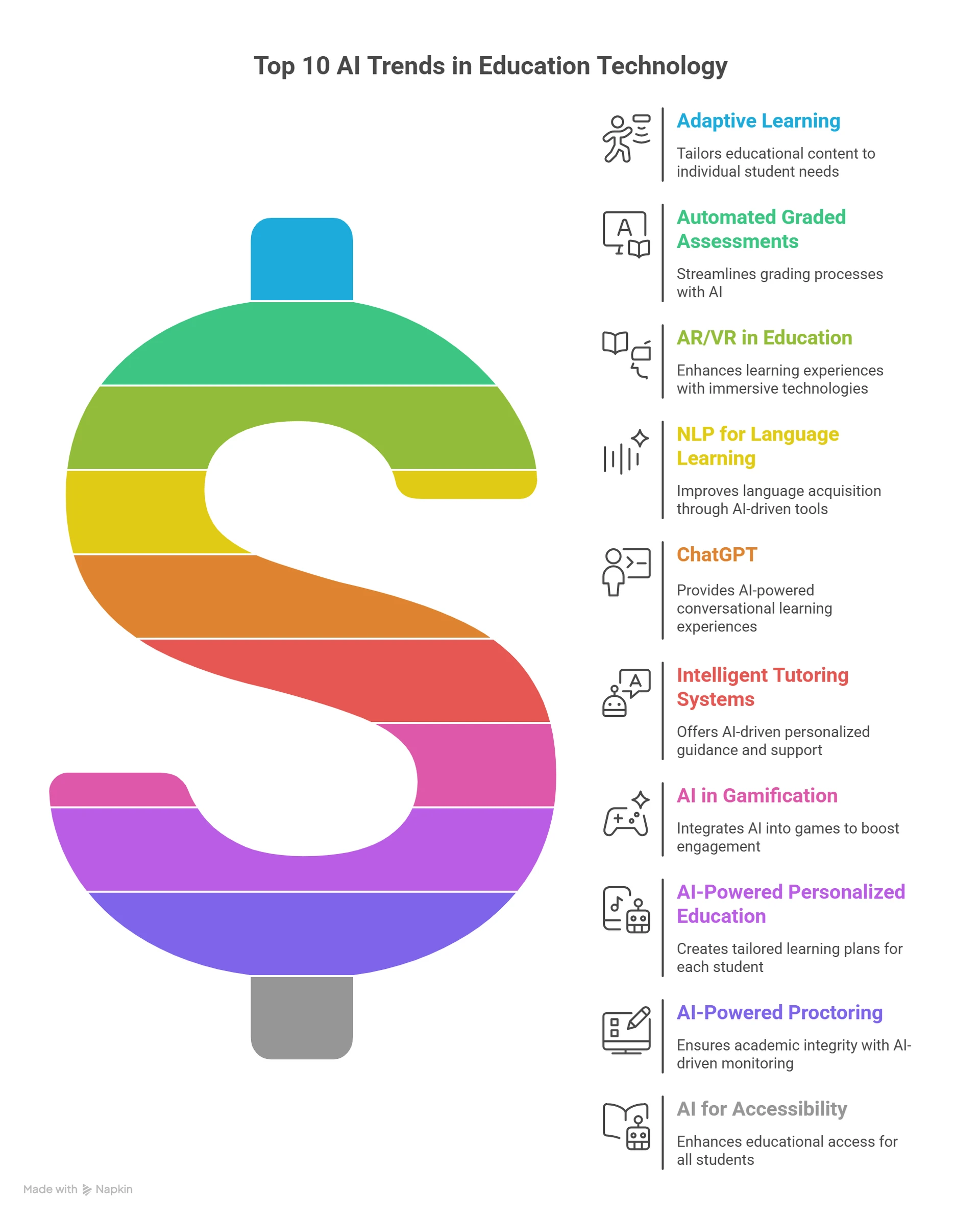
Staying informed about the latest developments in AI reveals its far-reaching impact across various industries, including finance and healthcare. However, AI truly stands out in education.
The shift toward personalized learning has fueled AI in the education market, hitting a value of USD 4 billion in 2022. Projections suggest a steady growth with a compound annual growth rate (CAGR) exceeding 10% from 2023 to 2032.
The emergence of AI in education is fueling effective transformations for educators and students.
Here are a few AI trends in education technology that you can look forward to in 2026:
1. Adaptive Learning
AI-enabled adaptive learning is a cutting-edge teaching strategy that uses AI in Education (AIED) to give every student a customized learning experience. This novel approach evaluates students’ learning styles, areas of strength, and weaknesses using data analytics and machine learning algorithms.
Based on this analysis, the system dynamically adapts the educational material’s pace, content, and difficulty level to the learner’s needs and competencies.
AI-enabled adaptive learning holds great promise for the future of education. Adaptive learning platforms are expected to evolve in sophistication, personalization, and efficiency in line with the rapid advancement of artificial intelligence.
The global adaptive learning market was valued at ~USD 3.8 billion in 2025 and is projected to grow to ~USD 18.11 billion by 2034 at a CAGR of ~18.9 %, reflecting strong forecasted demand for AI-driven personalization technologies.
2. Automated Graded Assessments
AI-driven feedback systems are revolutionizing the assessment of exams. Both educators and students can benefit greatly from these systems due to their efficacy, reliability, speed, and flexibility. Exam evaluation is largely being transformed by artificial intelligence (AI) technologies, such as natural language processing, pattern recognition, and adaptive learning.
As generative AI tools are data-driven, they can be instructed to understand particular grading criteria. They can then use this comprehension to grade students’ work efficiently.
Generative AI-powered assessments by auto-marking are a fair, effective, and dependable method. It eliminates the biases, discrepancies, and errors inherent in manual grading.
3. Augmented Reality and Virtual Reality in Education
AI is also a driving force behind advancements in immersive technologies, including augmented reality (AR) and virtual reality (VR). With the help of this education technology (EdTech), educators can offer their students engaging and interactive learning opportunities that let them experience virtual worlds and interact with simulated learning objects.
With VR and AR, students can visit locations they might not otherwise be able to. For instance, Google Expeditions offers online explorations to famous places, sites of historical significance, and even isolated ecosystems.
Using virtual reality headsets, students can explore ancient artifacts, virtually tour the Great Wall of China, and swim with underwater creatures from the comfort of their classrooms.
4. Natural Language Processing (NLP) For Language Learning
AI-driven Natural Language Processing (NLP) technologies are enabling teachers to better support students who have difficulty with reading by giving them improved ways to articulate themselves.
Using AI’s capabilities, NLP tools can evaluate and comprehend students’ written or spoken language, offering insightful analysis and constructive criticism.
These tools can pinpoint students’ grammar, syntax, and vocabulary comprehension issues and provide specific instruction to help them along their learning path.
5. ChatGPT
Educators are using artificial intelligence chatbots, such as ChatGPT, to improve their instructional strategies and give students individualized attention.
These chatbots function as virtual assistants, responding to inquiries, offering clarifications, and holding deep and meaningful discussions with students.
Because few educators are worried that ChatGPT and other AI chatbots could provide false information and encourage plagiarism claims, they have yet to embrace their use in the classroom. However, with ongoing improvements and the release of GPT4, designed to be more sophisticated, this could eventually alter perceptions.
6. Intelligent Tutoring Systems Driven by AI
Intelligent tutoring systems (ITS) utilize AI to provide students with personalized, one-on-one guidance. ITS examines student information, such as their progress, participation trends, and answers to questions.
Teachers also gain from this because it gives them more time to concentrate on other aspects of teaching, but most significantly, it helps the students. By providing them with tailored assistance akin to that of a real-life tutor, the ITS is promoting greater comprehension and memory retention.
7. AI in Gamification of Learning
AI can gamify study materials by adding a new degree of personalization, which increases user engagement and motivation.
Gamification designers can use AI algorithms to analyze user data to create experiences that are specifically customized for each player. This may result in a more captivating and immersive experience that is more tailored to each learner’s interests and preferences.
Using AI in the gamification of learning has several advantages, including its capacity to learn from user data.
By examining student behavior and preferences, AI can produce a customized experience that changes to meet each student’s needs. This can include tailored challenges or rewards, suggested content or activities, and advanced analytics that foretell the user’s future needs or wants.
8. AI-Powered Personalized Education
With the help of artificial intelligence, education can now be customized to meet the individual needs of every student, giving them individualized learning opportunities.
AI enables customized education, meeting individual student needs. How does AI personalize learning? AI algorithms evaluate student progress and provide tailored lessons. With AI, learners have a “specialized instructor” helping them overcome difficulties. What are the practical applications of AI-powered personalized education?
9. AI-Powered Proctoring in Smart Classrooms
Guaranteeing academic accuracy during examinations has become a major concern with virtual and remote learning.
AI-based proctoring evaluates a test-taker’s behavior, surroundings, and mobility in a manner akin to that of a human proctor. It can potentially make surveillance even more effective and scalable for online exams.
Artificial intelligence (AI) can help restore reliability during examination by detecting suspicious behavior, plagiarism, or AI-generated content. This can be done by utilizing facial detection, eye tracking, and audio evaluation.
10. AI-Powered Technologies for Increased Accessibility
Students with special needs and those with disabilities now have equal access to education.
AI-driven technologies, such as text-to-speech and speech recognition, can read aloud text displayed on the screen or listen to learners’ speech and translate it into written language. This facilitates learning and participation in the classroom for students who are deaf or blind.
The End Note
Education has evolved beyond classrooms to become anytime, anywhere learning thanks to digitalization. Technology-enabled blended learning will benefit pupils, educators, and organizations alike by increasing personalization. This is a win-win situation for individuals, institutions, and the public at large.
Hurix Digital‘s eLearning solutions are designed so that they provide learners with an ideal learning experience. We offer customized learning paths and content that can be tailored according to specific requirements.
Our set of eLearning solutions can help learners develop skills, gain knowledge, and stay updated with the latest trends in their field.
Get in touch with us today to learn more!
Frequently Asked Questions (FAQs)
Q1: Is EdTech expensive to implement for schools and institutions?
Cost is one of the most common concerns. While some advanced EdTech solutions require upfront investment, many platforms now follow subscription-based or cloud models, reducing infrastructure costs. Open-source tools, freemium AI platforms, and scalable cloud services allow institutions to start small and expand gradually based on impact and ROI.
Tip: Begin with pilot programs before full-scale rollouts.
Q2: Will AI and automation replace teachers?
No. EdTech is designed to support educators, not replace them. AI handles repetitive tasks like grading, analytics, and administrative work, allowing teachers to focus on instruction, mentoring, creativity, and emotional support. Human judgment remains essential for contextual learning and ethical decision-making.
Q3: How can institutions ensure data privacy and student safety?
With increased digital adoption, data protection is critical. Institutions should prioritize platforms that comply with global regulations such as GDPR, FERPA, and ISO security standards. Features like encryption, role-based access, and transparent data policies help safeguard sensitive information.
Best practice: Educate students and staff on digital hygiene and responsible data use.
Q4: Can EdTech work in low-connectivity or rural areas?
Yes — but with the right approach. Offline-first mobile learning apps, downloadable content, low-bandwidth platforms, and government-led connectivity initiatives are helping extend EdTech access. Bridging the digital divide requires collaboration between governments, EdTech providers, and NGOs.
Q5: Are AI systems biased or unfair to certain learners?
AI bias is a valid ethical concern. Bias can occur if algorithms are trained on incomplete or skewed data. To mitigate this, EdTech providers are adopting ethical AI frameworks, transparent algorithms, and regular audits. Human oversight remains essential to ensure fairness and inclusivity.
Q6: How can educational institutions prepare for EdTech trends in 2026?
Institutions can prepare by adopting scalable cloud-based platforms, investing in teacher training and digital literacy, prioritizing data security and ethical AI practices, and starting with pilot programs before large-scale implementation. Strategic planning ensures long-term success and ROI from EdTech investments.
Summarize with:

Senior Vice President
A Business Development professional with >20 years of experience with strong capability to sell new solutions and develop new markets from scratch. New Market Entry Specialist with experience working in the largest emerging markets. Exceptional experience in conceptualizing, ideating and selling new learning technologies like VR AR, etc. across multiple industry verticals.