 A Space for Thoughtful
Building Inclusive Workforce Programs Through Robust Multilingual Translation and Localization
Summarize with:
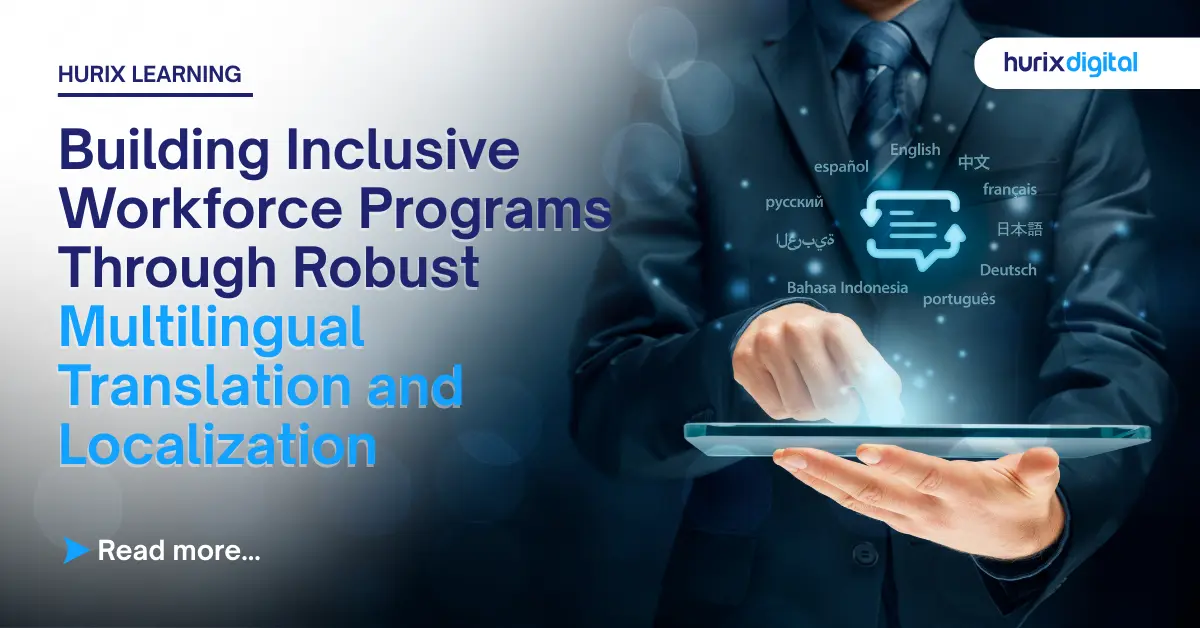
Workforce development initiatives are reaching broader audiences across geography, industry, and skill sets as governments, businesses, and educational institutions work to address the talent shortfall. However, one obstacle that should not be neglected in curriculum development or training technology is access to language. Most would-be learners struggle with workforce program content delivered in a single language, which is why robust translation and localization are essential to remove barriers to their participation and learning.
The trend towards globalization and the increased diversity of the global labor market have made multilingual translation and localization an integral part of the development approach to an inclusive workforce.
Translation cannot stop at translating a text from one language into another. It involves modifying learning resources, cultural examples, and user interfaces to make them more appealing to learners in the context of linguistic and regional diversity. Incorporating powerful localization into training programs can allow organizations to achieve a wide range of benefits, including greater access to skill development and enhanced program engagement and effectiveness.
Table of Contents:
- What is the Importance of Language Accessibility in the Workforce?
- How Digital Learning Systems Scale Translation and Localization for Global Teams?
- What Are the Main Challenges in Implementing Translation and Localization for Training?
- How Does Translation and Localization Drive Learner Engagement and Culture?
- The Global Verdict: Why Localization is the Future of Talent
What is the Importance of Language Accessibility in the Workforce?
The workforce training programs are typically designed to address a diverse population, i.e., with different levels of education, culture, and language. When training resources do not match learners’ native languages, their comprehension of the information decreases, and they have to work harder to decode it.
Research on language accessibility and education has consistently shown that students are better able to conceptualize complex procedures in a language they understand.
The teaching should be very technical, with precise instruction and strict compliance to ensure both the learner’s safety and skill. If workforce programs ignore language barriers, they will end up excluding many potential learners, especially in locations where training materials are only in English.
How Digital Learning Systems Scale Translation and Localization for Global Teams?
This is probably why the modern workforce solutions tend to rely so heavily on digital learning systems, which have, in fact, allowed the delivery of multilingual content at a much larger scale than the traditional classroom setup.
Learning management systems (LMS) can support multiple language interfaces, so learners can choose their preferred language and complete the same training modules and learning paths.
There are already solutions, such as Moodle and Canvas LMS, that are multilingual and allow offering localized courses to training providers and institutions serving a global market of learners.
Furthermore, the rate of translation of materials into different languages using AI-based technologies is increasing. The quality of translations offered by tools such as Google Translate and DeepL has improved over the last several years, and they can now produce high-quality translations that can be further refined by human translators to ensure quality and relevance.
However, despite the fact that AI tools may be used to accelerate the process, linguistic experts remain necessary to oversee translation and localization, ensuring that complex training resources do not lose their value and explanatory features.
What Are the Main Challenges in Implementing Translation and Localization for Training?
Although multilingual training programs are increasingly gaining prominence, companies still face numerous challenges when adopting large-scale localization strategies.
This is also a challenge, given that there are multiple language versions of the same material, which need to be updated for training programs and modules to provide learners with up-to-date information.
The technical precision is also hard to maintain in specialized fields like software engineering, medicine, and security, since weak renditions can lead to miscommunication or incorrect practice. Besides, certain languages require more space to translate than the original or at least the same amount of space. This may influence the design of a web-based interface or a teaching poster.
The teams in charge of the LMO should work in cooperation with designers and developers to ensure they are usable in a multilingual version. All these difficulties imply systematic translation procedures, controlled glossaries and rigorous quality controls in the context of workforce development for multilingualism.
How Does Translation and Localization Drive Learner Engagement and Culture?
Localization is key for learner engagement, as learners connect training materials to familiar cultural images, case studies, and examples, enabling them to apply knowledge to real-life situations.
For instance, a North American customer service training program might discuss the retail situations common in the US. If such a program is localized for Southeast Asia or Latin America, the scenario can be adjusted to better reflect local consumer behavior, which is a great way to make the content more meaningful and engaging for learners.
Research on education in the field of Instructional Design indicates that contextualized learning cases help learners relate theories to practice. Such contextualization is made possible through localization so that the cultural and professional realities of the target audience are represented.
The Global Verdict: Why Localization is the Future of Talent
As the workforce evolves, multilingual translation and localization have become essential for organizations offering global training programs. Thanks to advancements in AI-driven translation and speech recognition, scaling localized learning is easier than ever.
However, to truly engage learners across cultures, organizations must blend these technologies with human oversight and specific industry expertise. This integration ensures that training materials are not just accurate but also relatable and impactful.
The companies investing in multilingual learning approaches today will be better positioned to serve the global labor market, expand opportunities to acquire skills, and develop inclusive talent pipelines that capture the diversity of the current labor market.
Hurix Digital helps grow teams by mixing languages, training plans, and learning tools. This lets people learn anytime, anywhere, making it well-suited to many places around the world!
Connect with us to know more!
Summarize with:

Senior Vice President
A Business Development professional with >20 years of experience with strong capability to sell new solutions and develop new markets from scratch. New Market Entry Specialist with experience working in the largest emerging markets. Exceptional experience in conceptualizing, ideating and selling new learning technologies like VR AR, etc. across multiple industry verticals.