 A Space for Thoughtful

Unlocking Learning with Educational Games for Kids in K12 Classrooms
Summarize with:
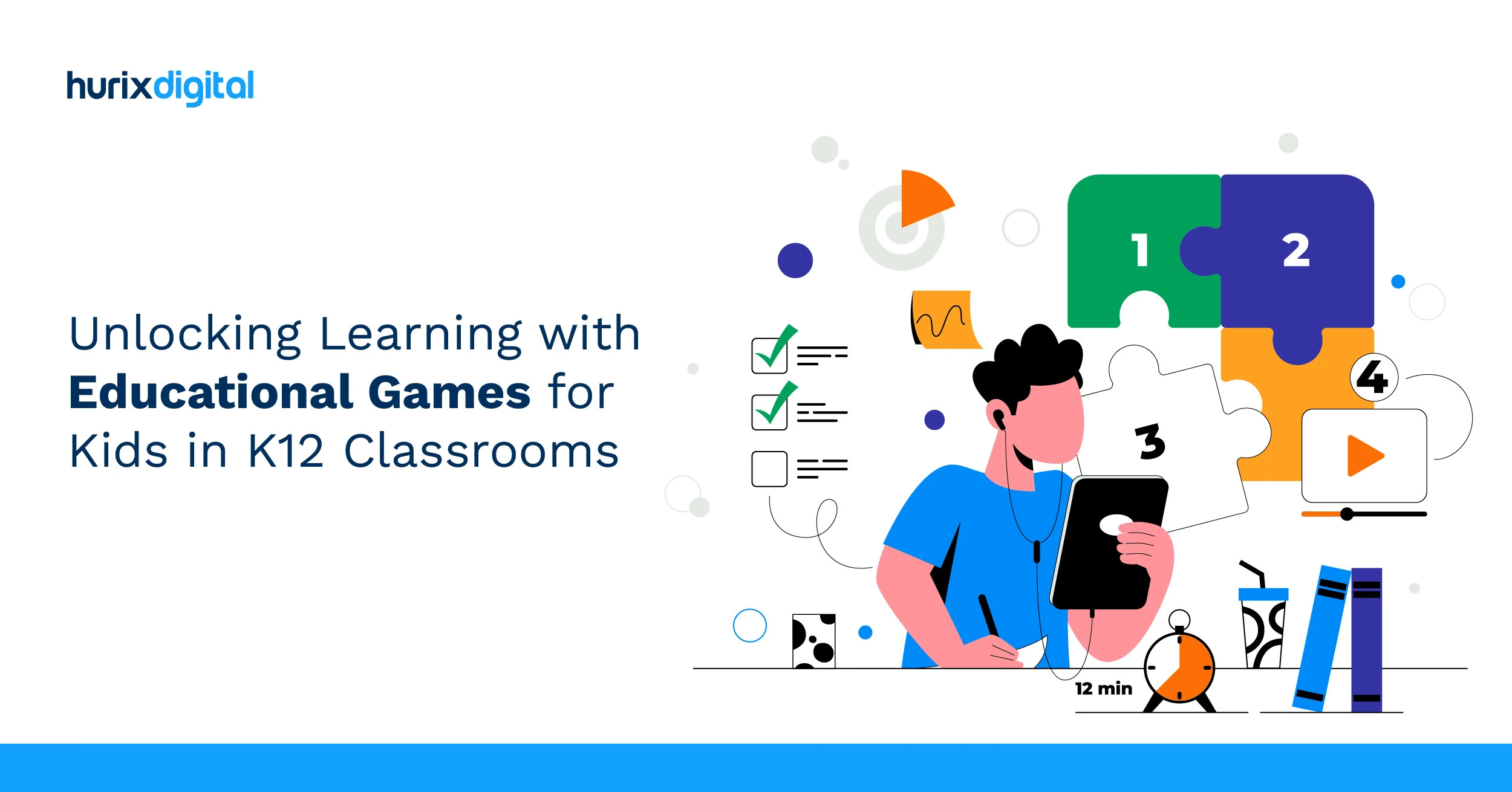
The digital era of innovation in education is upon us, and educators and learners are considering the potential benefits of these technological advancements. Classrooms and course materials are constantly evolving, and technology plays a primary role in driving student engagement and motivation. Educational games for learning, in particular, have emerged as a powerful tool.
Imagine a hypothetical educational scenario depicted through gamified learning solutions. That’s precisely what the edtech sector has brought to the education sector: more opportunities to explore students’ learning potential.
You no longer must depend on traditional teaching methods to deliver enhanced learning through online learning games. Today, game-based learning in a classroom is a game-changer with the myriad ways it helps students learn and apply different concepts in various contexts across generations. This blog will explore how educational learning games make education more engaging and effective.
Table of Contents:
- What is Game-Based Learning in Education?
- Examples of Educational Games for Learning
- The Role of Online Learning Games in K12 Education
- How Gamified Learning Helps K12 Students
- Benefits of Self-Centered Learning through Games
- How Educational Video Games Support Customized & Self-Centered Learning
- Making STEM, Coding, Math, and Science More Fun with Games
- Empowering Teachers with Educational Games
- Concluding Thoughts
What is Game-Based Learning in Education?
An interesting statistical finding is that the game-based learning market size and revenue share are expected to exceed USD 52.8 billion by 2030. With such a booming presence, it is important to understand how this pedagogical approach can help students worldwide.
Game-based learning is an interactive and collaborative form of teaching that promotes learning and challenges students by using game elements in the learning environment. This method aims to develop students’ critical thinking, innovation, and problem-solving skills.
Gamified learning solutions can be an application specifically designed to simplify mathematical concepts. Alternatively, they can be an actual game where students explore and learn through quests, levels, and rewards. Game-based learning can take many forms, providing a learning mode for teams or individuals. Some games are fully immersive worlds where students can choose their paths through adventures with different challenges. Meanwhile, other games are more like puzzles or interactive tutorials, using different types of media (text, images, video) to teach concepts engagingly.
Examples of Educational Games for Learning
Game-based learning can be used in various educational environments, including K12, higher education, and corporate training. This is one of the vital reasons the global K12 game-based learning market is accelerating, with a CAGR of 20% in the forecast period of 2021-2025. Let’s see why game-based learning software is such a raging success.
1. Video Games
There are multiple reasons why video games are so popular among children. Approximately 3.09 billion video gamers exist globally, which presents a massive opportunity for online game-based learning. Depending upon students’ interest levels, you can choose between role-playing games, action games, simulations, and adventures. A common thread in such environments is the ability to develop critical thinking and decision-making skills.
2. Puzzle Games
A brilliant example of a puzzle game is Sudoku, where you keep your brain stimulated and use your logic to complete the puzzle. Solving puzzles helps students develop a deeper understanding of different scenarios, emphasizing spatial and cognitive methods for recognizing patterns. Researchers have established a connection between puzzle-based learning and outcomes like problem-solving and cognitive thinking. Detective games are a subset of this category, where learners solve a mystery or challenge, developing problem-solving and observation skills.
3. Board Games
Popular board games include Ludo, Scrabble, Monopoly, and Chess. Each has the unique quality of keeping children highly engaged. Through these online learning games, children can learn important skills like vocabulary, problem-solving, and intellectual application.
4. Other Game Types
The variety of educational games for learning is wide. Other effective types include:
- Timed Games: Students work against the clock, improving engagement and quick decision-making.
- Collaborative Games: Learners work together to finish a task, enhancing teamwork and communication.
- Competitive Games: These introduce healthy competition, motivating individuals or teams to perform better.
- Simulations: These mimic real-life scenarios, allowing students to apply knowledge in a practical, virtual context.
- Mini-Games: Short games designed to reinforce specific lesson objectives within a digital course.
- Interactive Games: These use simple cause-and-effect interactions to help learners visualize key concepts.
The Role of Online Learning Games in K12 Education
Online learning games have become a pivotal tool, especially in remote and hybrid learning environments. They effectively keep learners engaged, motivated, and attentive. Here’s a closer look at their role:
1. Keeps Learners Engaged and Motivated
Students are more likely to be engaged when they have a goal to work towards and experience success. About 67% of students report that gamified learning is more engaging and motivating than traditional teaching. Game-based learning provides this drive by allowing students to progress at their own pace while facing challenges. Furthermore, students find motivation in achieving milestones. Educational games allow students to earn badges and other rewards for completing tasks, motivating them to continue.
2. Helps Retain Information
Games offer both short-term and long-term benefits for knowledge retention. Studies have shown that students who participate in online games retain more information than those who do not. Learning games provide knowledge through practical instances, where students understand concepts by participating in virtual scenarios. Instead of just memorizing lessons, students practice critical theories by solving problems in real-world situations.
3. Improves Soft Skills and Teaches Other Skills
Using games as a learning tool is an effective way to improve learners’ soft skills. Each game has predefined rules, and learners must follow them to achieve a high score. This system makes students focus on conceptual learning and its application. Additionally, games teach skills like problem-solving, sportsmanship, and peer collaboration. Some games require players to make quick decisions in a low-risk setting, boosting their confidence.
4. Beneficial for Students with Attention Disorders
Learning games are a good alternative for capturing students’ attention. Most students consider games a fun way of learning. In fact, research shows that online learning games can even help students who experience attention problems.
How Gamified Learning Helps K12 Students
STEM education is better understood through experiential and active learning. When incorporated correctly, gamified learning in STEM subjects can do wonders for students. Here’s how:
1. Promotes Active Participation
Providing active learning environments encourages engagement and a better understanding of the world. When games offer constructive and relatable challenges, these real-life scenarios help put knowledge into action and build student confidence.
2. Offers Flexibility in Learning
Gamified learning provides flexibility for trial and error. Students receive immediate results by earning badges and qualifying for higher levels. This enables your students to act confidently based on the knowledge they learn from interactive games.
3. Helps Them Prepare for Future Careers
Gamified learning prepares students for real-world challenges. The games teach innovation, practicality, and adaptability so they can make more informed judgments when they graduate.
4. Makes Difficult Topics Fun
Often, complex topics in science and math are hard to visualize from a textbook. Technical concepts can be learned and experienced firsthand through games. This approach transforms intimidating subjects into enjoyable ones, improving retention and fostering a positive attitude.
5. Promotes Collaborative Learning
When students are encouraged to play games as a team, it creates a collaborative opportunity. They can help each other and develop problem-solving skills together, reinforcing their understanding.
Benefits of Self-Centered Learning through Games
Self-centered learning, also known as self-directed learning, places the responsibility of learning on the student. In this approach, students actively set their goals, plan their studies, and evaluate their progress. The goal is to empower students to become independent, motivated, and lifelong learners. Educational games for learning are a natural fit for this model.
Here are 7 benefits associated with a self-centered learning approach facilitated by games:
- Adaptability: Students develop the ability to adapt their learning strategies to suit different subjects and challenges.
- Engagement: When students actively participate in their education, they are more engaged and committed to achieving their goals.
- Enhanced Retention: Ownership of the learning process leads to better retention and understanding of the material.
- Increased Motivation: Students are more motivated when they have control over their learning experience and can explore topics of personal interest.
- Lifelong Learning: This approach equips students with the skills to become independent learners throughout their lives.
- Personal Growth: It fosters critical thinking, problem-solving, and time management skills.
- Self-Awareness: Students gain valuable insight into their strengths and weaknesses, helping them make informed decisions.
How Educational Video Games Support Customized & Self-Centered Learning
Customized learning, also known as personalized or individualized learning, tailors instruction to meet the unique needs of each student. Educational video games often excel at offering these student-centered opportunities. Top education tech companies design games that support personalized learning paths, an approach supported by tech leaders like Bill Gates and Mark Zuckerberg.
Here is how educational video games support these modern learning models:
- Immediate Feedback: Most interactive online learning games provide prompt responses, allowing players to see the consequences of their decisions. This iterative process enhances learning retention and boosts self-confidence.
- Adaptability and Individualized Pace: Many educational games use adaptive algorithms that adjust difficulty based on performance. This ensures students are consistently challenged appropriately. This personalization enables students to progress at their own rhythm, minimizing frustration.
- Differentiated Instruction: Educational video games can accommodate different learning styles. They may offer multiple pathways to solve problems or present information in various formats (e.g., text, visuals, audio), allowing students to engage with content in a way that suits their needs.
- Progress Tracking and Data Analytics: Educational games often incorporate progress tracking and data analytics. By analyzing this data, educators can gain insights into a student’s progress, identify areas of strength or weakness, and make informed decisions.
- Gamification Elements: Points, rewards, and achievements create a sense of accomplishment and intrinsic motivation. By setting personal goals and monitoring their achievements, students become more self-aware and develop a growth mindset.
Making STEM, Coding, Math, and Science More Fun with Games
Gamified learning transforms the traditional classroom into an interactive journey. It is particularly effective for subjects that students often find challenging, such as coding, math, and science.
Learning Coding Through Games
Coding is about solving problems through logical steps, and games are built on the same principle. This inherent connection makes gamification a perfect fit for introducing programming concepts. Platforms like Light Bot, CodeMonkey Coding Adventures, and Minecraft Education Edition teach fundamental concepts like loops, conditionals, and variables in a playful manner. This approach increases motivation, improves retention, and enhances problem-solving skills.
Making Math Less Intimidating
Gamification in education can also mitigate Math anxiety. Educational video games can enhance students’ success and retention ability. Games prompt students to devise innovative problem-solving approaches, which enhances their grasp of numerical concepts. Regular engagement can cultivate computational fluency and a deeper understanding of mathematical principles.
Gamifying Other Subjects
The application of educational games for learning isn’t limited to STEM.
- History: Gamifying history can significantly increase classroom engagement. Methods like historical role-playing, quest-based learning on an interactive timeline, and virtual field trips can bring the past to life.
- Geography: Interactive maps and gamification techniques like quests and challenges can make learning geography fun. A study showed a 60% increase in student participation when geography lessons were gamified.
- Financial Literacy: Simulation games where students manage a virtual budget or role-play as an entrepreneur can teach crucial financial concepts in a safe, interactive environment.
Empowering Teachers with Educational Games
While student engagement is a primary benefit, game-based learning solutions also provide teachers with a helpful tool for curriculum enhancement. Interactive learning complements, rather than replaces, traditional instruction.
- Reinforcing Key Concepts: In the past, flashcards were used for memorization. Today, EdTech solutions move these repetitive actions to an interactive screen, helping students retain information while having fun.
- Immediate Assessments: In-game assessments provide immediate feedback, allowing educators to quickly identify students who are struggling or excelling. This empowers teachers to make necessary adjustments before a student falls behind.
- Bridging Learning Gaps: Games from top K12 education companies appeal to multiple senses at once. With vibrant colors, engaging sounds, and interactive gameplay, they cater to varied preferred learning styles.
- Developing Transferable Skills: Game-based solutions help students develop skills like digital literacy and collaboration. Educators can divide classrooms into teams to compete in an interactive learning game, bolstering communication, adaptability, and other essential skills.
Concluding Thoughts
Game-based learning is a powerful tool with broad applications. By integrating this technology into their coursework, educators can help students acquire the skills and concepts needed for success. These educational games for learning offer easy-to-digest curricula that capture students’ attention and make learning more effective.
Furthermore, educational institutions that incorporate this technology are investing in their students’ futures. At Hurix Digital, we recognize that online game-based learning appeals to all learners. With many benefits and evolving opportunities, we expect more institutions to embrace GBL and gamification technology in education in the coming years.
As a leading provider of premium K12 digital solutions, Hurix is proud to partner with Game Learning, a top EdTech company developing educational games. To learn more or to request a free demo, contact us today.
Summarize with:

Senior Vice President – Business Development
at Hurix Digital, with over 25 years of experience in EdTech and workforce learning. He excels in business development, customer relationship management, and scaling digital learning solutions, driving global growth through innovative content, simulations, and AI‑driven training offerings