 A Space for Thoughtful

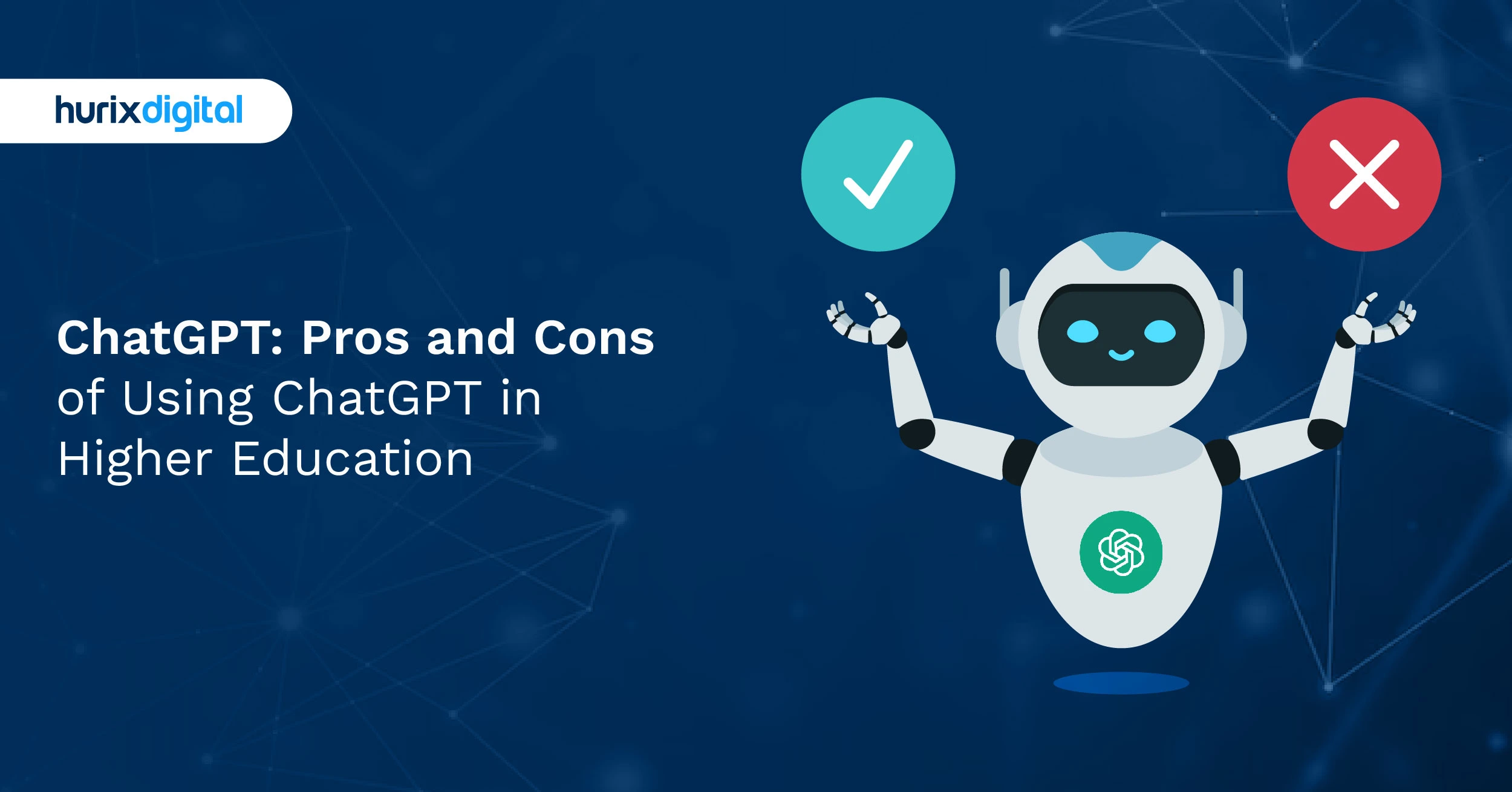
ChatGPT: Pros and Cons of Using ChatGPT in Higher Education
Summarize with:
In recent years, the integration of ChatGPT pros and cons into higher education has sparked an intense debate among educators, administrators, and students alike. On one hand, institutions are exploring ChatGPT’s potential to enhance accessibility, personalize learning, and streamline administrative tasks.
On the other hand, concerns around academic integrity, misinformation, and biases persist. As universities navigate this uncharted territory, understanding both the advantages and the risks of using ChatGPT is essential to harnessing its benefits while safeguarding the core values of education.
Table of Contents:
- What is ChatGPT?
- What are the Pros of Using ChatGPT?
- What are the Cons of Using ChatGPT?
- ChatGPT in Higher Education: Pros and Cons Comparison Table
- How Can Institutions Use ChatGPT for Learning Excellence?
- 10 Ways ChatGPT for Educators Aids in Learning Practices
- Helps in Creating Personalized Lesson Plans
- Used in Assessment and Grading
- Enables Creative Ways of Group Discussions
- Helps in Proofreading and Grammar Checks
- Supports Students with Special Learning Requirements
- Aids in Finding Teaching Plans and Resources
- Facilitates in Curating Teaching Aids
- Helps in Planning and Navigating Professional Communication
- Assists in Engaging Students in Creative Thinking
- Aids in Research and Development
- The End Note
- Frequently Asked Questions(FAQs)
What is ChatGPT?
ChatGPT is an AI chatbot using NLP to create human-like dialogue. It responds to queries and generates written content like blogs, social media posts, code, and emails. GPT, meaning “Generative Pre-trained Transformer,” describes how ChatGPT processes requests and formulates responses. Think of it as a digital assistant that can understand and generate human-like text. ChatGPT is trained with reinforcement learning through human feedback and reward models that rank the best responses. This feedback helps augment ChatGPT with machine learning to improve future responses.
Founded by an AI research organization called OpenAI, ChatGPT is a powerful language model. It generates intelligent, human-like text to answer questions and give solutions to real-life problems, mainly surrounding business, profession, and learning.
Out of its four models (GPT, GPT-2, GPT-3, and GPT-4) so far, GPT-4 is one of the most advanced ones yet. On estimation, it can respond using up to 25,000 words.
The use of AI in education is growing rapidly. Notably, ChatGPT — the conversational AI launched by OpenAI in 2022 — now has around 800 million weekly active users globally, roughly 10 % of the world’s adult population. The United States alone accounts for about 19 % of ChatGPT’s user base, with India, Brazil, and other countries contributing significant shares, highlighting how deeply AI tools are being adopted across regions and sectors.
Owing to its popularity and capability to generate human-like responses to questions, ChatGPT is becoming a trusted companion to many learners and educators. However, like any nascent technology, ChatGPT in higher education has its share of challenges.
What are the Pros of Using ChatGPT?
Now that you know the basics of ChatGPT, let’s see the pros of ChatGPT:
1. Improves Accessibility to Education
ChatGPT boosts educational accessibility by breaking down barriers for people with disabilities and non-English speakers. For example, it can read responses aloud for visually impaired students, summarize course topics for those with learning disabilities, and allow students who struggle with typing to speak their questions. These features make learning more inclusive.
There are various other benefits of ChatGPT, like it can translate English content for students into a language they are comfortable with, thus enabling them to understand their course material easily.
2. Helps with Homework
In a traditional scenario, students typically scour their textbooks and the internet for relevant assignment material. Unlike this, ChatGPT saves time and makes completing assignments easier.
When students type questions for an assignment on ChatGPT, the latter responds with explanations and examples. It provides students with an alternative way of answering assignment questions. It also offers academic phrases, terms, and sentence structures relevant to a particular context and, as a result, enriches students’ academic vocabulary and writing skills.
3. Provides Assistance to Educators
Using ChatGPT in higher education can assist professors in multiple ways, as follows:
- It can develop a comprehensive lesson plan for a course.
- It can generate a variety of questions like MCQs, true and false, fill-in-the-blanks, etc., for a class test or quiz.
- It can analyze students’ assignments and aid teachers in grading and providing constructive feedback.
- It can provide access to links containing additional educational resources for a course.
- It can offer tips and tricks for increasing students’ engagement and reducing troublesome behavior in the classroom.
4. Personalizes Learning
ChatGPT can understand students’ learning styles, providing a personalized learning experience. It can analyze students’ academic performance and structure the course to meet their requirements.
Through ChatGPT, students can learn at a comfortable pace and gain a thorough understanding of complex concepts. They can quickly access additional educational content by uniquely interacting with text-based research or learning material through ChatGPT.
Apart from this, they can improve the quality of their academic essays with the help of individualized and personalized feedback from ChatGPT.
5. Helps with Exam Preparation
When exams are around the corner, ChatGPT can help students prepare. It can recapitulate their class notes with emphasis on key terms. It can help them form an ideal answer to an important question. In addition, it can generate practice questions to help students become aware of their strengths and weaknesses based on subject matter.
What are the Cons of Using ChatGPT?
1. Lack of Academic Integrity
Academic integrity is the primary concern for using ChatGPT in higher education. Many educators believe that using ChatGPT for writing assignments will only promote cheating and plagiarism. Since ChatGPT generates responses quickly, it will decrease students’ abilities to brainstorm, think critically, and be creative with their answers.
2. Provides Inaccurate Information
ChatGPT’s responses can appear plausible and well-written, but may lack insight and accuracy. Detecting factual inaccuracies can be challenging, potentially harming students’ learning and decision-making skills. Always verify information from AI tools with reliable sources to ensure accuracy.
3. Biased Responses
AI chatbots are trained on a massive dataset. If the dataset contains biases, chances are that some of the responses produced by ChatGPT will be biased. These biases are harmful and can amplify discrimination against certain groups of people and create an unhealthy environment.
4. Limited Knowledge
Though ChatGPT is trained with a lot of information, there’s still some information it cannot access. Due to this, it may not be able to provide good answers about niche topics. It may also not be aware of the recent developments in different fields.
5. Inability to Multitask and Understand Context
ChatGPT can only work on one task and respond to one query at a time. If a student asks multiple questions at a time, ChatGPT may struggle to prioritize and slow down without responding to all the questions.
Additionally, ChatGPT can struggle to comprehend the context and nuances of human language. For instance, if a student uses humor or sarcasm in a question, ChatGPT may not pick up on that and provide an irrelevant response.
6. Lack of EI
Emotional intelligence (EI) plays an important role in educational settings. A human educator can understand the emotions of students and respond accordingly. An educator is capable of providing emotional support in challenging times. It isn’t the case with virtual chatbots like ChatGPT, which lack EI and thus are unable to comprehend human emotions. Though they can come across as empathetic, they fail to respond appropriately to complex human emotions.
ChatGPT in Higher Education: Pros and Cons Comparison Table
| Aspect | Pros | Cons |
|---|---|---|
| Accessibility | Supports students with disabilities, non-English speakers, and diverse learning needs. | Cannot fully replace human empathy and emotional understanding. |
| Homework & Study Help | Provides explanations, examples, practice questions, and summaries. | Risk of overreliance; may reduce critical thinking and independent problem-solving. |
| Educator Support | Assists with lesson plans, quizzes, grading, and resource curation. | Limited ability to fully understand context or multitask like a human educator. |
| Personalized Learning | Adapts to students’ learning styles and performance levels for tailored instruction. | Limited knowledge of recent developments and niche topics beyond its training. |
| Exam Preparation | Generates practice questions, highlights key concepts, and summarizes notes efficiently. | Responses may contain inaccuracies or misleading information. |
| Engagement & Gamification | Enables interactive lessons, quizzes, and gamified tasks, improving learning outcomes (~34.75%). | Gamification features depend on human setup; AI cannot monitor motivation or group dynamics fully. |
| Writing & Grammar Support | Proofreads, improves sentence structure, and enriches academic vocabulary. | Premium features require subscription; may not fully grasp nuanced academic style. |
| Research & Resources | Curates study materials, references, and educational content. | AI may produce biased content if training data contains biases. |
How Can Institutions Use ChatGPT for Learning Excellence?
Now you know the use of ChatGPT in higher education can be astounding on so many levels. But the question is, how can one do so?
Well, here are a few practical ways through which you can include ChatGPT pros and cons in your teaching regime:
1. Virtual Teaching
Research shows that about 50% of students worldwide have taken some form of online course — meaning nearly half of all learners have engaged with digital education.
ChatGPT offers a solution: a free virtual teaching assistant. It can answer questions, provide feedback, support research, and communicate on your behalf, helping to manage the workload.
So, it can be used as an efficient teaching assistant.
2. Gamification Features
In education, gamification is proven to increase student performance by 34.75%. This is so because gamified elements like quizzes, puzzles, etc., foster student engagement in the classroom.
With ChatGPT, you can easily do that. You can gamify your lessons, add quizzes and challenges, progress tracking, customizable avatars, and more to make your lessons more interactive for all students.
3. Skill Development Tasks
Here’s another fantastic use of ChatGPT in learning!
As mentioned previously, skill development is highly crucial for employment, irrespective of the number of degrees one holds. ChatGPT helps foster that by explaining concepts, curating tasks, generating Questions and Answers, and more.
So, suppose schools and colleges install this system in their teaching regimen. In that case, it will come in enormously handy in exposing students to a number of money-making aptitudes and fine-tuning their skills.
4. Grammar Support
With the rise of AI, one of the most prevalent problems that has found a permanent solution is lingual and grammatical inaccuracies.
You can easily integrate this powerful AI cum language processing system with your computer, enter the input prompt, and follow it up with a basic context explanation.
This will enable the tool to synthesize text and eliminate grammatical errors quickly.
5. Generating Study Materials
ChatGPT training can also help you generate study materials for your course curriculum. No matter the subject – literature, science, sociology, mathematics, or history – you can easily produce in-depth study materials.
In fact, you can also give it the command to be standard-specific, and it will retrieve age-appropriate data for your students.
10 Ways ChatGPT for Educators Aids in Learning Practices
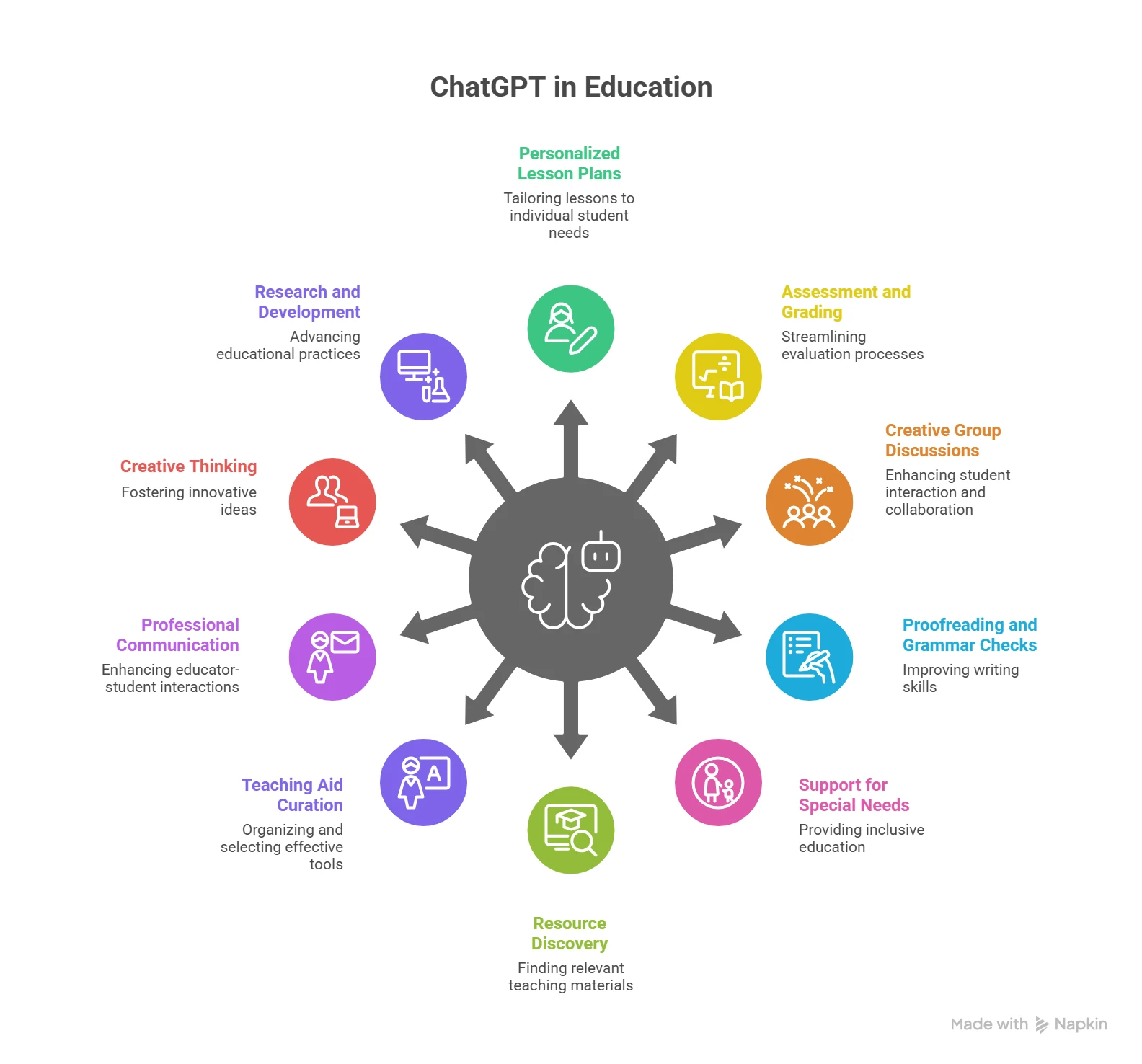
The coming together of AI and higher education is revolutionizing the way of learning. ChatGPT for educators has a wide array of benefits. Some of the key impacts are discussed below:
1. Helps in Creating Personalized Lesson Plans
Making lesson plans that suit the various learning demands and styles of pupils is one of the biggest challenges for teachers. ChatGPT for educators can help create individualized lesson plans based on unique student profiles, which can be a critical step in the process.
Teachers can input student data into the AI system, including learning preferences, skills, and weaknesses. After that, ChatGPT creates personalized lesson plans that reflect the specific needs of each student, leading to more successful educational outcomes.
2. Used in Assessment and Grading
Teachers can save a lot of time and effort by using ChatGPT for automated grading support.
Artificial intelligence-powered solutions can assist with objective evaluations like multiple-choice examinations and short-answer questions, yet they might not totally substitute traditional grading techniques.
ChatGPT for educators can offer immediate assessments and feedback, enabling students to rectify their mistakes and swiftly improve their comprehension of the subject. In addition to making teaching easier, this promotes a more effective learning environment.
3. Enables Creative Ways of Group Discussions
Group discussions boost student collaboration, critical thinking, and peer learning. ChatGPT helps teachers facilitate these discussions by providing stimulating topics, insightful questions, and conversation starters.
Additionally, it can assist in monitoring the discussion to ensure all students participate and share their thoughts. This creates a dynamic and inclusive learning environment.
Teachers can build a dynamic and welcoming environment that promotes growth, cooperation, and learning by using AI in the classroom as a communication tool. With the aid of this cutting-edge AI technology, instructors can concentrate on their most crucial task: fostering their pupils’ inquisitive and imaginative brains.
4. Helps in Proofreading and Grammar Checks
Using ChatGPT’s natural language comprehension capabilities to help teachers assess and enhance students’ written work is another example of how AI can be put to use in the classroom.
Teachers can use ChatGPT to swiftly examine and fix grammatical, punctuational, spelling, and syntax issues in their written documents, including lesson plans, resources, and email correspondence.
5. Supports Students with Special Learning Requirements
ChatGPT uses NLP and machine learning to translate information into multiple languages, including French, Spanish, and Italian. It also excels at meeting the needs of students with accessibility issues, helping those with dyspraxia, ADHD, visual impairments, dyscalculia, and dyslexia to learn and retain information more effectively. This makes education more accessible and inclusive.
For example, understanding the meaning and context of a piece of writing is one of the main difficulties for dyslexic writers. AI in online education can assist with this by presenting the data in a larger text format, making it simpler to grasp.
6. Aids in Finding Teaching Plans and Resources
Teachers may spend a lot of time coming up with fresh concepts and finding necessary materials. By offering innovative lesson suggestions and making helpful resource recommendations based on a particular topic matter and curriculum objectives, ChatGPT can assist in saving crucial time.
For example, a teacher searching for innovative ways to deliver a history lesson can enter pertinent curricular objectives or keywords, and ChatGPT will present a range of appropriate lesson plans and materials.
This feature reduces the amount of time needed for lesson planning while also facilitating teachers’ access to the most recent educational resources.
7. Facilitates in Curating Teaching Aids
ChatGPT for educators offers interactive teaching tools to enhance student engagement and support lesson planning. It can recommend a range of instructional games, simulations, movies, animations, quizzes, presentations, and more based on your subject matter.
For example, ChatGPT provides brand-new possibilities when you want to create an interactive video on the planets. The bot may request a delivery window ranging from a few minutes to a few hours for producing high-quality videos.
8. Helps in Planning and Navigating Professional Communication
Teachers can use ChatGPT prompts to communicate effectively with parents, colleagues, and students through customized messages.
Whether evaluating student progress, sending automated feedback reports, requesting donations, or creating newsletters, ChatGPT acts as a reliable writing assistant. This streamlines communication and saves time.
9. Assists in Engaging Students in Creative Thinking
Students should be encouraged to improve their critical thinking abilities. Educators can use ChatGPT in education to spark interesting conversations and push students to consider a topic from a variety of perspectives.
To encourage students to think critically and respond creatively, teachers can utilize AI in education to produce open-ended questions, discussion topics, or even hypothetical situations.
Students can improve their ability to analyze and solve problems while also gaining a deeper comprehension of the subject matter by taking part in these interactive exercises.
10. Aids in Research and Development
A powerful strategy for encouraging the interest of learners and encouraging autonomous investigation is inquiry-based learning. Educators can use ChatGPT in the classroom as a helpful research assistant for students to uncover facts, materials, and concepts that will assist with their projects or assignments.
ChatGPT enables students to explore further into their preferred topics, enhancing their comprehension and expertise by providing real-time support and a wide range of perspectives.
By assisting students in formulating research topics, assessing sources, and organizing their findings, AI in education can also help students strengthen their research skills.
The End Note
You’ve now explored ChatGPT’s pros and cons, from creating personalized lessons and increasing educational access to potentially generating biased responses and inaccurate information. Understanding these aspects is crucial for effectively integrating AI in higher education. To transform your university’s educational approach, consider partnering with Hurix Digital.
Based on internal projections and third‑party financial analysis, OpenAI’s revenue could reach approximately $29.4 billion in 2026 — significantly higher than $1 billion or the earlier multi‑billion levels seen in 2024–2025.
Using ChatGPT in higher education will certainly bring some transformations. However, if you want to completely transform the education at your university to a top-notch level, Hurix Digital can help.
Hurix Digital offers custom learning solutions for educational institutions and is a trusted partner of education companies like Cambridge University Press, Carnegie Learning, Wiley, and more.
For a state-of-the-art educational transformation, get in touch with Hurix Digital.
Frequently Asked Questions (FAQs)
Q1: What is ChatGPT and how does it work in education?
ChatGPT is an AI chatbot developed by OpenAI that uses natural language processing (NLP) to generate human-like text. In education, it can answer questions, generate explanations, summarize notes, and assist both students and educators with learning, teaching, and administrative tasks.
Q2: How can ChatGPT help students with learning and exam preparation?
ChatGPT supports students by explaining complex concepts, generating practice questions, summarizing class notes, and highlighting key ideas. It can also personalize learning based on a student’s performance and learning style, helping them prepare more effectively for exams.
Q3: What are the risks of using ChatGPT for assignments and research?
While ChatGPT is helpful, it can provide inaccurate or biased information and may encourage overreliance, reducing critical thinking. Academic integrity is a concern since students could use it to generate answers without understanding the material.
Q4: How can educators use ChatGPT to improve teaching and lesson planning?
Educators can use ChatGPT to create lesson plans, quizzes, grading templates, and teaching aids. It also helps with proofreading, generating study materials, and facilitating creative discussions or gamified learning activities, saving time and enhancing student engagement.
Q5: Does ChatGPT provide accurate and unbiased information?
ChatGPT strives to provide helpful responses, but its accuracy depends on its training data. Some responses may be outdated, incomplete, or biased. Users should verify important information using reliable sources, especially for academic purposes.
Summarize with:

Senior Vice President – Business Development
at Hurix Digital, with over 25 years of experience in EdTech and workforce learning. He excels in business development, customer relationship management, and scaling digital learning solutions, driving global growth through innovative content, simulations, and AI‑driven training offerings