 A Space for Thoughtful


What is Business Simulation? Type & Benefits of Using Business Simulations
Summarize with:
Summary
A business simulation is an immersive, risk-free learning environment that mirrors real-world market dynamics, allowing professionals to test strategies and see the immediate consequences of their decisions. In an era where 94% of business leaders prioritize “learning-by-doing,” these simulations have become the gold standard for leadership development and operational training. By bridging the gap between theoretical knowledge and practical execution, a business simulation doesn’t just teach—it builds the muscle memory required to navigate a global economy projected to reach $173.25 billion in digital training value by 2026.
Business simulations were formerly relatively unknown technologies, in part due to the high entry and utilization hurdles. However, they have emerged as accessible tools with strategic significance over the last five years or more. A study published in the Journal of Educational Computing revealed that incorporating a Business Simulation Game enhanced learner engagement and the development of Higher-Order Thinking Skills. Furthermore, an experiment published in Library Hi Tech found a positive correlation between mobile business simulation games and entrepreneurial attitudes and self-efficacy.
Business simulations are potent tools for organizational training and development. They provide a virtual environment where individuals can gain hands-on experience managing multiple aspects of a business. Participants undertake strategic decisions, analyze outcomes, and learn from their mistakes in a risk-free setting. Here, we will explore the meaning of business simulations, delve into simulation training examples, and highlight their numerous benefits.
Table of Contents:
- What Do You Mean by Business Simulation?
- Types of Business Simulations and Techniques
- 8 Advantages of Employing Business Simulation
- Experiential Learning Develops Practical Skills
- Risk-Free Environment Fosters Decision-Making Skills
- Collaboration and Teamwork for Holistic Business Understanding
- Long-Term Thinking and Strategic Planning
- Gain Understanding of Business Operations
- Build Leadership and Strategic Thinking Skills
- Adapt to Changing Market Conditions
- Get Instant Feedback
- How to Get Started with Business Simulation Training in Your Organization
- The Bottom Line
- FAQS
What Do You Mean by Business Simulation?
Business simulations are interactive, computer-based programs that mimic real-world business operations, dynamics, and decision-making processes. These immersive experiential tools allow participants to engage in a simulated business environment, offering valuable learning experiences. Business simulation refers to an artificially generated activity or event that mimics a real-world example in the world of business. Companies and business programs use such simulations for training to help equip learners with practical skills.
Individuals can explore and respond to various strategies within this safe space without the potential risks and associated negative consequences of real-world scenarios. Consequently, this familiarity with corporate conditions and factors reinforces their business acumen. By adopting an automated, AI-powered Learning Management System, businesses can generate unlimited simulations that emulate real-world conditions.
A range of exercises and business simulation activities designed to align with the responsibilities associated with their roles within the company require participants to apply their skills and make relevant decisions in a robust, secure environment. A combination of technologies, such as cloud computing, Artificial Intelligence (AI), Virtual Reality, Augmented Reality, and data analytics, is harnessed to generate the simulations. In turn, learners can practice extensively in diverse market scenarios. They can build experiential skills that prepare them to make data-driven, strategic decisions swiftly and accurately.
As a conduit between learning and real-life application, virtual business simulation facilitates a collective learning experience. This experience enables participants to gain a deeper understanding and engagement with course material, their workplace, and their specific industries.
The global corporate training market is hitting a $56.51 billion valuation by 2026, with experiential learning like simulations leading the charge.
Types of Business Simulations and Techniques
Depending on the industry, organizations may employ diverse business simulation activities to support professionals in advancing their comprehension and skills in the business domain. Here are some common types and techniques.
1. Strategic Simulations
Strategic simulations focus on performing numerous administrative duties or making managerial choices for various departments to develop participants’ strategic thinking and decision-making skills. The simulation training may involve participant groups discussing and collaborating to imitate different management teams. Moreover, it may also consider many such critical strategic choices with others to consolidate their interpersonal communication skills. Business strategy simulations excel in aiding leaders to define their strengths and providing them with insights into potential career paths.
Participants may set long-term objectives, analyze market trends, evaluate competitors, formulate business plans, allocate resources, and adapt their strategies to changing environments. This level of self-awareness is valuable for individuals in understanding themselves and for their current and future employers, who can identify opportunities to leverage their talents effectively.
2. Marketing Simulations
Market simulation is a comprehensive approach to exploring different marketing facets, such as product creation, pricing strategies, promotional activities, and distribution methods. Participants actively conduct market research, devise marketing campaigns, analyze consumer behavior, and utilize their findings to inform decision-making processes.
Marketing simulation training is a valuable tool for individuals to gain insights into the intricate dynamics of the marketplace. For instance, participants may navigate challenging decision-making scenarios under pressure and assess the repercussions of their marketing choices on overall business performance. Businesses embarking on new products or brand launches especially favor marketing simulation.
3. Financial Simulations
Financial simulations enhance participants’ financial literacy and decision-making abilities by simulating monetary scenarios such as budgeting, forecasting, investment decisions, and financial risk management. These simulations highlight the impact of an organization’s internal financial resolutions by providing practical insights into effective financial management strategies within a business context. For example, individuals gain a deeper understanding of how organizations can implement cost-cutting measures while maintaining quality and efficiency by participating in business appreciation simulations. Experiencing the consequences of their financial choices enables participants to comprehend fiscal concepts and their impact on the organization’s bottom line.
4. Operations Simulations
Operations simulations are designed to educate new professionals and support current employees in honing their industry-specific skills, particularly in managing the operational aspects of a business. This includes areas such as production, supply chain management, and logistics. The simulation immerses participants in situations where they learn how to maximize resources, streamline processes, evaluate the viability of a product, and address risk management and end-user satisfaction while tackling operational challenges through virtual scenarios. Ultimately, the simulation training works towards helping individuals acquire valuable insights into optimizing resource allocation and production processes and effectively managing inventory.
5. Leadership Simulations
A valuable tool for training managers incorporated in leadership development programs, these simulations offer aspiring leaders the opportunity to gain hands-on experience in maneuvering the intricacies of leading an organization without subjecting the actual company to risks. Through advanced curriculum and real-world business scenarios, participants explore complex interpersonal dynamics, resolve conflicts, and motivate their team. Leadership simulation training provides a safe space to practice leadership skills, receive feedback for improvement, learn from failures, and acquire valuable skills to accelerate strategic change. In essence, leadership simulations expedite learning in a highly realistic manner and allow participants to gain ready exposure to apply their practical knowledge to real-world business events.
6. Process Simulations
Process simulations use mathematical techniques such as analysis of sales performance, statistical forecasting, and inventory planning. This kind of simulation primarily deals with working with different types of data, finding patterns, discussing the various implications, and coming up with outcomes.
7. Monte Carlo/Risk Analysis Simulation
Monte Carlo simulation is a method of risk analysis. Businesses generally use this simulation before implementing a critical project or any change in a process. It is built on mathematical models and uses the empirical data of the actual system’s inputs and outputs (e.g., production yield and supply intake). Once done, it then identifies the potential risks or uncertainties through probability distributions. This simulation can be implemented in various industries, including manufacturing, oil and gas, supply chain management, and engineering. Incorporating this type of training will help employees learn to identify risks and find appropriate solutions.
8. Discrete Event Simulation
A discrete event simulation model enables enterprises to observe the specific events that lead to business processes. For instance, in general, the technical support process involves the clients calling the business, the business system receiving and assigning the call, and the service representative or agent picking up the call. Here, enterprises can use a discrete event simulation model to help employees thoroughly understand and examine the technical support process. Discrete event simulation models allow learners to study various processes used in different industries (e.g., manufacturing, industrial, healthcare, banking, and more) and a diverse range of outcomes.
9. Agent-Based Modeling and Simulation
An agent-based simulation is typically a model that understands and examines the impact of an agent on a specific business environment or system. The agent here could be anything from people to equipment or anything else. The simulation primarily includes the agent’s behavior, which serves as the rules or guidelines of how agents must behave in the system. Learners can then assess how the system responds to such rules.
By 2026, 42% of frontrunning companies are using AI-nudged simulations to personalize training paths for their leadership teams.
8 Advantages of Employing Business Simulation
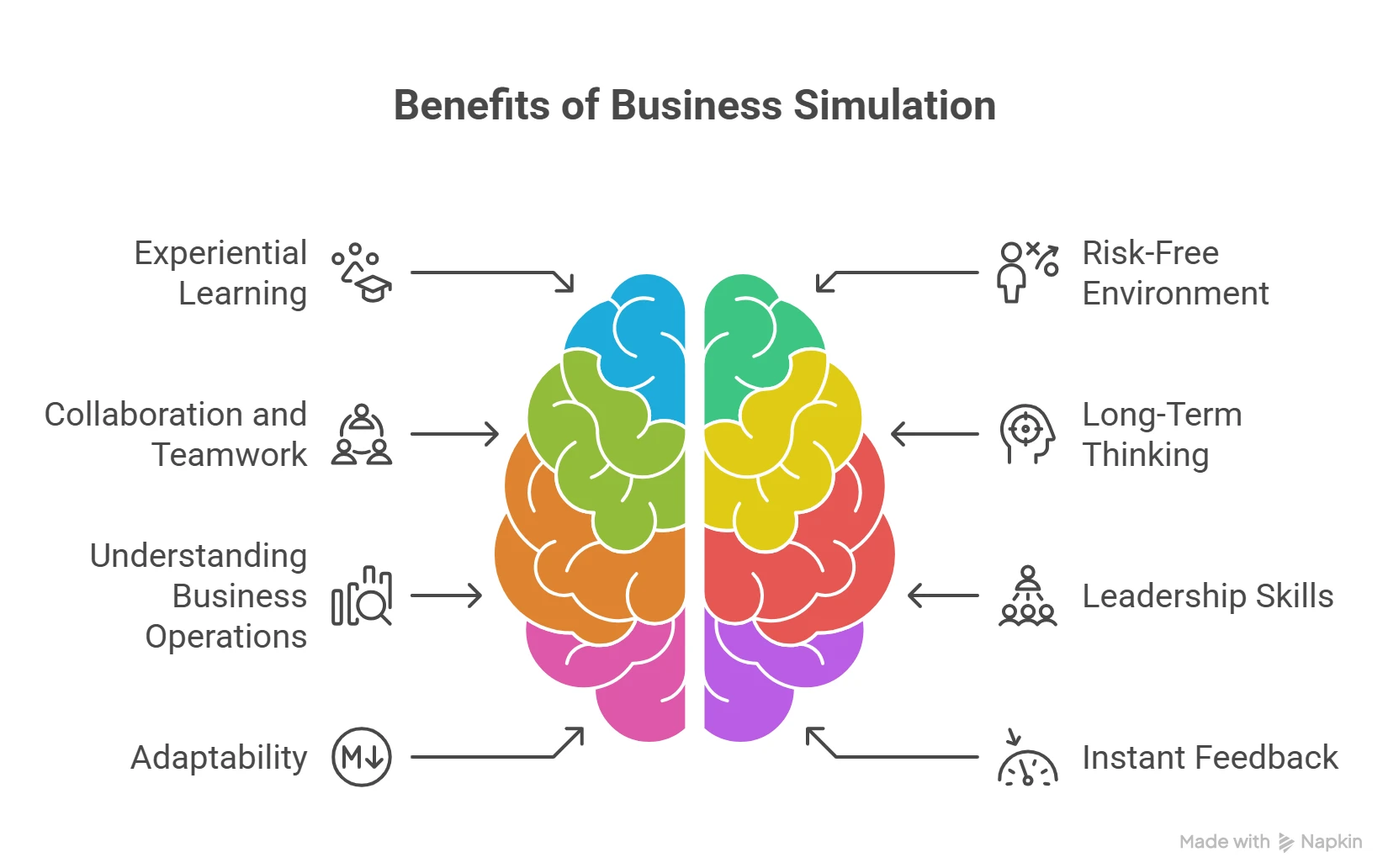
Business simulation acts as a platform to cultivate tangible skills and outlook, promoting the acquisition of management capabilities by integrating strategic objectives with training goals. The global virtual training and simulation market is estimated to grow to $1174.03 million by 2031, growing at a CAGR of 13.30%. Discussed below are some key business simulation benefits.
1. Experiential Learning Develops Practical Skills
Business simulation offers hands-on, experiential learning that bridges the gap between theoretical knowledge and real-world application. Participants gain practical experience by putting concepts learned in classrooms or training sessions into action, exploring effective strategies, and developing innovative solutions to challenges. This practical learning approach not only enhances knowledge retention but also enables active participation while nurturing critical thinking skills.
Did You Know? Studies show that learners in simulated environments retain 75% more information than those in traditional lecture-based settings.
2. Risk-Free Environment Fosters Decision-Making Skills
Virtual business simulation allows participants to experiment with various workplace scenarios in a risk-free environment where failure is safe. This allows them to strengthen their risk assessment and benefits estimation aptitudes. By enabling individuals to make decisions and observe the repercussions of their choices without fearing the accompanying risks, simulations encourage them to navigate obstacles in their future roles as business professionals. In a business simulation, failure catalyzes improved learning, as participants are more inclined to reflect on and analyze their decisions when confronted with unfavorable results. Consequently, individuals can identify areas for improvement and develop strategies to overcome challenges, nurturing a resilient and adaptable approach to problem-solving.
3. Collaboration and Teamwork for Holistic Business Understanding
Unlike solitary learning or individual debates, business simulation activities encourage participants to interact with each other, sharing their perspectives and leveraging their collective strengths. This collaborative approach allows for the exploration of theoretical frameworks and facilitates decision-making as a group. Participants can evaluate various ideas and strategies through conversation and debate, leading to a more comprehensive and well-rounded understanding of the impending business endeavor. By bouncing off each other’s strengths, individuals can contribute their unique skills and knowledge to the teamwork dynamics, resulting in a richer learning experience for all involved.
4. Long-Term Thinking and Strategic Planning
Business simulation prompts participants to think strategically and consider the long-term implications of their decisions. They learn to analyze market trends, assess competitors, identify opportunities and threats, and align their actions with organizational objectives. This strategic mindset enhances the ability to anticipate future challenges and make informed business choices that support sustainable growth.
5. Gain Understanding of Business Operations
Participating in a business simulation gives you practical exposure to how various departments function and are interconnected. In the real world, making decisions in one department often impacts other departments massively. Simulations help you understand and mirror these dynamics and predict the business’s complexities. For example, when marketing expenditures are increased to boost product awareness, the simulation might show the impact on cash flow, production schedules, or inventory levels. This comprehensive perspective promotes systems thinking—a skill critical for understanding how small decisions contribute to larger organizational outcomes.
6. Build Leadership and Strategic Thinking Skills
For individuals aiming for leadership positions, business simulations offer a unique opportunity to hone and enhance their leadership skills. You will face situations that test your ability to inspire your team, resolve conflicts, and achieve group success. These experiences are crafted to replicate the challenges and complexities that leaders encounter in real-life situations. Furthermore, these activities assist in refining your capacity for critical thinking, effective prioritization, and adaptation to changing conditions. Gradually, you will become more skilled at making wise decisions that support both immediate objectives and broader aspirations.
7. Adapt to Changing Market Conditions
Being adaptable is crucial in the current unpredictable business scenario. Business simulations frequently include dynamic factors such as changing market preferences, emerging competitors, or unforeseen economic shifts. These situations compel you to think quickly and develop solutions on the spot. For example, you may need to assess and adjust a product strategy due to a competitor’s bold pricing strategies. On the other hand, you might need to redistribute resources to accommodate sudden increases in customer demand. Such situations compel you to think analytically and respond quickly.
8. Get Instant Feedback
One of the most impactful features of business simulations is the immediate feedback they offer. After making choices or finishing tasks, you can quickly observe the results of your actions, frequently displayed as key performance indicators (KPIs) or financial data. This feedback serves as a roadmap for enhancement. For example, if your tactics resulted in a drop in profitability, the simulation might identify areas where you underestimated potential risks. You can then modify your strategy in future rounds, deepening your comprehension. This careful process guarantees that every error becomes constructive.
How to Get Started with Business Simulation Training in Your Organization
Implementing business simulations might seem complex, but with the right approach, it can be a transformative journey. Here’s a step-by-step guide on how to get started and maximize the impact on your employees.
1. Define Your Training Goals Clearly
First, you must identify the specific learning objectives. What are the skills or knowledge areas you want employees to focus on? Examples include critical thinking, financial acumen, and strategic decision-making. Then, align these goals with organizational needs. For instance, if your organization faces rapid industry changes, consider simulations that encourage adaptability and resilience.
2. Select the Right Simulation Model
Different models suit different purposes, and choosing the right one ensures training relevance and depth. For example, for risk analysis, Monte Carlo simulations provide excellent insights for high-stakes projects. On the other hand, for process optimization, discrete event simulations are ideal for understanding and refining workflows.
3. Use Real-World Data for Realistic Scenarios
Simulations are more effective when based on real organizational data, offering employees a realistic learning environment. You can source data internally by considering historical sales figures or project data to mirror actual challenges. Additionally, incorporating industry-specific scenarios makes the experience more engaging. Studies indicate that employees retain up to 60% more information when training simulations incorporate real-world data.
4. Start Small with Pilot Programs
Instead of a full-scale launch, run a small group test. Choose a department or team and implement a short simulation to gauge effectiveness and identify potential challenges. Afterward, gather feedback by surveying participants to understand what worked well and where adjustments are needed. This pilot feedback can help refine your approach before a broader rollout.
5. Incorporate Feedback Loops and Debriefing Sessions
After each simulation session, a structured debrief allows participants to reflect, discuss, and connect lessons to their roles. To enhance debriefing, encourage open dialogue and allow learners to share their experiences. It’s also vital to link insights to their real roles. A strong debrief makes the experience applicable, reinforcing that simulations are valuable learning tools, not just games.
6. Track Metrics to Measure Success
Finally, track metrics to measure your program’s success. You can quantify learning outcomes using assessments, feedback, and performance data to track skills gained. Also, assess engagement levels. A well-received simulation usually has high engagement rates, which can be a proxy for long-term retention.
Check out EXCLUSIVE: Hurix Mini-Book: Effective Training Techniques for Enterprises with Distributed Workforce
The Bottom Line
The real power of a business simulation lies in its ability to turn “passive knowledge” into “active skill.” We’re seeing a massive shift where organizations are ditching dry manuals for “Cognitive Load Optimized” environments. It’s a move that can spike training efficiency by 42%. For the 1.3 billion professionals upskilling globally, this isn’t just a trend—it’s a survival tactic. By backing these simulations with real-time data and AI-driven feedback loops, companies ensure their teams are “machine-ready” and capable of making high-stakes decisions. Ultimately, it’s about making sure classroom theory actually holds weight in today’s high-speed, $87 billion digital economy.
Business simulation empowers individuals and organizations to cultivate crucial skills and competencies without facing real-world risks. Digital transformation has profoundly disrupted many sectors, reshaping job roles and creating new opportunities. To stay competitive, workforces must continuously upgrade their skills. Access to superior business simulation training enables businesses to prepare their teams for new challenges and unpredictable market conditions.
Participants develop relevant skills and gain a comprehensive understanding of business strategy and management systems that equip them to improve their performance, enhancing the company’s financial operations overall. Over time, businesses can eliminate errors committed by their workforce, which, in turn, leads to fewer liabilities such as lawsuits and penalties. As professionals build skills for the future, their ability to solve problems improves, which translates to sustainable, faster business growth.
Experience Hurix Digital’s simulated learning solutions that offer hands-on training, replicating real-world scenarios with remarkable accuracy. Curated to assist participants in achieving a big picture of how their decisions and actions translate into outcomes, our business simulation software drives success for individuals and organizations alike.
Our experts can help you achieve the big picture you want with our advanced simulated learning solutions.
Frequently Asked Questions (FAQs)
Q1: How do business simulations prepare leaders for ‘Black Swan’ market events?
Unlike static case studies, modern simulations use “Stochastic Modeling” to introduce unpredictable variables—like sudden supply chain shifts or AI disruptions. This forces leaders to practice agility under pressure, ensuring they have a pre-vetted crisis playbook before a real disaster strikes.
Q2: Can business simulations be integrated directly into a standard LMS?
Yes. Most high-end simulations now use LTI (Learning Tools Interoperability) or xAPI, allowing them to plug into your existing LMS. This lets you track not just if a learner finished the module, but the specific logic and decision-making patterns they used during the simulation.
Q3: What is the cost-to-benefit ratio of digital vs. physical simulations?
While digital simulations have a higher upfront development cost, they offer infinite scalability. In 2026, the cost-per-learner for a digital simulation is roughly 40% lower than physical workshops when distributed to more than 500 employees, primarily due to the elimination of travel and venue overhead.
Q4: Are simulations effective for technical ‘Hard Skills’ or just ‘Soft Skills’?
They excel at both. While often used for leadership (soft skills), “Systemic Simulations” are now being used to train engineers and data scientists on how a single technical change affects an entire business ecosystem, bridging the gap between the IT department and the boardroom.
Q5: How does ‘Generative AI’ change the way business simulations are built?
Generative AI allows for “Dynamic NPC” (Non-Player Character) interactions. Instead of following a pre-written script, the simulation can now generate unique responses to a learner’s specific input, making the training feel significantly more realistic and personalized.
Summarize with:

Senior Vice President
Julia brings over 20 years of global experience in digital learning and business strategy. She specializes in client success, enterprise learning solutions, and driving growth through innovation, with a focus on AI, VR, and emerging technologies across diverse industry verticals.