 A Space for Thoughtful
Can Data and AI Create the Campus of the Future?
Summarize with:
The post-pandemic education era has seen a massive shift toward online learning environments, and the potential of AI to revolutionize education has been recognized. The introduction of AI and data analytics has produced phenomenal advancements in institutional operations. The age-old techniques of delivering unidimensional, non-reciprocating, classroom-based, rote learning are simply not relevant anymore. Instead, institutions have started initiating a paradigm shift that focuses on fostering innovation, honoring creativity, and facilitating research.
The adoption rate of big data analytics and artificial intelligence in enterprises is 60%. As institutions, you recognize the need for AI integration in universities to enhance learning, streamline administration, and foster quality research. To stay ahead of cutting-edge competition, you must understand the complexities of integrating digital transformation in education and prepare for advanced, future-proof IT infrastructure.
However, when it comes to higher education, colleges and universities often find themselves in a bind. While on the one hand, they are required to maintain an excellent quality of education, they are also expected to deal with the scourge of continually rising prices. In such a situation, improving student enrolment and the overall return on investment (ROI) of their online courses for higher education becomes an extremely challenging task.
Table of Contents:
- Why Does AI and Data Analytics Integration Matter in Higher Education?
- Understanding Big Data and Its Role in Education
- The Benefits of Big Data Analytics in Education
- Why is Data Analytics Important for Student Career Development?
- Why Data Analytics is Key to Enrollment Success?
- Top Student Enrollment Platform Challenges for Modern Institutions
- How Does Platform Integration Enhance Your Overall Enrollment Strategy?
- What’s the Measurable ROI of a Next-Gen Student Enrollment Platform?
- Key Data Points for Effective Enrollment Management
- Mining Your Data Gold: Key Metrics for Enrollment Optimization
- Data-Driven Decisions: From Insights to Actionable Strategies
- Emerging Trends in Data-Driven Enrollment
- Developing a Strategic IT Plan for AI and Data Analytics Integration
- Investing in Digital Literacy and Professional Development
- Keeping Institutional Goals in Sync with AI Integration
- Cost Factor and Funding
- Preparing for the AI Revolution
- Promoting Interdisciplinary Collaboration
- Addressing Ethical and Security Considerations
- Monitoring, Evaluation, and Continuous Improvement
- Strategies for Integrating Big Data Analytics Solutions
- Understand Big Data Sources
- Use the Right Tools and Big Data Analytics Platforms
- Collaborate with Data Experts and IT Professionals
- Prioritize Data Security and Privacy
- Evaluate Physical Space Utilization
- Promote Continuous Assessment and Iterative Improvement
- Enhance Teaching Methods with Data Insights
- Promote Data Literacy
- What are the Best Practices for Smooth Platform Implementation and Adoption?
- How do Student Enrollment Platforms Ensure Data Security and Compliance?
- How does a Platform Support Scaling Enrollment While Maintaining Quality?
- To Wrap Up
Why Does AI and Data Analytics Integration Matter in Higher Education?
One of the prime roles of integrating AI and Data Analytics in Education is improving the student’s learning journey, growing the institute’s knowledge base by leveraging the power of AI, and optimizing the administrative ecosphere for streamlined decision-making. The following pointers further elaborate on the advantages of AI integration in educational systems and how they impact students, staff, and faculty.
1. Powerful Learning Ecosystems
- Combining Large Management Systems (LMS) with AI in classrooms enables an AI environment that can cater to [students’ educational requirements, monitor learning patterns, and craft personalized career paths. This helps break away from the limitations of a traditional classroom.
- Implementing Intelligent Tutoring Systems (ITS)provides students with personalized feedback and learning programs. Your classrooms equipped with ITS can provide timely and targeted assistance to students who can’t reach the faculty.
- To make higher education more attractive, VR and AR may offer learners more engaging learning experiences. Interested students who would have input into fields such as medicine and engineering with direct, hands-on applications greatly benefit from such immersive learning.
2. Enhanced Administrative Process
- Leveraging the power of AI and Data Analytics to review faculty performances can help bridge the gap between students and faculty.
- AI chatbots can handle management tasks such as admission processes, financial management, student feedback, and parent queries. Chatbots can provide prospective students with 24/7 assistance in answering questions related to different courses offered, admission requirements, and deadlines. Such support can transform more inquiries into applications.
3. Innovation in Research
- Introducing AI research tools in educational programs and using data analytics to back up student research can significantly accelerate research projects.
- Collaborations and interdisciplinary programs experimenting with AI and Data Integration will ensure your institute keeps up with technological advancements.
After understanding the implications of AI technologies in institutes, you must plan strategic advancements to help your institute move towards an AI-enriched ecosphere.
Understanding Big Data and Its Role in Education
“Big data” refers to the vast amounts of information generated and collected daily. This data explosion is not limited to Excel spreadsheets and cannot be covered by manual record-keeping.
According to a Gartner report, the use of data analytics in education will increase significantly in the coming years. Institutions need big data analytics platforms and advanced big data analytics technology to leverage this data strategically using stringent programs.
Big Data in education includes:
- Student Data
- Course Data
- Instructor Data
- Classroom Facility Data
- Resource Allocation
Implementing data analytics in education involves several crucial components:
- Data Collection using accurate and reliable data
- Establishing data governance policies to maintain data quality and security.
- Data integration, which combines information from different sources
- Collaborating with data analysts to ensure accuracy.
The Benefits of Big Data Analytics in Education
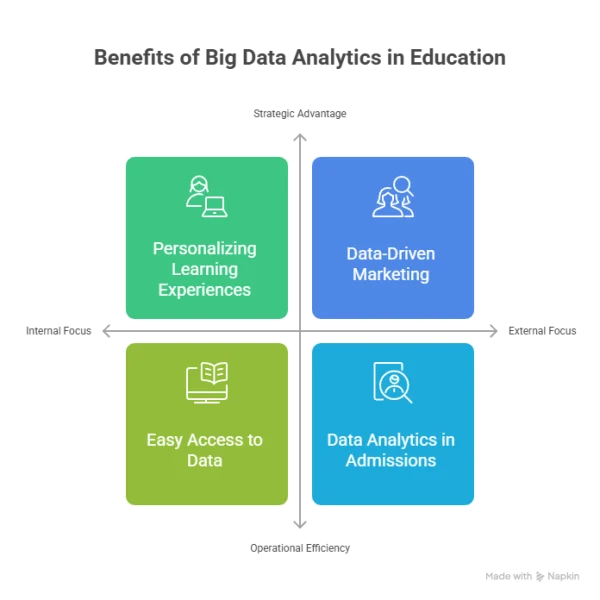
The global big data analytics in education market is predicted to reach $57.14 billion by 2030, at a CAGR of 15. This growth underscores the increasing importance and potential of big data analytics in shaping the future of education.
Implementing big data analytics in education offers the following benefits:
1. Personalizing Learning Experiences
One key advantage of implementing data analytics strategies to improve student learning is personalizing learning according to each student’s needs. This approach boosts engagement and helps students thrive in competitive environments. Smarter, more efficient, and more personalized educational programs are being designed daily so that the specific needs and requirements of various students can be met in a specialized, targeted, and comprehensive way.
2. Easy Access to Data
With data analytics tools, accessing data becomes streamlined. Big data analytics technology stores, manages, maintains, and organizes information, making it easy for all stakeholders to retrieve the necessary data quickly. Improving institutional data accuracy helps universities find out whether the course content is meeting student aspirations or not. It can also provide details about their overall performance, learning outcomes, and interaction levels.
3. Data-Driven Marketing
The marketing teams of various educational institutions use data analytics to create special campaigns that rely on:
- Student Segmentation: Segment students based on academic interests and geographic location.
- Personalized Content: Suggest programs that align with students’ interests and career goals.
- Campaign Performance Analysis: Evaluate the success of marketing campaigns in real time.
According to a study, the universities that applied the right digital marketing strategies enjoyed an increase of 10% in students. For example, UMUC adopted advanced analytics, where they managed to record a 20 percent increase in new student enrollment while using 20 percent less money in marketing.
4. Data Analytics in Admissions
University admissions teams leverage data analytics in various ways:
- Predictive Modeling: Use historical data to predict a student’s success, considering test scores and extracurricular activities.
- Application Screening: Speed up the application review process based on a set of criteria, along with human evaluation.
- Diversity: Analyze demographic data to address biases in the admissions process.
- Application Feedback: Gather and analyze applicant feedback to improve the admissions process continuously.
5. Data Analytics in Scholarships
Data analytics enhances financial aid distribution:
- Need-Based Scholarships: This helps to assess financial needs based on family income.
- Merit-Based Scholarships: This helps to analyze performance in all fields to award merit-based scholarships.
- Scholarship Package Optimization: This helps to ensure each student receives appropriate financial support.
Why is Data Analytics Important for Student Career Development?
Data analytics plays an increasingly pivotal role in student career development as it provides critical insights that help plan educational and professional pathways.
1. More Effective Guidance
In an increasingly complex and uncertain job market, traditional career pathways fall short and are unable to meet each student’s nuanced and personal needs. Data analytics helps bridge this gap and enhance the effectiveness of career guidance. One major benefit is its ability to deliver personalized guidance. Data analytics tools can customize recommendations by analyzing students’ academic performance, skills, and interests.
2. Identify Employment Trends
Analytics can help students and universities understand labor market trends and skills that are in demand. Through employment data and alumni information, students can gain real insights into the pathways of particular courses. This enables students to make strategic decisions, ensuring they are prepared for the job market.
3. Placement Programs and Internships
Internship and job placement programs can be improved by analyzing patterns in successful placements. Further, feedback and outcome data on internships or placements can contribute to improving career guidance programs. It can also help placement programs match students with opportunities based on their unique profiles, interests, and achievements.
4. Identify Student Strengths
Data analytics can enhance a student’s self-awareness by providing insights into their strengths and weaknesses to help them determine which career they are well-suited to. Tools that analyze academic performance, extracurricular activities, and conduct personality assessments can help identify student strengths and career inclinations.
Why Data Analytics is Key to Enrollment Success?
The world is increasingly data-driven, and any university making the most of data analytics in education will compete in the higher education system. Analyzing huge amounts of data reveals precious information regarding students’ behavior, likes, and trends. A university’s data-driven approach ensures that such decisions are well-informed for recruitment strategy, campaign marketing, and financial aid.
This benefits the university institutions in optimizing enrollment strategies and data analysis, which includes:
- Revealing Trends: Only through data analysis can hidden trends and patterns be unveiled. Therefore, you find your student segments with different needs and preferences where you could tailor outreach.
- Predictive Behavior of Students: Using historical data, you can predict which students are most likely to apply, enroll, and thrive at your university. This will help you reach out and target resources accordingly.
- Streamline Registration Process: Understanding bottlenecks and inefficiencies in the registration process through data insights can be adapted to streamline procedures that make registering easier for prospective students.
Top Student Enrollment Platform Challenges for Modern Institutions
The dance an institution performs to enroll top students is a complex one, and the platforms meant to simplify it often introduce their own brand of chaos. It’s rarely about a shiny new system failing to perform. More often, it’s about the impossible task we place upon them.
Think about the sheer impossibility of integration, for instance. An institution isn’t a blank slate. It’s decades of accumulated processes, with data tucked away in various nooks like financial aid, housing, student records, and alumni relations. Trying to get a sleek, modern enrollment platform to “talk” seamlessly to these grizzled veterans? It’s less like plugging in a USB drive and more like attempting a delicate brain transplant while the patient is awake.
Then there’s the myth of personalized engagement at scale. Every platform promises it, but what does that really look like? It often boils down to an automated email triggered by a specific click. The moment a student feels like just another number in a CRM system, you’ve lost something vital. It’s a constant, uneasy tension: efficiency versus authentic connection. And often, efficiency wins out, to the detriment of human feeling.
How Does Platform Integration Enhance Your Overall Enrollment Strategy?
When we discuss how enrollment strategy can be improved by integrating through platforms, it’s easy to skip directly to the technical aspect. However, in reality, it is about something much more basic: eliminating friction. Consider a potential student. She begins with an application, followed by an inquiry. Then she requires money, then housing contacts. Each of those may have been a silo in the past.
Now, suppose that those systems are actually talking to each other. That initial application data doesn’t exist in the admissions portal alone. It feeds into your student information system, your CRM, and even pre-fills financial aid forms. There is only one instance when the student enters her core details. She has experience whose integration becomes almost instinctual. It seems to be the same conversation and not a sequence of unrelated obstacles.
Our benefits are profound. We have the complete picture of the journey of every student, which brings a deeper insight, rather than just efficiency. Platform coordination is a hard task, but a crucial one, showing which students falter at what stage and what questions are frequently asked. Having the full picture enables us to be proactive, individualize outreach, and prioritize the creation of actual relationships, which is the real purpose of enrollment.
What’s the Measurable ROI of a Next-Gen Student Enrollment Platform?
When we discuss the tangible return on investment of a next-generation student enrollment platform, it’s easy to jump straight to the numbers. But really, it’s not something you can find in just one line of a spreadsheet. Consider an admissions officer who must handle endless paper applications, find missing transcripts, and stay on the phone constantly. A properly built platform manages that administrative chaos.
This piece of time is saved. Staff are not so busy that they have to do all sorts of data entry and manual follow-ups. This is reflected in reduced operational costs. However, it might be “soft savings” where the freed-up capacity is used for more valuable human interactions.
After that, there is the yield increase. If the application process is slow, full of obstacles, and the status update is not immediately available, students often walk away. They will choose a process that appears less complicated and more responsive. A platform that makes the journey easier is nearly as valuable as one that prevents students from falling through the cracks. These students, in the future, will pay tuition fees and become alumni.
Key Data Points for Effective Enrollment Management
An application of data analytics in education requires that universities first collect and analyze the right points, which can only be achieved by tracking the key metrics from application rates, acceptance rates, yield rates, enrollment trends, and so many others.
Further demographic data regarding academic performance and financial aid utilization will further help unveil student behavior and preferences. To reach your enrollment numbers, gather the right sets of data to analyze:
- Demographic Data: This includes age, location, ethnicity, socioeconomic background, and prior educational experiences.
- Academic Performance Data: Analyze high school transcripts, standardized test scores, and past academic performance.
- Financial Aid Information: Track financial aid applications, awards, and student loan trends.
- Engagement Metrics: Analyze website traffic, application completion rates, social media engagement, and event attendance to understand student interest.
Mining Your Data Gold: Key Metrics for Enrollment Optimization
Maximize the analytics of the data on only a few key metrics that will significantly improve success in enrollment. To find actionable insights, focus on the following:
- Recruitment Funnel Analysis: Track student movement through your recruitment channels (e.g., website visits, info sessions). This helps identify areas for improvement and optimize your outreach strategy.
- Application Conversion Rates: Analyze the percentage of students who inquire, apply, and ultimately enroll. Identify what factors influence conversion and leverage that knowledge to boost enrollment.
- Student Retention Statistics: Track student progression and graduation rates to identify opportunities for improvement in learning support services and student engagement initiatives.
Data-Driven Decisions: From Insights to Actionable Strategies
The term “data analytics” in education refers to gathering, evaluating, and applying insights to decision-making. Using data-driven insights, universities can then enhance their marketing initiatives, create a targeted recruitment plan, and enhance the student experience.
Better decision-making based on data guarantees that the organizations can do the following:
- Personalizing the Student Journey: Tailor content and communication based on individual student profiles and interests. This creates a more engaging experience and showcases your university’s unique value proposition.
- Finding High-Potential Candidates: Use data to find students who meet your admissions requirements and have a strong track record. Scholarship possibilities and focused outreach are made possible by this.
- Enhancing Advertising Campaigns: Examine the efficacy of various marketing platforms and modify your budget as necessary. Campaigns should target the most likely-to-convert demographics.
- Allocating Resources for Maximum Impact: Based on data analysis, direct resources to projects and activities that have the best chance of increasing enrollment.
Emerging Trends in Data-Driven Enrollment
Enrollment management is moving toward a more data-driven future. New developments in artificial intelligence, machine learning, and predictive analytics are altering how colleges handle enrollment and recruitment.
1. Artificial Intelligence Applications
Artificial intelligence is identified as a powerful ally that higher education institutions can exploit to optimize their enrollment process. AI-driven personalized learning contributed to an impressive growth rate of 62% in test scores and academic performance.
- Student Lead Scoring: With the advancement of AI-based lead-scoring models, students will be scored automatically based on all parameters, including demographics and academic performance. Hence, admissions teams can work with the highest-quality leads and place all the resources correctly.
- Predicting Success Among Students: AI algorithms may scan through historical data and come up with predictive patterns regarding which students might perform better. By pointing out at-risk students early, the institution could support and intervene, eventually enhancing the retention rates for such students.
2. Predictive Analytics for Personalized Learning
Predictive analytics is one of AI’s applications. It bases its predictions on historical data to make projections about the future. Thus, predictive analytics can personalize the learning experience for individual students in higher education.
- Personalized Learning Paths: AI systems will identify each student’s style, rate of progression, and strengths and recommend a personalized path to learning. This can spur enormous levels of student engagement and motivation.
- Early Intervention: Predictive analytics can flag students as likely to fall behind before that happens. Thus, early intervention strategies such as targeted tutoring or academic counseling can keep them on the right track and improve their chances of success. This has proven to raise retention rates amongst students from 3% to 15% respectively.
Developing a Strategic IT Plan for AI and Data Analytics Integration
The IT strategies designed to integrate AI and data analytics into education should be tailored to your institute’s priorities and needs. For example, the priorities could include better student learning platforms, avant-garde research laboratories, or simplifying redundant administrative functions. The following are some key points to consider:
1. Investing in Digital Literacy and Professional Development
To fully harness the potential of AI and its applications in your institution, you need to train the faculty and staff in digital literacy constantly. Invest in training programs for students and faculty to educate them about AI-driven tools, techniques, and strategies. For example, Universities like Stanford and MIT hold regular workshops to familiarize their students and faculty with AI and data analytics applications in education, research, and business.
2. Keeping Institutional Goals in Sync with AI Integration
Integrating AI and data analytics in higher education will require an in-depth understanding of what your institution needs and how the AI integration can achieve these requirements. Defining long-term goals, implementation methodology, data security and management, and stakeholder and faculty development are examples of subtle complexities that are imperative to your institute’s robust planning.
3. Cost Factor and Funding
Once you identify the scale and expanse of AI infrastructure in your institute, review the financial implications. This includes planning for properly architected hardware, software, workshops, training grounds, maintenance costs, and future risks. Your institute can also actively contact funding sources, alumni, and partnership opportunities to implement the designed digital transformation in education.
4. Preparing for the AI Revolution
Besides stakeholder and faculty engagement, your institute must focus more on student involvement in planning committees and interactive sessions to prepare for the AI revolution. This engagement enables interdisciplinary innovations, enhanced learning experiences for students and faculty, and an assessment of AI’s practical applications in education ecosystems.
5. Promoting Interdisciplinary Collaboration
MIT’s Schwarzman College of Computing is an excellent example of interdisciplinary collaboration to experiment with the potential of AI and data analytics in education and research. To ensure constant innovation and growth in educational programs, encourage research projects that bring together experts from various departments to harness the full potential of AI and data integration in education.
6. Addressing Ethical and Security Considerations
Strict security protocols and privacy measures must be implemented to protect sensitive student data and the institute’s information. Implementing ethical AI practices and ensuring transparency in AI decision-making is imperative for the institute’s ethical and moral framework. Regular security audits, access control, and encryption are some examples of measures to protect student data and regulate AI on ethical grounds.
7. Monitoring, Evaluation, and Continuous Improvement
Your institute can build Key Performance Indicators (KPIs) to constantly monitor various metrics such as graduation rates, student learning outcomes, teaching practices, research productivity, and operational efficiency. This helps you track the efficiency of your educational IT roadmap and optimize overall digital architecture for a productive AI ecosystem.
Strategies for Integrating Big Data Analytics Solutions
Here are some of the integral big data analytics solutions and strategies to improve student learning:

1. Understand Big Data Sources
Finding and understanding the different data sources that are available to your organization is the first step. Important sources of information include demographic data, teacher evaluations, and attendance records. It is imperative to ensure data accuracy by standardizing data collection methods across the institution and comparing qualitative feedback with quantitative data.
2. Use the Right Tools and Big Data Analytics Platforms
Choose the most user-friendly and comprehensive big data analytics platforms for easy learning for all stakeholders and advanced analysis for expert users. Mobile learning apps are also popular tools that institutions can use to attract tech-savvy students. With mobile learning apps, students can access course content, assignments, and real-time discussions from anywhere.
3. Collaborate with Data Experts and IT Professionals
Partner with big data analytics solutions and professionals to develop customized tools for data collection and analysis. This collaboration ensures the tracking of relevant metrics and smooth integration of data analytics into the curriculum.
4. Prioritize Data Security and Privacy
Implement robust security measures by using strong user authentication and encryption for all kinds of data, implementing strict access controls, and continuously monitoring for unauthorized activities. Blockchain technology is also increasingly adopted within educational institutions so that the awarding and verification of academic credentials can be done securely.
5. Evaluate Physical Space Utilization
Optimize the use of physical space by analyzing data on classroom and resource usage, student movement patterns, and course enrollment trends. Adjust class schedules and resources to improve efficiency and satisfaction.
6. Promote Continuous Assessment and Iterative Improvement
Continuously assess and improve your data analytics framework by validating data insights through practice, collecting feedback, and using statistical methods to identify flaws in data collection and analysis.
7. Enhance Teaching Methods with Data Insights
Use data analytics to evaluate the effectiveness of teaching methods, identify areas where students struggle, and adjust instructional approaches. Digital content can play a key role here, through interactive eBooks, video-based learning, and gamification. 93% of institutions believe that video is an essential element in enriching the learning experience.
8. Promote Data Literacy
It is essential to train both students and faculty in data literacy. Educating them on how to interpret and use data effectively influences informed decision-making based on evidence and not on human intuition.
What are the Best Practices for Smooth Platform Implementation and Adoption?
Launching a new platform mainly faces challenges related to people, not technology. Understanding workflow, quirks, and natural resistance to change is crucial. Empathy is essential.
- Start with a Pilot Program: A wiser approach is to launch a pilot program with a small, willing, and vocal team. They will identify defects and mismatched processes. Listen carefully to their feedback and act on it to build trust.
- Provide Diverse Training: Training is more than boring slides. Some prefer practical methods, others quick reference guides. Some feel comfortable with brief, in-person support. Having support close by is beneficial.
- Communicate and Listen: Never stop talking and listening. Explain why tasks are done and celebrate small wins. Understand user struggles. Progress is slow, but when voices are heard and suggestions integrated, adoption feels genuine.
How do Student Enrollment Platforms Ensure Data Security and Compliance?
Behind the easy application wizard is the mundane but vital work around data security and compliance. It can be reduced to a few pillars. First, there is excessive attention to encryption, which makes it extremely hard for unauthorized eyes to view data.
Next comes access control. It is all about making sure that the right people access the right information. An admissions officer may have to look at the academic records of a student, but he definitely does not have to look at the financial aid status. Granular permissions are implemented with careful specifications on who is allowed to see, edit, or delete what.
Finally, there is accountability through audit trails and logs. Everything the platform does is logged to build trust, catch bad actors, and demonstrate compliance with laws like FERPA and GDPR. These logs help answer questions about data changes and show ongoing compliance.
How does a Platform Support Scaling Enrollment While Maintaining Quality?
Increasing enrollment and actually retaining quality is a balancing act. When a platform has to handle thousands of new learners all at once, you could easily be overwhelmed by the sheer scale. A strong platform does not eliminate human review but streamlines it. It automates the mundane, such as checking papers and reminders, and allows workers more time to work on complex, discretionary cases.
Quality is sometimes determined by small factors. A quality platform predicts the most frequent questions and provides them as frequently asked questions (FAQs) and refers less complex requests to effective chatbots. This frees support personnel to help solve special, critical problems.
Infrastructure-wise, it is more about resilience building than capacity building. When thousands of people use the platform at the same time, the platform should be able to distribute the load. The goal is to ensure the technical architecture is strong enough to make the user experience smooth, customized, and human.
To Wrap Up
Data analytics in education has emerged as a powerful and strategic tool for universities to optimize enrollment strategies. By analyzing vast amounts of information, from recruitment funnels to student engagement metrics, universities can make strategic data-driven decisions while strengthening their outreach and resource utilization. As times change, colleges and universities will begin to craft world-class, digital courses with the latest curriculum and state-of-the-art instructional design. This will lead to an enhancement of learning outcomes, helping educational institutions strengthen their retention rates and boost their annual returns on investment.
Are you ready to harness the power of data and revolutionize how your university approaches enrollment strategy? Hurix Digital can help. With our advanced data-driven solutions, we provide actionable insights and predictive analytics to refine recruitment efforts, target high-potential candidates, and enhance resource allocation.
Talk to us today and explore how our data-driven solutions can help you achieve your goals.
Summarize with:

Vice President & SBU Head –
Delivery at Hurix Technology, based in Mumbai. With extensive experience leading delivery and technology teams, he excels at scaling operations, optimizing workflows, and ensuring top-tier service quality. Ravi drives cross-functional collaboration to deliver robust digital learning solutions and client satisfaction