 A Space for Thoughtful

Mobile App Development Guide for Creating Apps That Users Actually Love!
Summarize with:
When you design a mobile app, the primary focus is on reaching as many people as possible and having a great impact on its users. Although several factors contribute to a positive user experience, selecting the best mobile app development platform is the most vital one. Many elements help in choosing the right mobile app development platform, such as budget, platform knowledge, and expertise.
This comprehensive guide will walk you through the entire mobile app development lifecycle. We will cover how to choose the right platform, create a unique app, and follow the essential steps for building it. Furthermore, we will explore optimization for peak performance, strategies for monetization, and the latest trends that will shape the future of mobile apps.
Table of Contents:
- What are the Main Platforms for Mobile App Development?
- How to Choose the Right Mobile App Development Platform
- Creating a Unique and Successful Mobile App
- 6 Steps to Build Your Own Mobile App
- Understanding How to Monetize Mobile Apps
- Mobile App Development Trends
- A Final Word
What are the Main Platforms for Mobile App Development?
To date, the two most important platforms for mobile app development are Android and iOS. These two platforms share the maximum global market, with about 36 billion and 129 billion apps downloaded from the Google Play Store and the Apple App Store, respectively.
In addition, these two platforms use different frameworks, such as React Native, Xamarin, and Flutter.
- Flutter helps developers develop apps from a single codebase. It currently holds a 46% market share.
- React Native is used to develop seamless apps that are better for both Android and iOS.
- Ionic has many UI elements that are built through Apache and Angular.
- Using Xamarin provides direct access to APIs along with strong community support.
- Apart from these, NativeScript provides an open-source framework for operating the user interface without web views.
Choosing between iOS, Android, or cross-platform development is a critical decision. The choice of platform significantly impacts your app’s reach. Therefore, you should assess the pros and cons of each platform against your app’s requirements to make an informed decision.
How to Choose the Right Mobile App Development Platform
The choice of a mobile app development platform can define a business’s success. Consequently, many factors must be considered to make the correct decision.
1. Geography and Target Audience
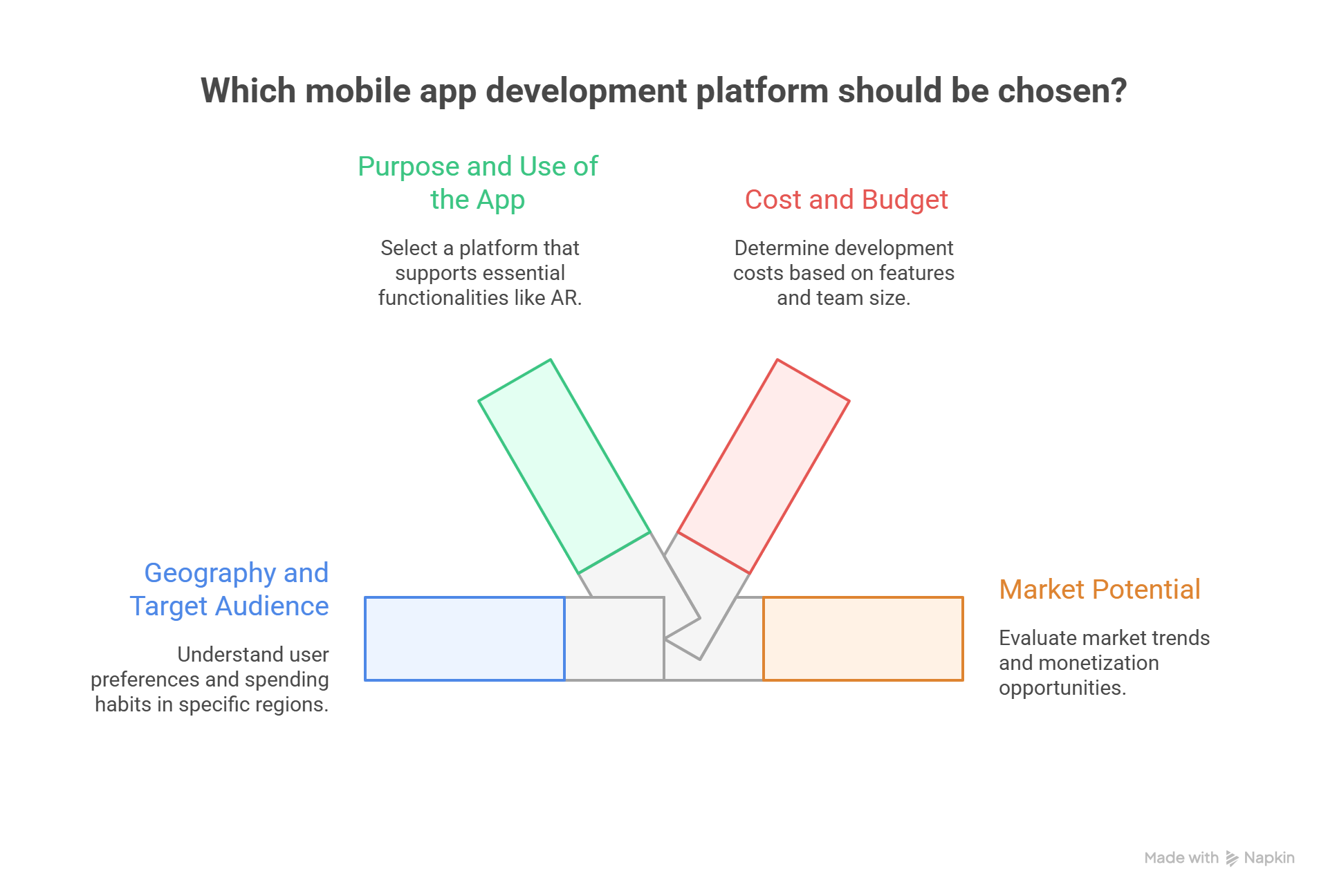
When choosing a platform, it is very important to understand your target audience and their geography. This information helps in understanding their nature, spending habits, and interests. For example, users of the iOS platform are generally more comfortable spending money. Android’s user base, on the other hand, is quite diverse, and the market is also larger. Knowing the platform preference of the target audience helps in choosing the right platform. So, if your target audience is in Australia, North America, or Japan, then Android might be the right choice.
2. Purpose and Use of the App
It is also important to know the app’s main purpose. Many times, it is difficult to find the same app functionalities on all platforms. For instance, if most of your app’s functions use augmented reality (AR), it is better to choose iOS because Android does not support as many AR functions.
3. Cost and Budget
Available resources are also a major factor in choosing which platform to use for app development. To determine the cost, you should know the app’s design and all its features. Additionally, knowing the correct development costs gives an idea of both the development time and the team size required. Accordingly, a realistic budget can be determined. It is a common misconception that development in iOS is cheap while Android is expensive. What many fail to understand is that while the development platform matters, factors like features, team members, and deadlines also significantly impact the cost.
4. Market Potential
Understanding market potential is crucial for making informed decisions. Since both iOS and Android apps adopt different strategies, it is important to understand the target audience and their preferred devices. This understanding will also help you evaluate each platform’s growth trends and user demographics. Additionally, you can gauge the app’s monetization potential, ensuring the app maximizes its revenue opportunities and reaches its intended user base.
Creating a Unique and Successful Mobile App
With millions of apps available, standing out is a challenge. Using mobile app development services is one efficient way to increase your app’s visibility. Here are expert tips for creating a distinctive and profitable mobile application.
1. Research Your Audience and Competitors
First, you must understand the user base and target audience for your app. Analyze their requirements and demands before creating the product. This research will assist in developing an app that can truly stand out.
Simultaneously, to perform better than your competitors, you should research and analyze them. Find out what other mobile application companies are doing, and identify the features, functions, and strategies responsible for their apps’ success.
2. Focus on a Great User Experience (UX)
The app should be easy to use and provide the best user experience. You can achieve this by focusing on the aesthetics of the app, ensuring easy navigation, maintaining accessibility, and using clear language. A well-designed user interface can boost application conversion rates by 200% and user experience design by 400%.
3. Develop a Strong Marketing Strategy and SEO
For the mobile app to reach a wider audience, a good marketing strategy is important. You can make use of various techniques such as promotional ads, social media campaigns, and events.
Moreover, having good search engine optimization (SEO) will get your app ranked among the top results. When users search for related terms, your app should be visible to encourage views and downloads.
4. Get Feedback from Users
User feedback is always valuable for improving any app. The suggestions and reviews from customers can help you make the required enhancements, showing that you are responsive to their needs and continuously working to better their experience.
6 Steps to Build Your Own Mobile App
Building an app from idea to launch is an exciting yet demanding undertaking. This step-by-step playbook will equip you with actionable insights into crafting, testing, and deploying a high-performing mobile app.
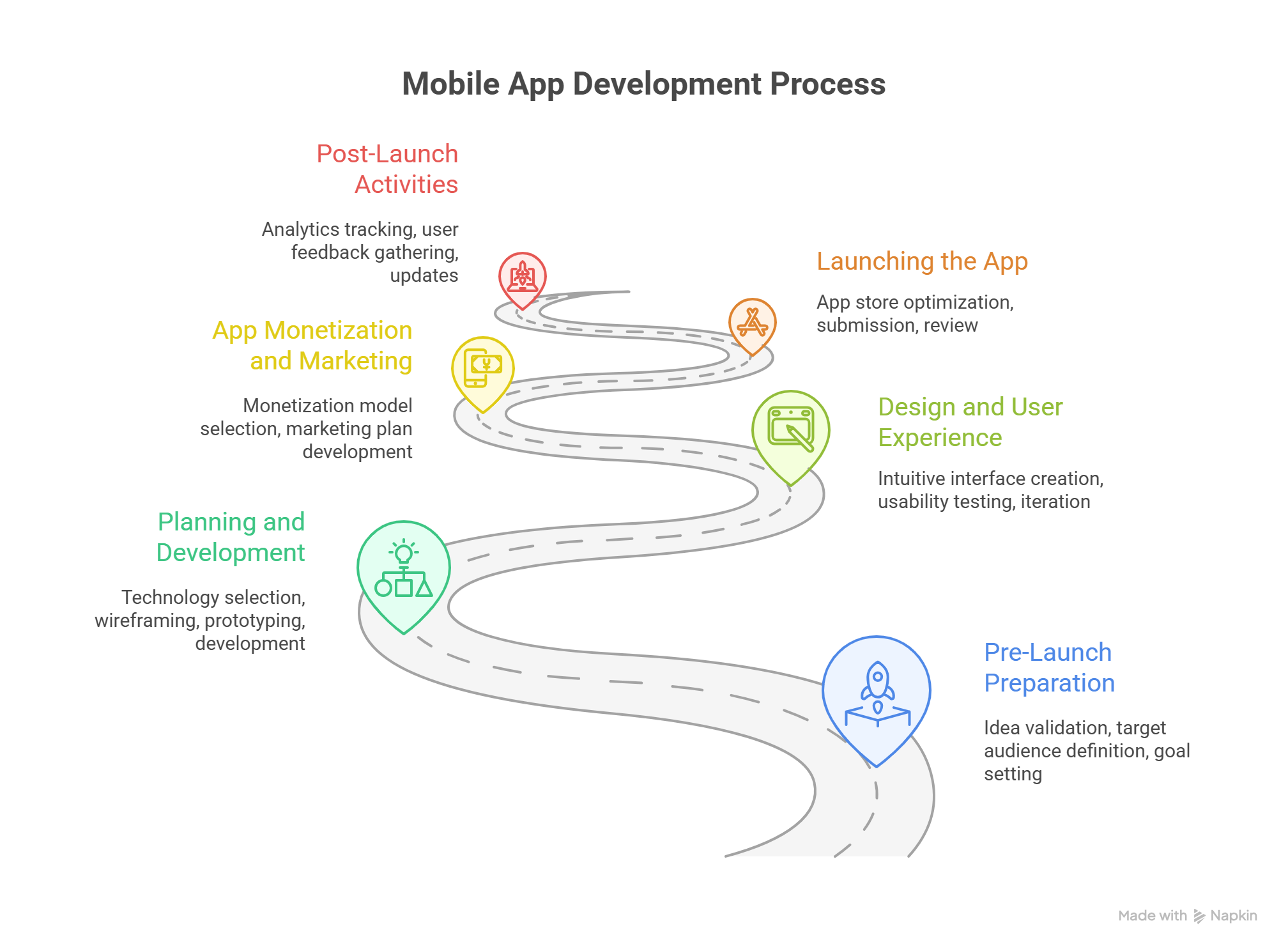
Step 1: Pre-Launch Preparation
Before diving into development, you must lay a solid foundation.
- Idea Validation: At the core of every successful app lies a solution to a problem. Meticulously pinpoint the problem your app aims to solve. Then, conduct market research and competitor analysis to understand the landscape and identify gaps for your unique selling proposition.
- Define Target Audience: Craft detailed user personas to envision your ideal users. Dive deep into their demographics, behavior patterns, and pain points to tailor your app precisely to their needs.
- Set Clear Goals: Outline specific, quantifiable success metrics like user growth, engagement levels, and monetization. Establish Key Performance Indicators (KPIs) such as conversion rates or retention to measure success.
Step 2: Planning and Development
This phase brings your concept to life.
- Choose Technology: Decide between iOS, Android, or cross-platform development. Then, leverage robust development tools and frameworks that align with your app’s functionality and scalability needs.
- Wireframing and Prototyping: Visualize your app’s structure with mockups and wireframes. Subsequently, develop a prototype for early-stage user testing to ensure it aligns with expectations before heavy investment.
- Development Phase: Decide whether to hire developers or use app development platforms based on your budget and timeline. A well-defined timeline with achievable milestones keeps the project on track.
Step 3: Design and User Experience (UI/UX)
A great design is crucial for user retention.
- Create an Intuitive Interface: Strive for simplicity, intuitive navigation, and visually appealing design elements. Center your design around user needs by conducting usability tests to ensure it resonates with your audience.
- Testing and Iteration: Usability tests provide invaluable insights into how users interact with your app. Use the feedback gathered to iterate on your app’s design and functionality, aligning it more closely with user expectations.
Step 4: App Monetization and Marketing
A great app needs a solid business strategy.
- Monetization Models: Select a model that complements your app. Options include freemium, subscriptions, ads, or in-app purchases. Ensure it aligns with your value proposition without compromising the user experience.
- Marketing Plan: Build anticipation before launch with teasers and sneak peeks. Post-launch, utilize App Store Optimization (ASO), social media, and influencer collaborations to bolster visibility.
Step 5: Launching the App
The launch is a critical moment for your app’s journey.
- App Store Optimization (ASO): Craft a compelling app title and description with relevant keywords. Also, invest in striking visuals like an attractive app icon and screenshots.
- Submission and Review: Adhere meticulously to app store guidelines to prevent rejection. Be proactive in addressing user reviews and feedback to foster positive ratings.
Step 6: Post-Launch Activities
The work doesn’t stop after the launch.
- Track Analytics: Regularly monitor user engagement, retention rates, and other KPIs. These insights help you understand your app’s performance and guide strategic adjustments.
- Gather User Feedback: Encourage users to provide feedback through various channels. Use this information to roll out meaningful updates and improvements, showing your commitment to enhancing their experience.
Understanding How to Monetize Mobile Apps
App monetization is the process of turning your app’s users into a sustainable source of income. The mobile app industry is booming, expected to reach a market size of $673.80 billion by 2027. To tap into this potential, you need the right strategy.
Key Monetization Strategies
- In-App Purchases (IAP): This strategy involves allowing users to buy items directly within your app. These can be consumables (like in-game currency) or non-consumables (like premium features or ad removal).
- Advertising: Displaying ads can be very lucrative. Popular ad formats include banners, interstitials, video ads, native ads, and rewarded ads, where users watch an ad for an in-app reward.
- Freemium Model: This approach offers a basic version of the app for free and encourages users to upgrade for premium features. It’s an effective way to expand your user base.
- Subscriptions: This model provides a predictable, recurring revenue stream by offering exclusive content or features to paid subscribers. It works well for apps with regularly updated content.
Best Practices for App Monetization
- Start Early: Plan your monetization strategy during the development phase.
- Highlight Value: Users will only pay if they see clear value. Offer a free trial to let them experience premium features.
- Flexible Pricing: Experiment with different price points and offer various subscription periods.
- A/B Testing: Test different ad placements, formats, and pricing to optimize results.
- Track Analytics: Monitor key metrics like downloads, user engagement, and retention to refine your strategies.
- Stay Updated: Adapt your strategies to evolving industry trends and best practices.
Mobile App Development Trends
The mobile app market is constantly evolving. Staying ahead of the curve means embracing new technologies. Here are the top trends to watch for are as follows:
- Internet of Things (IoT) Integration: The network of connected gadgets continues to expand. Mobile apps are central to controlling everything from home automation systems to kitchen appliances, offering users convenience and automated control.
- 5G Technology: With its ultra-fast speeds and reduced latency, 5G is transforming connectivity. It enables fully immersive AR/VR experiences and allows developers to incorporate advanced machine-learning algorithms without sacrificing performance.
- Augmented Reality (AR) and Virtual Reality (VR): These interactive technologies are set to have a major influence on sectors like tourism, education, and retail.
- Artificial Intelligence (AI): AI is becoming more integrated into mobile apps, moving beyond chatbots to streamline the development process and enable sophisticated features.
- Cross-Platform Development: Frameworks like Flutter are gaining traction, allowing developers to build apps for multiple platforms from a single codebase. This approach reduces development costs and time while still delivering a high-quality user experience.
- Wearable Technology: The demand for wearables is growing, with the market expected to expand at a 14.6% CAGR between 2023 and 2030. Developers are creating apps that seamlessly transfer information between mobile and wearable devices, creating an integrated ecosystem.
A Final Word
Choosing the right platform, designing a user-centric experience, and implementing a sound monetization strategy are all critical pieces of the mobile app development puzzle. The journey from an idea to a successful app hinges on multiple factors, from understanding your target audience to staying ahead of market trends. By considering these elements, you can lay a strong foundation for your app’s success in a competitive market.
And Hurix Digital is the perfect partner in this journey! Our web and application development solutions can help you develop a strong and effective mobile app that will help you navigate and excel.
So what are you waiting for? Contact us today!
Summarize with:

Vice President & SBU Head –
Delivery at Hurix Technology, based in Mumbai. With extensive experience leading delivery and technology teams, he excels at scaling operations, optimizing workflows, and ensuring top-tier service quality. Ravi drives cross-functional collaboration to deliver robust digital learning solutions and client satisfaction