 A Space for Thoughtful
Top Online Learning Challenges, and Smart Ways to Solve Them
Summarize with:
Education has been witnessing a steady shift to the online world over the past few years. Leaving behind rote learning in physical classrooms, schools, universities, and other institutes around the world are now offering online learning solutions that enable people to access education from anywhere they might be.
While this shift has had several benefits, especially during the COVID-19 pandemic, as it allowed students to attend their classes regardless of the physical restrictions levied by lockdowns worldwide, the approach comes with its fair share of challenges. There are many online learning challenges that you might have faced, but not known exactly why.
This blog will dive into five key challenges in online education for teachers and students alike and what institutions can do to bridge these gaps.
Table of Contents:
- Top 5 Online Learning Challenges Students Face
- Who is Likely to Face Challenges in Online Education?
- How to Tackle Online Learning Challenges?
- How to Genuinely Measure Learning Outcomes Beyond Standardized Test Scores?
- How to Deliver Quality Equitable Learning Experiences?
- How to Ensure Curriculum Relevance for Tomorrow’s Jobs?
- Embracing the Challenges
Top 5 Online Learning Challenges Students Face
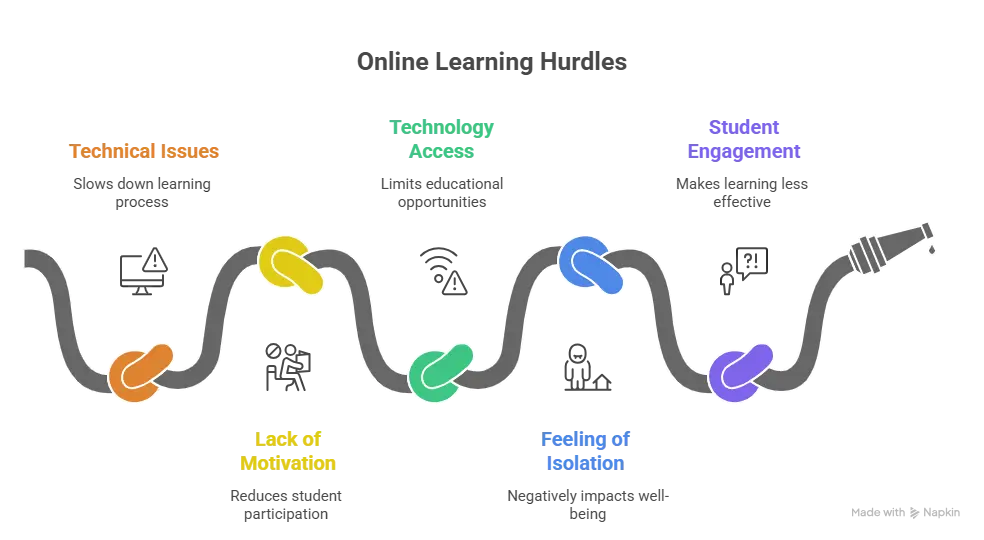
The latest trend of eLearning is gaining attraction among learners, even though learning hurdles can’t be ruled out. Here are the 5 major online learning hurdles you should know:
1. Decreased Resolutions to Technical Issues
Online education has only been made possible due to the immense role played by technology. This could be in the form of the devices students use to access their programs online, the massive platforms that provide these programs, or even the devices both students and teachers use to access these resources.
While this whole ecosystem has improved access to education on the whole, it also means that any technical issues now have to be dealt with at an individual level.
For instance, the sudden switch to online education during the pandemic came with a huge learning curve, especially for teachers who weren’t as accustomed to using technology as younger students were.
To further complicate this, any issues with their devices, difficulty in understanding the interface, or more, had to be dealt with by the teachers themselves by seeking their kids’ help or that of those around them. This is one of the key challenges that can be a barrier to accessing this technology.
2. An Increasing Lack of Motivation
One of the biggest changes the shift to online education has brought about is an increasing lack of motivation. This is because students are often more motivated to engage with their academic courses in a physical environment with their peers and teachers.
With the switch to online learning, however, the lack of a friendly and competitive environment often takes away from a feeling of urgency and the importance of time management.
This, in turn, affects their ability to meet deadlines, attend their classes on time, and progress in their learning. Further, it makes students more prone to get distracted, especially with the immense amount of content available online.
3. The Lack of Technology to Access Online Education
According to a study conducted by the Pew Research Center, one-third of households with children between the ages of 6-17 and an annual income that falls below $30,000 have no access to high-speed internet at home.
This digital divide prevents this group of students from being able to access a commodity as essential as their K-12 level education.
While the US has been significantly increasing its investments in e-learning, this gap is yet to be bridged. Further, students’ preference for a fully virtual system of learning is also relatively low.
65% of teens in the US say that they would like to return to school in person post-pandemic, displaying a strong preference for learning with their peers present in person.
4. An Increasing Feeling of Isolation
The sudden shift to online education has also led to increased feelings of isolation, as students no longer have their peers to rely on.
After all, human beings are social animals, and human interaction is crucial from a psychological perspective. This is possibly one of the biggest challenges in online education.
While the quiet and alone time that comes with studying from home can benefit some, it often leads to demotivation for others. This sense of demotivation also makes it easy for them to get distracted.
Further, the preference for studying in school is one of the primary factors influencing the statistics mentioned in the previous section.
5. The Challenge of Keeping Students Engaged
While it’s common for students to feel boredom, demotivation, or even isolation, constructively tackling these issues can also be challenging for teachers.
This is because online education doesn’t offer them the luxury of curating engaging modes of studying or collaborative projects the way they would in a physical classroom.
As a result, teachers also have to think of new ways to keep their students engaged to ensure that they remain motivated, manage their time well, and progress academically.
Who is Likely to Face Challenges in Online Education?
The challenges in online education mentioned above are just the tip of the iceberg. There are several more ways in which online education, at its current nascent stage, can prove to be challenging to all its stakeholders.
Those directly involved in dispensing and receiving this education (teachers and students) are bound to deal with these challenges daily.
However, teachers can only do so much when they’re separated from their students via a screen, and this is where ed-tech companies and those that curate online courses must find intuitive ways to make the learning experience more wholesome and engaging for students and teachers alike.
Moreover, those from comparatively underprivileged backgrounds are likely to face these challenges far more intensely, as they often deal with a lot more when it comes to the digital divide, isolation, or even distractions as a result of having to contribute to their finances.
How to Tackle Online Learning Challenges?
Here are 4 methods to tackle online learning challenges:
1. Establish a Routine and Schedule
Having a routine and schedule helps students stay disciplined and focus on goals. If the students have busy schedules for 24 hours, they have to manage their routine tasks and times. They should find time to be active and relax. Students can multitask to manage time.
Students should list things to complete within the deadline and set daily reminders. In addition, avoiding distractions from social media, internet browsing, online gaming, etc., would help save time to focus more on the given course.
2. Utilize Online Tools
Students can utilize online tools and have more autonomy in making their schedules. They can study whenever it feels convenient, which helps them to have control over their schedule and avoid distractions. You can encourage students to leverage online learning tools to explore career advancement opportunities.
3. Create Opportunities for Interaction
The students’ frustration can increase when their classmates or teachers are absent to discuss a topic. Instructors can overcome this problem by organizing groups, forums, or webinars for the students to discuss questions and gather information. Even teachers can offer classes through FaceTime.
Interactive sessions can be conducted using polls, live chat, games, and more.
4. Find Motivation
Lack of motivation is one of the major disadvantages for online learners. Students should be involved in positive talks, and this behaviour may help to maintain their focus firmly. In addition, instructors can compete with them and give rankings, prizes, and certificates. It will make them engage in studies better.
They can be motivated further by using the study materials in a fun way by creating videos, making challenges, conducting quizzes, etc.
How to Genuinely Measure Learning Outcomes Beyond Standardized Test Scores?
Much of what one learns is often so far beyond the pristine circles of a multiple-choice paper. Although some are convenient, standardized scores can hardly give the entire picture of the intellectual development of a student and the extent of his or her knowledge. It is sort of comparing a cook to one whose skills cannot be assessed on the basis of how good the food can be made or modified to match various tastes, but rather on the basis of what they can name their food.
In order to truly measure learning, we must consider its application, a critical part of learning in education. Can a learner grasp a complex concept and explain it in their own words, even to someone with no background knowledge, without losing its meaning? Can they take unrelated pieces of information and turn them into an argument, an invention, or a project? This is where genuine evaluation shines through projects where students create, debate, build, or even teach a concept to their peers. Think of a student who not only remembers the dates in history but also analyzes primary sources for bias, or one who writes and then debugs a complex piece of code they built from scratch. These are powerful exercises in knowledge; far beyond just recognizing the right answer on a test.
It is also about seeing the learning process in action, how students are challenged to solve complicated, unclear problems, how they persevere despite failures, how they work together, how they tolerate opposition to other ideas, and how they change. These are the major signs of actual knowledge and wisdom, which are difficult to quantify. Portfolios not only record the results but also include the steps, thoughts, frustrations, and discoveries made in the process. More than any score could ever tell, self-reflection and personal growth plans tend to tell a lot.
Yes, it’s messier. The shift of a single number requires more time, sensitivity, and caution among teachers. But isn’t the payoff worth it? Consider the student who is bad at exams but introduces a discussion in the classroom that sheds light on the connections that others had overlooked. It is where learning actually comes to life. That is what standardized tests just cannot measure.
How to Deliver Quality Equitable Learning Experiences?
The desire to personalize learning, to actually make education about the individual learner, usually directly collides with a giant, prickly question: how can we make it so and still not compromise the quality, or leave some students behind? The simple part is to give out tablets and enroll all in some learning platform. That’s infrastructure. The actual difficulty is to come up with systems that really comprehend and react to the alarmingly diverse ways humans learn, not in some hypothetical theory, but in the sloppy, clamorous reality of classrooms and living rooms.
Students enter the learning environment with all they have, including the knowledge they have acquired, cultural orientation, ways of interacting with people, and even their mood during a particular day. All that should be considered by real personalization. However, when we attempt to scale then things become tricky. There are far too many so-called personalized methods, which merely involve pushing the students along pre-determined adaptive tracks. This is where learning in education takes on a deeper meaning—it’s not just about consuming content but creating engaging, adaptive experiences that respect each learner’s individuality.
Authentic quality isn’t about fancy content but interaction. An algorithm can identify gaps, but can’t look a frustrated student in the eye or ask the right questions to motivate them. Technology should assist teachers, automating dull tasks so they can guide, interpret, challenge, and inspire. Keeping the human aspect is essential, requiring continuous effort to ensure students become not just data points but intelligent, curious individuals.
How to Ensure Curriculum Relevance for Tomorrow’s Jobs?
Attempting to design the curriculum of the future in a way that would be applicable to future jobs may seem like attempting to hit a moving target with a blindfold. It is untidy, intricate, and, frankly speaking, somewhat overwhelming. Future-proofing education may sound like a great idea to call upon, but it can be too positive. The fact of the matter is that the future is not something that we can nail down. It changes, and changes at night.
Then what do we retain when particular skill sets are evolving at a faster rate than we can impart them? It is not about cramming students on the use of a single software tool or one overheated methodology that will become outdated in a very short time. The actual emphasis must be on the development of the ability to learn, unlearn, and relearn throughout a lifetime. Critical thinking, creativity, problem-solving, collaboration, and emotional intelligence are the human skills that will stand the test of time regardless of the trend. Machines may be better than us at work, but they cannot yet match the human judgment, empathy, or even the power of original thought. It is where the future graduates must shine.
To get there, we must rethink curriculum building. Stagnant, one-size-fits-all of the industrial age. Consider it more of a garden maintenance; it requires constant attention, trimming, and adjustment to the seasons. The teachers, the industry, and the policymakers must continuously engage in dialogue rather than meeting once a year at a conference. What are the obstacles that are arising? What are the important skills now? It is not just adding a faddish course, but integrating versatility into all the subjects. It is experimentation, trial and error, and developing. The result? The living curriculum that evolves with the world.
Embracing the Challenges
We’ve listed some of the most common challenges that online education brings. However, with the industry still at a very nascent stage and countries investing more money every passing year into online education, the scenario is bound to change.
We’re more likely to see intuitive solutions to some of these challenges to ensure everyone benefits from online learning with no barriers standing in their way. Hurix Digital’s K12 and Higher Education Solutions are making massive headways in bridging this gap to make online education more accessible and intuitive for all its beneficiaries.
Reach out to our team of experts to know more!
Summarize with:

Senior Vice President – Business Development
at Hurix Digital, with over 25 years of experience in EdTech and workforce learning. He excels in business development, customer relationship management, and scaling digital learning solutions, driving global growth through innovative content, simulations, and AI‑driven training offerings