 A Space for Thoughtful


Instructional Design for Higher Education: A Comprehensive Guide
Summarize with:
Summary
Instructional design frameworks are the architectural blueprints used to create effective, learner-centric educational experiences in higher education. By applying systematic models like ADDIE, Merrill’s Principles, or Backward Design, institutions can ensure that learning outcomes align with 2026 workforce demands. As the digital publishing market reaches $56.51 billion, the integration of these frameworks into AI-driven Learning Management Systems (LMS) has become the primary catalyst for improving student retention by up to 25% and ensuring 100% WCAG accessibility compliance.
In the constantly evolving landscape of academia, effective instructional design for higher education has emerged as a vital component for enhancing student engagement and learning outcomes. Gone are the days when a syllabus and a few lectures were sufficient. Today, universities and colleges must compete on the global stage, offering courses that are not only informative but also accessible, engaging, and pedagogically sound.
From an educational perspective, instructional design refers to the systematic and deliberate process of crafting learning experiences. It encompasses the transformation of learning principles and theories into tangible plans for instructional materials, activities, resources, and evaluation strategies.
This comprehensive guide aims to provide educators and administrators with a robust roadmap. We will explore why these frameworks matter, how to ensure accessibility for all students, and the top models you can leverage to create impactful learning experiences.
Table of Contents:
- What is Instructional Design for Higher Education?
- Why Apply Instructional Design Models in Universities?
- Designing for Accessibility: A Core Requirement
- Top 5 Instructional Design Frameworks for Higher Education
- 7 Steps to Implement Instructional Design Strategies
- What Does the Future of Learning Architecture Look Like in 2026?
- To Wrap Up
- FAQS
What is Instructional Design for Higher Education?
Instructional design (ID) in the context of higher education involves understanding the specific needs and goals of adult learners to strategically plan out learning paths. It is not merely about digitizing textbooks; it is about creating an architecture for learning.
The learning design framework guides educators in effectively planning the overall process. By combining various methods, tools, and media, educators can design environments that suit specific learning objectives. This rigorous process is used for:
- Designing and developing engaging learning materials: Building content that is clear, concise, and stimulating, utilizing various formats like presentations, simulations, or interactive activities.
- Implementing and evaluating the effectiveness of instruction: Putting the designed materials into practice and assessing their impact on learner achievement.
- Revising and refining the instruction as needed: Continuously monitoring and improving the instructional design based on learner feedback and performance data.
Why Apply Instructional Design Models in Universities?
Instructional design frameworks help teachers and educators create optimized and creative learning experiences. When you use framework tools for designing higher education courses, you stay aligned with the institution’s goals and purposes for its students.
Here are the primary reasons why adopting a structured instructional design model is essential for effective teaching and learning:
1. Guidance in Course Development
Developing a course from the ground up can often feel overwhelming. Nonetheless, using instructional design frameworks simplifies this process by offering structured guidelines and templates. This approach conserves time and minimizes the chances of missing essential components, such as aligning assessments with learning objectives or considering accessibility.
By posing essential questions—such as what an instructional design framework is and how it can be customized to meet specific course goals—you can create courses that are efficient and flexible for future requirements.
2. Quality Assurance and Consistency
Instructional design models guide creation with clear objectives in mind, minimizing flaws and maximizing learning impact. Think of them as blueprints for intentional design. They ensure that regardless of who is teaching the course, the core learning outcomes and structural integrity remain consistent and high-quality.
3. Improved Evaluation and Review Processes
Instructional design frameworks highlight ensuring that assessments align with learning objectives. This connection guarantees that evaluations effectively review student progress and skills.
Formative assessments, often incorporated into these frameworks, offer continuous feedback, enabling students to recognize areas that need improvement and modify their learning approaches. These frameworks are known for employing various assessment methods, including quizzes, projects, peer reviews, and reflections.
4. Time and Resource Optimization
Higher education instructional design models provide a structured roadmap for developing learning materials, including necessary components, activities, and assessments. This streamlines development and fosters reuse, saving precious time and resources. Instead of reinventing the wheel for every semester, the framework allows for scalable updates.
5. Enhanced Collaboration
By providing a shared framework, models facilitate seamless collaboration between instructional designers, subject matter experts (SMEs), and stakeholders. It ensures high-quality instruction that aligns with both learner and organizational needs.
6. Continuous Improvement
Higher education is ever-dynamic, and instructional design frameworks support continuous improvement by using evaluation as a core component. The feedback collected during and after course delivery can inform revisions, ensuring that the content remains relevant and effective.
Designing for Accessibility: A Core Requirement
Before diving into specific frameworks, it is crucial to address a foundational element of modern instructional design for higher education: accessibility.
Advancing technology has made it possible to design inclusive courses, but this requires intent. The term “accessible” in this context means that students with disabilities can engage and interact with the content in a way similar to students without disabilities. The Americans with Disabilities Act (ADA) mandates inclusive accessibility, including online educational opportunities.
While online instructors spend a lot of time designing courses that foster academic excellence, they also need to be aware of the simple strategies that can make their courses ADA-compliant. Given below are some of the best practices for accessible instructional design.
1. Prioritize Easy-to-Read Fonts
Sans serif is the ideal font style to use when designing accessible courses. Unlike fonts such as Times New Roman, Sans Serif fonts (like Arial and Helvetica) do not have additional strokes attached to the letters, making them easier to read on digital screens. Once you have decided upon the font style, ensure consistency of use throughout the course to minimize cognitive load.
2. Master Color Contrast
For better usability, use a dark-colored font on a light background. Also known as high contrast, the ideal text design method is to use black font on a white background. You should avoid the use of extremely bright background colors such as yellow and red. Furthermore, avoid combinations like red/green or yellow/blue, as students with color blindness may not be able to differentiate the text from the background.
Check color contrast with our free tool here!
3. Simplify Text Formatting
The thumb rule is to follow the ‘less is more’ approach. Avoid unnecessary use of bold and italics, and only underline content that is to be hyperlinked. Variations can discourage students with disabilities from engaging with the content. Additionally, ensure consistency in page navigation and button placement.
4. Manage Graphics and Animation
Graphics are powerful, but to make accessible courses, you must avoid animated and blinking images that put a strain on the eye or could trigger photosensitive seizures. Ensure all images have “alt tags” (alternative text) so screen reader technology can describe the visual to visually impaired students.
5. Audio/Video Considerations
For students with hearing disabilities, all videos must be captioned. Conversely, for the visually impaired, there should be audio descriptions. Including full transcriptions of audio and video lectures allows students to access content via assistive technologies. Always use universal formats like MP3 or MP4.
6. Searchability and Navigation
All text within a course should be searchable. Furthermore, it is important to keep in mind that not all students are comfortable with a touchscreen or a mouse. Ensure your course content supports keyboard-only navigation.
Top 5 Instructional Design Frameworks for Higher Education
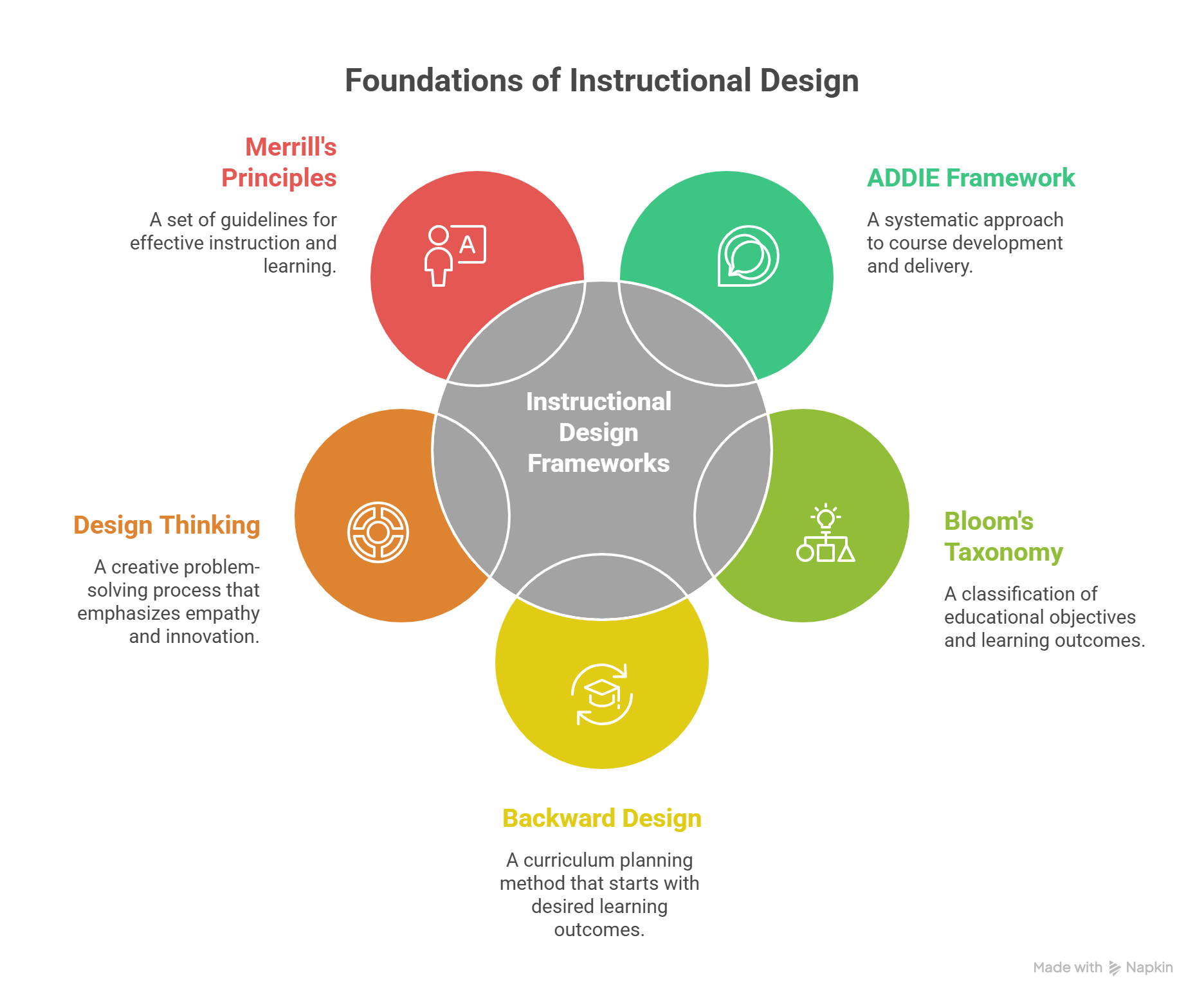
With accessibility principles in mind, we can now explore the specific models that drive curriculum creation. Here are the top instructional design frameworks widely adopted in higher education for creating impactful and engaging learning experiences.
1. The ADDIE Framework
The ADDIE framework uses five factors—Analyze, Design, Develop, Implement, and Evaluate—to help instructional design professionals tackle higher education projects in stages. It is arguably the most common curriculum design framework available.
The key components of this model are:
- Analysis: This phase involves establishing the main instructional problem and overall instructional goals, followed by identifying the learner’s needs, including existing skills and knowledge.
- Design: This step involves outlining the learning objectives, instructional strategies, content, assessments, lesson planning, subject matter analysis, and media selection.
- Development: At this stage, instructional designers create and assemble content and various instructional materials.
- Implementation: This step involves delivering the training, including detailed instructional guides for facilitators, testing key resources, and considering staffing needs.
- Evaluation: This final step involves finalizing both formative and summative evaluation plans.
The highlight of the ADDIE framework is that it effectively tackles eLearning development rather than just learning behaviors. It allows instructional designers to dig deeper into desired outcomes to create personalized resources.
2. Bloom’s Taxonomy
In Bloom’s taxonomy framework, educators classify the different skills and objectives they set for their students. Created by Benjamin Bloom in 1956 and revised later, this is an excellent classification system for organizing the different levels of cognitive learning.
The key components of this framework are:
- Remembering: Retrieving prior knowledge from long-term memory.
- Understanding: Constructing meaning from instructional messages.
- Applying: Implementing a procedure in a given situation.
- Analyzing: Breaking material into constituent parts and determining how parts relate to one another.
- Evaluating: Making judgments based on criteria and standards.
- Creating: Putting elements together to form a coherent or functional whole; reorganizing elements into a new pattern or structure.
3. Backward Design / Understanding By Design (UbD)
This is another popular framework based on cognitive psychology. It is primarily an iterative process that constantly promotes reflection and improvement of the curriculum. The “backward” aspect refers to starting with the end goals rather than the materials.
The key components are:
- Identification of Desired Results: Considering long-term goals and examining content standards.
- Determination of Assessment Evidence: Distinguishing between performance tasks and other evidence. Performance tasks require students to apply their learning to a new situation to assess their understanding.
- Planning of Learning Experiences: Planning lessons and activities to effectively address the goals identified in the first stage.
4. Design Thinking Framework
It is a solution-based approach that involves clearly understanding and empathizing with the learner. The designer works on the specific needs of the learner and the creative solutions that instructional design in higher education can offer.
The key components include:
- Empathizing: Gaining an empathetic understanding of the problem by observing and engaging with students.
- Defining: Analyzing observations to define the core problems.
- Ideating: Identifying new solutions using various techniques.
- Prototyping: Producing inexpensive versions of the product to investigate solutions.
- Testing: rigorously testing the complete product using the best solutions from the prototyping phase.
5. Merrill’s Principles of Instruction (MPI)
Founded by M. David Merrill, this framework centers on task-based learning. The key premise is that effective learning experiences are rooted in problem-solving.
The key components include:
- Demonstrating: Designers need to consider adding videos, tutorials, and image-rich infographics that showcase main ideas.
- Applying: This comes in the form of interactive problem-solving and task performance.
- Activating: Learners must be able to link the information to pre-existing knowledge.
- Integrating: Learners must get the chance to integrate their newly acquired skills into their lives.
- Engaging: Task-centric learning encourages learners to engage with the content by using everything they’ve learned to solve real-world problems.
7 Steps to Implement Instructional Design Strategies
Crafting impactful instructional materials requires a deliberate and systematic approach. Whether you are overhauling a degree program or creating a single online module, following a structured path ensures success. Here is a streamlined seven-step framework for implementing instructional design for higher education:
- Analyzing Needs: This involves a thorough examination of curriculum goals, student demographics, and external factors influencing educational objectives. Ask yourself: What is the gap between the current state of learner knowledge and the desired state?
- Learner Profile: Develop a comprehensive understanding of your students. Analyze their background knowledge, prior experiences, learning styles, and preferred instructional modalities. Are they working professionals? Undergraduate students? This profile dictates the tone and pace of the course.
- Learning Objectives: Define clear, measurable objectives that translate desired outcomes into concrete targets for evaluation. Focus on demonstrable knowledge, skills, and behaviors students should acquire by the program’s end.
- Instructional Design Selection: Select the most effective approach among the frameworks discussed above (like ADDIE or UbD) to achieve your learning objectives. Consider incorporating diverse elements, like engaging multimedia, interactive activities, and collaborative tasks.
- Content Organization: Structure your content logically. Storyboards are valuable for outlining information flow, sequencing key points, and integrating engaging elements like visuals and technology.
- Prototyping and Testing: Create a prototype of your learning materials before full development. This allows you to pilot test with a small group of students and gather valuable feedback to refine the design before a full rollout.
- Implementation and Evaluation: Monitor and assess your implemented program. Track student progress, analyze performance data, and gather feedback to refine your instruction.
What Does the Future of Learning Architecture Look Like in 2026?
In 2026, higher education isn’t just about what you teach; it’s about how that content is built. Moving away from tired, lecture-heavy models toward ‘Cognitive Load Optimized’ frameworks isn’t a luxury—it’s a survival tactic. By prioritizing modular design, universities can effectively boost instructional efficiency by 42%, finally meeting the needs of 1.3 billion digital learners. When we back these frameworks with structured XML and AI-assisted authoring, we turn content into a machine-readable asset. This makes it discoverable for today’s AI ‘Answer Engines’ and ensures our academic theories actually hold weight in an $87.43 billion digital economy.
To Wrap Up
Instructional design is not a rigid formula. The true art lies in the thoughtful selection and nuanced application of these components, considering the subject matter and the unique needs of your students. Instructional learning design frameworks in higher education are often used when planning for online learning. However, the structure they offer can also be used by educators who are planning courses that will be delivered in face-to-face or hybrid formats as well.
Through ongoing evaluation and refinement, educators can encourage an environment where knowledge is not simply transferred but actively embraced and internalized, empowering students to embark on their chosen field with confidence.
If you’re exploring ways to enhance your training programs with tailored solutions, consider partnering with an experienced team. With decades of expertise in creating innovative learning materials for corporate and educational organizations, Hurix Digital offers comprehensive support to meet your instructional design needs.
We not only bring deep expertise to the table but also collaborate closely with you to ensure the solutions align with your organization’s goals. Reach out to us to learn more about how we can assist you in achieving your training objectives.
Frequently Asked Questions (FAQs)
Q1: Which instructional design framework is best for AI-integrated learning?
The ADDIE model remains the gold standard for AI integration due to its iterative “Evaluation” phase, which allows developers to audit AI-generated content for algorithmic bias and pedagogical accuracy before final deployment.
Q2: How do instructional design frameworks impact EAA (European Accessibility Act) compliance?
Frameworks like Universal Design for Learning (UDL) are essential for EAA compliance. They mandate “Multiple Means of Representation,” ensuring that content is natively accessible (via text-to-speech, alt-text, and reflowable layouts) for the 16% of the global population with disabilities.
Q3: Can these frameworks be applied to Microlearning in higher education?
Yes. Merrill’s First Principles of Instruction are particularly effective for microlearning. By focusing on “Task-Centered” and “Activation” phases, designers can break complex higher-ed subjects into 3-to-5-minute “Knowledge Nuggets” preferred by the 5.78 billion mobile users worldwide.
Q4: What is the role of ‘Semantic Mapping’ in modern instructional design?
Semantic mapping involves tagging instructional elements with machine-readable metadata. This allows AI tools to “understand” the relationship between a learning objective and a specific content module, enabling the automated creation of personalized learning paths.
Q5: How does ‘Backward Design’ improve 2026 graduate employability?
Backward Design starts with the “Desired Results”—specifically the skills required by the 2026 workforce. By aligning assessments with these high-demand competencies first, universities ensure that every instructional activity directly contributes to the student’s career readiness.
Summarize with:

Senior Vice President – Business Development
at Hurix Digital, with over 25 years of experience in EdTech and workforce learning. He excels in business development, customer relationship management, and scaling digital learning solutions, driving global growth through innovative content, simulations, and AI‑driven training offerings