 A Space for Thoughtful
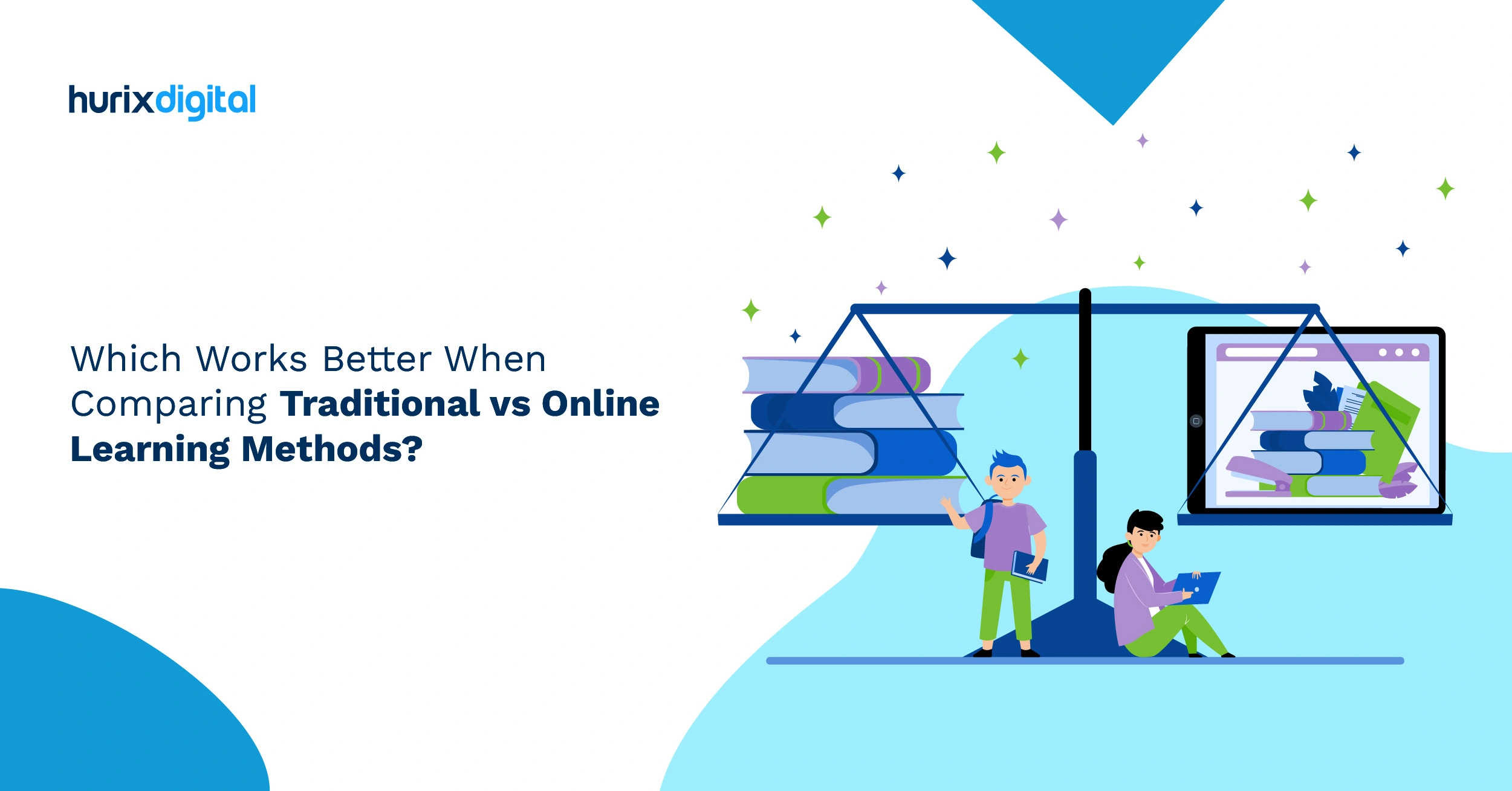
Which Works Better When Comparing Traditional vs Online Learning Methods?
Summarize with:
Online classes can be challenging, and we might just have the right solution for you to overcome them. You remember how you were underwhelmed after watching a movie based on your favorite book? Yes, the plot, characters, conflicts, and resolution were the same. But something was missing.
Whatever that ‘something’ was, there’s a chance that it will go missing when you translate your classroom sessions to online learning. The stakes are higher, though. Your students don’t just risk getting bored. Your students risk not learning anything at all.
However, all the good stuff need not be lost in translation. Think of all the movies that have successfully traveled from books to screen. These are the stories that used the medium best. You also just need to understand the online classes space better to make sure that your transition is effective.
Table of Contents:
- Understanding the Shift: Traditional vs Online Learning
- Why Make the Switch? Key Advantages of Online Learning Over Traditional Methods
- Essential Building Blocks for Taking Offline Classes Online
- Making the Transition: Online Education vs Traditional Education
- Conclusion: Embracing the Future of Learning
Understanding the Shift: Traditional vs Online Learning
The emergence of the digital era has brought about a paradigm shift in the way modern education and training systems operate. Traditional formats of face-to-face, unidimensional learning are no longer the only effective tools for training. Instead, an ecosystem of simple, efficient, and contextualized learning processes has been created with the primary aim of enhancing flexibility, reducing costs, and developing a customized, convenient, and self-paced learning environment.
This virtual learning architecture, which has streamlined information, improved access, and increased opportunities across the world, is known far and wide as online learning.
Online learning, in simple words, is a specific type of learning which largely takes place over a variety of digital media. Rather than conducting classes in a physical setting, online learning focuses on providing knowledge through eBooks, videos, webinars, discussion forums, and live Q&A sessions.
Why Make the Switch? Key Advantages of Online Learning Over Traditional Methods
As an enterprise or educational institution, if you intend to use online learning over more conventional methodologies, here are a few advantages that you will be able to accrue from switching over:
1. Greater Access
Online learning provides greater physical access, especially in terms of narrowing geographical distances. Irrespective of where your employees or students are located, with eLearning at your disposal, you can easily provide all of them with the same digital course. Doing so will permit you to eliminate the need for proximity and yet impart the same training everywhere.
2. Reduced Costs
Unlike their traditional counterparts, eLearning techniques do not require a massive barrage of unscalable resources. You don’t have to incur a huge amount of expenditure in buying equipment, hiring instructors, renting classrooms, or printing course material. Instead, you can simply design an internet-based course, which carries greater quality and maximum value.
3. Personalized Delivery
Online learning, being sophisticated in origin and individualistic in extent, allows for training lessons to be delivered in a dynamic, transparent, and personalized manner. Lessons can be wrapped up within a single session, and specific areas that need attention can be focused on. Problems, issues, or doubts, if any, can also be immediately addressed.
4. Quick Upskilling
The development of new technologies requires employees to upgrade their skills on a daily basis. If they opt for the traditional training mechanisms, it can cost them an arm and a leg! Online learning, on the other hand, enables employers to quickly upskill their employees (beginners & veterans alike) without enrolling them in a formal school.
5. Better Outcomes
With eLearning, getting feedback, tracing results, and measuring outcomes in an objective way becomes tremendously easy. You can quickly track the growth chart of each employee or student and follow their entire learning curve. This can equip you to make interventions and adjustments, as and when necessary, in order to improve productivity and augment performance.
And this is just the tip of the iceberg! Online learning also works wonders in facilitating understanding, enhancing pace, refining credentials, and reducing the carbon footprint of each organization.
Essential Building Blocks for Taking Offline Classes Online
The good news is that converting your enterprise or educational institution from a traditional learning environment into an online learning environment is not a challenging task. You are merely expected to make a few simple changes, and, as an organizational beneficiary, you are good to go.
This migration process, which is presently being undertaken by almost 98% of companies in the world, essentially requires understanding the online medium and using it effectively. Here’s how you can get started—and just so we keep going with the book-to-movie theme, we’ve used movie titles to convey our point. It works as a list of good movie recommendations as well.
1. Great Expectations: Keep Expectations Reasonable
In a class, your students are kind of a captive audience. They are in front of you and are sharing space with other students who have assembled for the same reason. In online classes, they are sharing space (and maybe even devices) with other people who don’t have the same agenda. This is the foundational difference that you will need to address.
Tips:
- Plan and structure your class for each week such that you provide all reading materials, assignments, etc., right at the beginning of the week. Enable students to pace themselves during the week.
- Consider providing assignment details beforehand, such as lecture notes, podcasts, or recorded videos.
- Design coursework such that you use online sessions meaningfully to build on what learners have explored in their own time. For example, instead of a 1.5-hour session on Schrodinger’s equation, you can split the session into three 30-minute classes. In one session, you explain the context. Give students time to understand it and how it is derived. Set up an online forum where students can clarify doubts and crowdsource solutions. Then reconvene for another half-hour session where you go over an assignment. You can also set aside some time a few days later for a quick refresher.
2. Schindler’s List: Maintain a Safe Space for Your Students
Online learning can be a space for deep community building where students learn from each other. Or it can also be a space for cyber-bullying. The 2017 School Crime Supplement (National Center for Education Statistics and Bureau of Justice) indicates that, nationwide, about 20% of students ages 12-18 experienced bullying.
It is not reasonable to expect that all your students will participate equally in the class or even behave sensitively. If you can create and nurture a space where students feel encouraged to share their ideas and also be open to dissent without feeling defensive, you have a successful program on your hands.
Tips:
- Set up a strong code of conduct. Have ice-breaker sessions with students online. Maybe have a coffee and cake session where everyone discusses their travel plans post the lockdown.
- Do not assume that they will all know and connect online, the way they do offline. The rapport for online classes has to be built, often from scratch.
- Set up a precedent for what is or is not acceptable. You may choose to moderate every comment in a discussion group if you have the time. Alternatively, call out and respond to every instance of breach of the code of conduct.
3. Hidden Figures: Be Inclusive with Online Classes
The profile and pattern of student engagement in online classes differ from an actual physical classroom. In the real world, you can gauge the interest of a student, even if they are silent. However, in the online space, there is no accurate way to understand whether the student is bored, confused, or has switched off mentally. (Keeping cameras on during online sessions is good, but not a surefire way to understand this.)
Online courses also bring up unique concerns related to accessibility. Can every student access and learn from the material you have shared? Do your presentations include colors that will alienate students with color-blindness?
Tips:
- Go through the accessibility guidelines of your zone or state. Revisit your training content to see that it meets these guidelines. You could work on a master checklist regarding the same, so that there is some uniformity in the way content accessibility is treated.
- Have periodic check-ins with students one-on-one. This could just be a message or a short call to understand how they are feeling, where they are placed, and if they need help with something.
- You could assign online class mentors to help you with managing students. This is ideal for complex, smaller classes where students are receptive to hand-holding by a peer. If you do go ahead with this approach, you will need to spend some time preparing the mentor.
4. Devil Wears Prada: Swap Style for Substance Wisely
Yes, we’ve all heard about how superb videos are and how incredible infographics can be! But be careful when sprucing up your presentations or repurposing your calculus information to fit a video format. Do not swap style for substance. Simplicity is the most important barometer for increasing retention. However, keeping things simple is a whole other discipline.
Tips:
- Organize your content and observe:
- Is everything really necessary to be taught in class?
- Can some of the information be part of an assignment?
- Can you spot any repetition or redundancy that you can remove?
Remember that these are only guidelines. You can sculpt your content in different formats to suit your needs. The best way to make the online transition is to regard the online LMS as a virtual classroom and not just a content depository.
Making the Transition: Online Education vs Traditional Education
The comparison between online education and traditional education is not about which is better, but rather about understanding how to leverage the strengths of each medium. While traditional classroom settings offer face-to-face interaction and immediate feedback, online learning provides flexibility, accessibility, and personalized pacing.
The key to successful transition lies in:
- Understanding your audience: What are their technological capabilities? What are their learning preferences?
- Choosing the right tools: LMS platforms, video conferencing tools, and collaboration software
- Training educators: Ensuring instructors are comfortable with the technology and pedagogy of online teaching
- Maintaining engagement: Using interactive elements, gamification, and regular check-ins
- Measuring success: Setting clear KPIs and tracking student progress
Conclusion: Embracing the Future of Learning
Learning online is about reimagining the entire learning process, not just about technology. By following these building blocks and understanding the fundamental differences between online learning vs classroom learning, you can create an engaging, effective, and inclusive virtual learning environment.
The transition from offline to online classes requires careful planning, thoughtful execution, and continuous improvement. But with the right strategies in place, you can ensure that nothing gets lost in translation. Perhaps even discover new possibilities that weren’t available in traditional settings.
At Hurix Digital, we are geared to help institutions and students make the transition to online programs seamlessly. Get in touch with us to learn more.
Summarize with:

Senior Vice President
A Business Development professional with >20 years of experience with strong capability to sell new solutions and develop new markets from scratch. New Market Entry Specialist with experience working in the largest emerging markets. Exceptional experience in conceptualizing, ideating and selling new learning technologies like VR AR, etc. across multiple industry verticals.