 A Space for Thoughtful
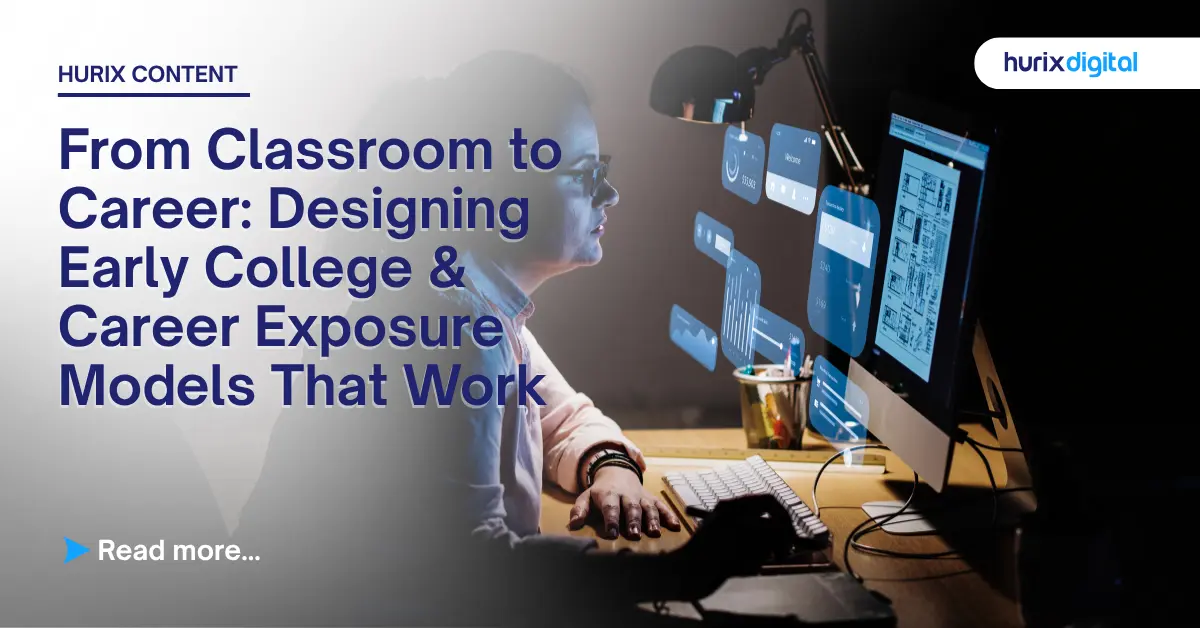
From Classroom to Career: Designing Early College & Career Exposure Models That Work
Summarize with:
The degree is losing its grip as the golden ticket. Ask any hiring manager what they need right now. They rarely mention a specific diploma or a degree. They want proof of capability. They want problem solvers. Yet we still see a massive disconnect. Universities churn out graduates. Industries are seeking skilled talent. Somewhere in the middle, potential gets lost.
We are witnessing what some are calling the “Placement Panic.” The Class of 2026 will enter a job market where skills are prioritized over credentials. But many school systems are still running on 2010 software. If you’re a Chief Learning Officer (CLO), Dean, or VP of Digital Transformation, the message is clear: you need a radical content transformation strategy. You need to stop relegating career exposure to a senior-year perk and instead make it a foundational pillar.
Table of Contents:
- Why Middle School is the New High School
- The Architecture of a Modern Exposure Model
- The Tech Stack: 2026 and Beyond
- The Enterprise Trade-Off: Build vs. Buy vs. Partner
- The Non-Negotiable: Accessibility as a Feature
- Ready to Transform Your Content Strategy?
- Frequently Asked Questions
Why Middle School is the New High School
Don’t wait until they turn 18 to talk about pathways. Studies reveal students stop caring about learning sometime in middle school when they don’t see relevance. They ask you the question you dread as teachers, “Why do I need to know this?” If you say, “Oh, it’s for the test.” You just lost them. If you say, “Well, this is how you build a robot or learn to cure diseases.” You may have a chance.
Successful early college and career exposure models are moving downstream. We call this the “Shift Left.” It borrows from software engineering, where you test early to avoid bugs later. Here, we test interests early to avoid dropouts later.
These programs are moving away from “career days” with a few pamphlets. They are moving toward contextualized learning. Think about the difference. The old way involved a guest speaker talking for an hour. The new way has a 7th grader using a digital twin simulation to understand logistics. Or running a virtual business that requires algebra to stay profitable.
This goes beyond improved pedagogy. It serves as a strategic pipeline investment. For enterprises, this “shift left” means brand loyalty and talent cultivation start at age 12.
The Architecture of a Modern Exposure Model
It takes more than dumping tablets in a classroom to build this. You need an infrastructure that allows for scalability and insight. Textbooks don’t do a great job at portraying what a job feels like. To solve this, many progressive organizations are launching shimmery interactive online degree programs that are less lecture and more flight simulator.
Say you’re a nursing student. Or even a high school student interested in health care. You’re placed in a simulated environment where you have to triage patients entering an ER. You decide. You react. You panic. These grounds provide students with future career opportunities. Reading about a job is one thing. Test driving a lifestyle is another.
We’re also seeing significant growth in dual enrollment. The old way, where high school students take college English 101 courses, is shifting. In 2026, we’ll see a focus on nano credits.
Instead of walking away with just a diploma, students should be able to earn a micro-credential in Data Literacy, Python, or even Project Management. These stackable credentials give the student currency in the workforce training world. For the school, you create a sticky situation with the student who will return later in life to earn more credentials.
The Tech Stack: 2026 and Beyond
Technology makes this possible. But you have to pick the right tools. Everyone is talking about AI in classroom experiences. We’re trimming down the noise. And no, we are not advocating for students to have ChatGPT write their essays. We’re advocating for Teacher-First AI.
The best implementations we see leverage AI as a cognitive partner. Grading. Scheduling. Routine data crunching is automated. That leaves the human teacher free to do what they do best: teach.
Students can have mentorship tailored specifically to them. AI assessment tools like Dictera can assess performance and make targeted recommendations. Maybe they ace pattern recognition, but data dumps confuse them. The platform provides interactive lessons designed to patch that gap.
The Enterprise Trade-Off: Build vs. Buy vs. Partner
For the CLO or the University VP, the challenge is execution. Do you build these platforms in-house? The “Build” trap is tempting. You want control. But building a proprietary immersive learning platform is a beast. You end up managing technical debt instead of learning outcomes. Unless you are a tech company, your core competency is likely education or workforce readiness, not software engineering.
The smarter play often involves partnering. You need content transformation experts like Hurix Digital, who already have the infrastructure in place. You bring the curriculum. They bring the gamification engine, the AI analytics, and the distribution rails. By focusing on content transformation rather than software engineering, you ensure that your digital tools actually serve your pedagogical goals.
The Non-Negotiable: Accessibility as a Feature
Here is where many well-intended initiatives slip off. They built a beautiful, high-bandwidth, VR-heavy career exploration program. It looks aesthetically pleasing in the brochure. But it is completely unusable for 15% of the student population. If digital content fails to meet WCAG standards, you risk more than a lawsuit. You actively filter out talent.
In enterprise content management, inclusivity is a quality metric. An inaccessible program is low-quality. This is a core philosophy at Hurix Digital. Accessibility cannot be an afterthought.
Alt-text rarely suffices. You need AI-driven descriptions that explain the context of an image. Our tool, Equalsense, specializes in this. We also have to consider navigation. Can a student with motor impairments navigate your career simulation using a keyboard? If the answer is no, the model is broken.
Ready to Transform Your Content Strategy?
Building the next generation of career pathways requires more than vision. It requires the right digital infrastructure. At Hurix Digital, we help higher education institutions and enterprises convert static curriculum into engaging, future-ready learning experiences through professional content transformation services.
From AI-driven accessibility tools like Equalsense to full-scale content transformation services, we ensure your learning models work for everyone. We take the heavy lifting out of digital transformation so you can focus on the learning.
Schedule a call with one of our content transformation experts to explore how we can support your goals with scalable, accessible digital solutions tailored to your institution’s needs.
Frequently Asked Questions(FAQs)
Q1:What exactly is “Content Transformation” in the context of early career exposure?
Content transformation is the process of converting traditional, static educational materials, like textbooks and standard slide decks, into interactive, digital-first experiences. In career exposure models, this means turning a lesson on “what an engineer does” into a simulated environment where a student must solve a structural problem using real-world logic and tools.
Q2:Why should career exposure start as early as middle school?
Research indicates that student engagement often drops in middle school when learners fail to see the relevance of their curriculum. By introducing “Shift Left” models, educators can connect abstract concepts (such as algebra) to tangible career paths (such as logistics or data science) at a pivotal age, preventing future dropouts and helping students make more informed elective choices in high school.
Q3:How do micro-credentials differ from traditional diplomas?
While a diploma represents a broad completion of a multi-year program, a micro-credential (or nano-credit) validates a specific, high-demand skill—such as Python coding, project management, or data literacy. These stackable credentials provide students with immediate “workforce currency” and allow employers to verify specific capabilities that a general degree might not explicitly prove.
Q4: How does AI improve the teacher’s role instead of replacing it?
The “Teacher-First AI” approach automates the administrative “noise”—such as grading routine assignments and scheduling—and provides data-driven insights into student performance. This frees up educators to focus on high-value mentorship and personalized instruction, using AI as a partner to identify learning gaps and suggest targeted interventions.
Q5:Why is accessibility a “non-negotiable” for digital learning models?
Beyond legal compliance (like WCAG standards), accessibility is a quality and talent-retention metric. If a career simulation isn’t compatible with screen readers or keyboard-only navigation, you are effectively barring 15% of the student population from discovering their potential. True content transformation ensures that the “future of work” is inclusive of all learners.
Summarize with:

Vice President – Delivery at Hurix Digital,
With over 20 years of experience in the digital learning and interactive systems industry. She specializes in operational excellence and end-to-end project delivery, overseeing complex learning solutions from conception to execution. With a strong background in practice leadership and delivery strategy, Reena focuses on driving efficiency and high-quality outcomes for global clients in the corporate and digital education space.