 A Space for Thoughtful

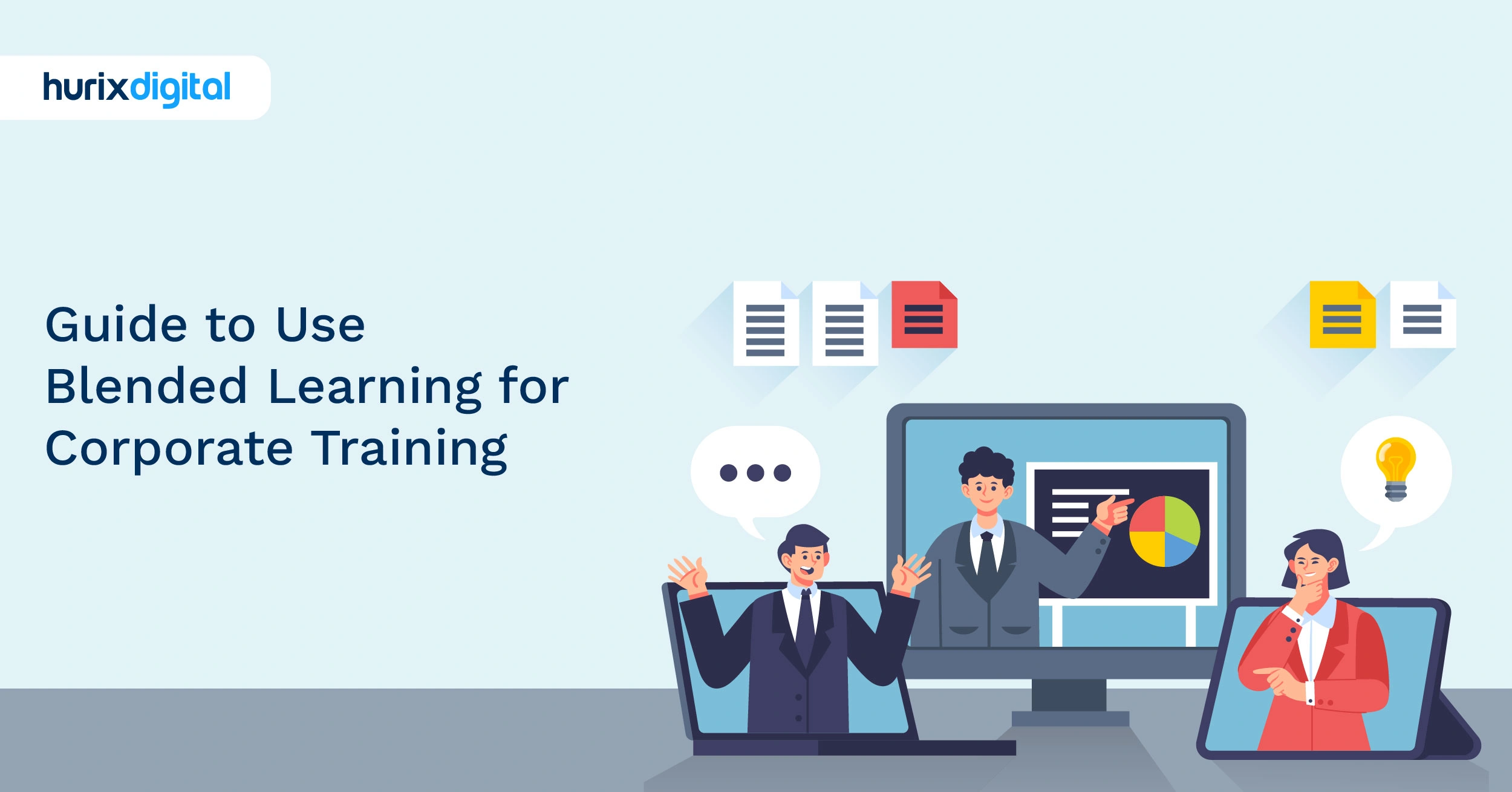
Guide to Use Blended Learning for Corporate Training
Summarize with:
Ever since online training made an appearance on the corporate training scene, several companies jumped on the bandwagon and replaced their expensive instructor-led training with online training modules and simulations. Only to revert to traditional teaching methods after meeting with various degrees of failure.
These expensive experiments brought home the fact that not all technology in the world, be it a computer course or a robust learning management system (LMS), can replace the effectiveness of the tried and tested face-to-face training in traditional classroom settings. Yet, online training has its own share of benefits which organizations can only ignore at their own peril. So, the question is how to make the best out of both worlds, both the old and new training approaches? The answer lies in creating an environment of blended learning in corporate training.
Table of Contents:
- Why Use Blended Learning in Corporate Training?
- Why Blended Learning is the Right Approach for Enterprises?
- 5 Ways You Can Use Your LMS to Create a Blended Learning Environment
- Benefits of Blended Learning in Corporate Training
- Summing Up
Why Use Blended Learning in Corporate Training?
Most organizations, for decades, have followed the tried and tested instructor-led employee training format to train employees, mainly because it is highly effective. However, it has its share of issues, such as logistics, scheduling trainer-led sessions, and the high cost of corporate training.
Given the ever-changing technology landscape, it becomes imperative for organizations to ensure continuous training for employees to remain relevant in the market. However, continuous learning through the traditional classroom format would be expensive and logistically unfeasible; therefore, there was a need for a new form of learning, and the digital environment came to the rescue and gave birth to what is now known as blended learning, a hybrid approach to learning, utilizing both classroom and web-based learning methodologies. This trend is now growing at a feverish pace, and reports suggest that the global eLearning market is expected to grow at a CAGR of 11.091% during 2014-2019.
Why Blended Learning is the Right Approach for Enterprises?
Training is a crucial factor contributing to organizational success, and so it is very important that it is delivered right and with an approach that finds wide acceptance with employees. While the millennial generation is more comfortable with technology, almost all organizations would have employees who would be more comfortable with a human instructor to aid their learning. By using the right mix of classroom instruction with eLearning tools and resources, blended learning offers an enriched learning experience.
- Expands Reach: Since blended learning combines the best of both classroom and eLearning, it helps to expand the reach and appeal to a wider audience with a wider variety of learning styles and circumstances. Classroom learning provides learners the opportunity to interact with the instructor and peers, and learn from hands-on activities. It also provides each learner the opportunity to share experiences and perspectives.
Classroom learning encompasses the best of group learning by sharing resources and experiences. Online learning is more personalized, as it allows employees to track their own learning progress and learn at their own pace. Besides, digitalized content for blended learning also allows organizations to deliver training to employees across geographies and time zones at low costs. Blended learning also enables employees to access content on the go, using their mobile devices anytime and anywhere.
- Increases Engagement: Blended learning involves the use of a wide array of content types. In a blended learning environment, learners can participate in classroom discussions with the instructor and peers, and also learn through immersive media formats such as audio, video, text, graphics, presentations, etc. With these formats and interactions, employees are more likely to relate to the lessons, engage, retain their learning, and apply it in real-life situations.
However, classroom learning alone needs to align with every employee’s schedule, which makes it complicated and inconvenient, while significantly adding to travel and accommodation costs. By incorporating the eLearning component in their training, organizations can provide their employees with more flexibility to access and participate in the training conveniently ,as per their own schedules, when they have time and are able to focus more on the content.
- Access Ready References: Online learning, in combination with classroom learning, provides a platform to organize and present materials that learners might need in the context of their classroom learning. Learners can be asked to come prepared for a particular lesson in order to save time. There may be some employees who are not familiar with the content to be taught in the classroom. To keep them on the same page, the instructor can provide online references to all employees to help them get acquainted with the subject, and an online assessment can also be administered to check their proficiency. Apart from pre-training, blended learning can also be used post-training. Learners can be provided with links to online materials that they can study at their leisure to supplement classroom teaching.
- Facilitates Collaboration: Blended learning provides learners the opportunity to collaborate both in the classroom and on online forums and communities. This helps to further deepen the learning experience.
By using online tools to complete certain tasks, blended learning provides more time for collaborative work, such as problem-solving activities and guided practice. Moving away from physical classrooms, employees can use online tools such as discussion and chat forums to interact with a wider audience and extend face-to-face training for improved outcomes.
- Simplifies Assessment: Using online tools, instructors can quickly administer quizzes and tests to assess the proficiency of their learners. Besides, several online learning platforms also provide reporting capabilities that automatically generate statistics and analytics. Trainers can use these reports to judge the capabilities of their learners and also to fine-tune their future training programs.
5 Ways You Can Use Your LMS to Create a Blended Learning Environment
Here are some fascinating ways your business can use to incorporate blended learning in corporate training:
1. Instructor-Led Training (ILT) Management
With this system, instructors can schedule a time and place for in-person training within their LMS. Employees can register for these sessions, or instructors can assign who has to attend. Leading up to the session, employees can see the agenda for the training session, what it will cover, what, if anything, they have to bring along, and, in case they have to do some homework to better follow the training module. The instructor, on the other hand, can see who is attending the session.
Unlike other eLearning modules that can be taken by the learners at their own convenience, an ILT session in a classroom ensures that all learners are at the same level. ILT management thus ensures that within an LMS, while both the instructor and employees have the flexibility towards achieving certain learning outcomes, they remain on schedule and on the same page with both their online and offline learning schedules.
2. Virtual Classroom Functionality
This functionality in an LMS allows learners to log in and remotely attend instructor-led lessons. A virtual classroom includes features such as audio/video streaming and embedded chats that allow learners to participate in the ILT session and ask questions. Then, other tools such as whiteboards and media streaming allow smooth communication between the teacher and the learners.
These sessions can also be recorded and shared later with those who could not participate in the session. Virtual classrooms are of great use to businesses of all size,s as it can be difficult to tear people away from their desks to attend a classroom for training. Besides, it’s a great way to provide ILT to remote employees.
3. Collaboration Tools
Within an LMS or an offline ILT session, trainers can set up discussion boards where they can discuss course content, ask questions, provide answers, share related resources, and, in sum, add more interest to the chapter under discussion.
Learners can also rate the courses, thus giving crucial feedback to the instructors, which they can use to further improve the effectiveness of their courses. These collaboration tools mirror the social media tools that support interactivity through feeds and comment threads, and facilitate discussions and ongoing learning long after the class is over.
4. Customize Learning Paths
Instructors can use learning paths to customize a series of courses to help employees achieve competency in certain areas. These paths can be for the whole group or individual learners. They include assessment tools that allow learners to pass an online assessment based on an ILT or offline course, and based on that, progress from one level to another.
The benefit of these learning paths is that they allow the learners to connect the dots and view disparate eLearning and classroom training modules as a cohesive whole. Additionally, instructors can adjust the pace of these learning paths according to the complexity of the modules or whether the target groups or individuals are progressing or falling behind the set goals.
5. Analytic Tools
These tools in an LMS allow the course administrators to gauge the effectiveness of their training courses. Analytic tools collate and analyze data such as pass/fail rates, etc., and present it in the form of infographics, reports, and diagrams for the administrators to study and gain insights.
With this data, they can understand the areas to focus on, adjust their classroom instruction to plug knowledge gaps, spend more time on certain topics, and provide more individualized attention to those lagging.
Benefits of Blended Learning in Corporate Training
Blended learning combines traditional face-to-face learning with peers or teammates in an organizational context with online learning to meet the evolving needs of students, employees, educators, trainers, and academicians. Basically, blended learning in corporate training helps to take learning outside the walls of the classroom, making it possible to access resources both online and offline, anytime and anywhere:
1. Makes Classroom Learning More Efficient:
In a blended learning environment, the instructor can introduce and set the context of a lesson in the classroom and then ask learners to complete certain sections of the lesson on their own using web-based resources. This is not only time-saving but also gives the instructors more time to clarify doubts and assess the comprehension levels of the learners in the classroom.
Consider the following scenario: employees are provided with some web links in advance to read up on information related to their classroom training. By the time they come to the classroom, they are already familiar with what is going to be taught. Since they already have a context, they are better positioned to grasp the lesson. Besides, it also provides employees more time to discuss with the instructors and also clarify their doubts. Thus, blended learning is not only time-saving, but it also moves away from the traditional way of teaching, which involved the transfer of knowledge from the teacher to the taught. In blended learning, the conversation is more equal, with learners also taking responsibility for their own learning.
2. Enables Learners to Plug Existing Knowledge Gaps
Another advantage of blended learning is that it can be used to ensure that all learners have the same level of knowledge. In a traditional classroom setting, not all learners have the same level of understanding and retention.
However, using online resources, learners can build on their classroom experience, fill their knowledge gaps, and be at the same level as the rest of the team. By providing advance notice of training sessions, learners can come prepared to address their knowledge gaps and thus benefit from the training. In another context, some pharmaceutical companies are using blended learning courses, where medical representatives with no relevant life sciences background are required to complete and pass online courses before attending classroom sessions. This ensures that all learners, irrespective of their educational backgrounds, benefit from instructor-led training in classroom settings.
3. Saves Time and Money
According to IBM estimates, nearly 40% of classroom employee training costs are spent on travel and lodging. Online employee training helps reduce not only travel and lodging costs but also all logistics costs associated with classroom-based employee training. Furthermore, it also helps reduce the number of man-hours lost in travel, resulting in increased productivity. With learning materials available both online and offline, organizations can ensure that employees have access to all relevant information at the time when they most need it.
4. Flexible Training Complimented with a Human Touch
Blended learning in corporate training allows learners to learn at their own pace, in the comfort of their own space. At the same time, it adds the much-needed warmth of a human interaction, enabling learners to interact with a subject expert not only to discuss and clarify their doubts but also to seek motivation in case of self-doubt and any insecurity that could otherwise affect their progress.
Summing Up
While blended learning in corporate training is now the way forward in employee training, it is important to note that each organization is different and there is no one-size-fits-all approach they can take. Getting it right is something that is going to take time, patience, and strategic planning to arrive at the best way to use your online and offline resources.
Once you know what to impart and how to impart, conduct in-depth research on various LMS vendors who specialize in your area of industry and have the right combination of knowledge, skills, and expertise to create a blended learning environment tailored to your needs. Remember, the success of your blended learning will rest on a solid foundation of technology, so choose your LMS vendor wisely if you are looking for a new system.
Get in touch with us today to learn more!
Summarize with:

Chief Learning & Innovation Officer –
Learning Strategy & Design at Hurix Digital, with 20+ years in instructional design and digital learning. She leads AI‑driven, evidence-based learning solutions across K‑12, higher ed, and corporate sectors. A thought leader and speaker at events like Learning Dev Camp and SXSW EDU