 A Space for Thoughtful

AI is Changing Mobile Apps. Here is How You Can Keep Up!
Summarize with:
Did you know that about 85.82% of the world’s population uses smartphones? That is a staggering 6.92 billion users worldwide. It’s also no surprise that the mobile application market, driven by advancements like AI in Mobile App Development, was valued at $206.85 billion in 2022 and is expected to grow at a CAGR of 13.8% till 2030.
With people relying on their smartphones more than ever before, mobile app development solutions have been looking for ways to streamline app development. With an ever-increasing demand for more feature-rich and complex requirements, they found their answer in artificial intelligence.
This blog will dive into ways AI in mobile app development is growing and highlight best practices on how to use it effectively.
Table of Contents:
- The Scope of App Development
- Factors that Influence the Cost to Develop an App
- What Exactly is AI in Mobile App Development?
- 5 Steps to Follow While Integrating AI into Mobile Applications
- Innovative Ways to Use AI in Mobile App Development
- Real-Life Examples
- Takeaway
The Scope of App Development
The scope of app development encompasses various dimensions crucial for understanding cost factors.
- It involves delineating between different types of apps, such as web-based, mobile applications, or hybrids that combine aspects of both.
- App complexity levels range from simple utility apps to those with moderate functionalities and complex systems requiring intricate development.
- Developers must consider the target platforms, including iOS, Android, or cross-platform solutions, each with unique development requirements and considerations.
Navigating these aspects effectively aids in crafting accurate cost estimates and ensures alignment with project objectives and user expectations.
Factors that Influence the Cost to Develop an App
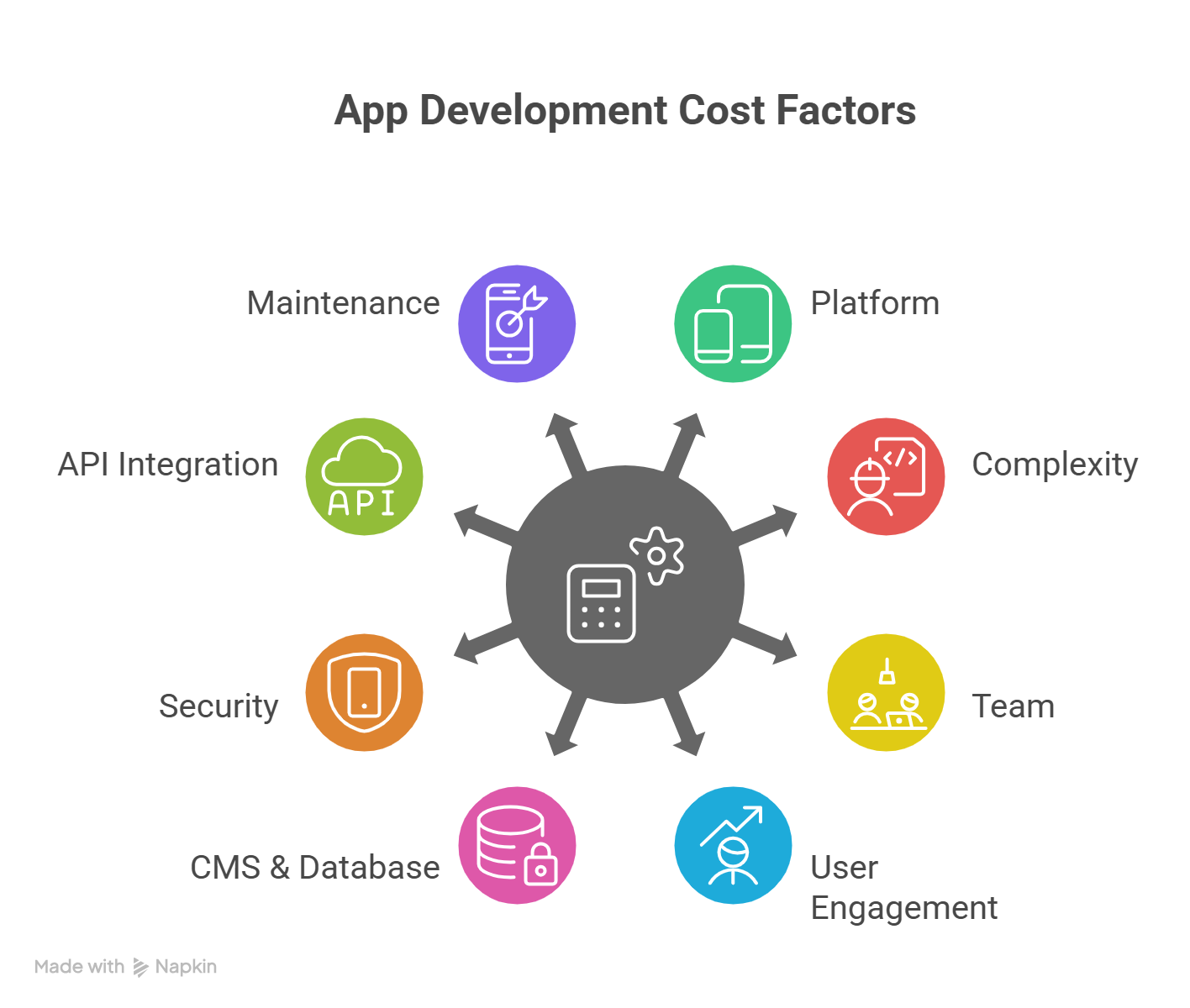
Your enterprise’s online presence hinges significantly on the app you develop. It should not only be visually captivating but also functionally resilient. However, it’s crucial to acknowledge that there’s no standardized cost for app development.
Numerous factors intertwine to influence the overall expenditure required for a quality app. We will explore these factors in detail below.
1. Platform of App Development
Your app can be native or cross-platform. The former is custom-built for specific platforms like iOS or Android. The latter’s underlying code is versatile, which allows it to be deployed on any platform.
- Developing a cross-platform app is cheaper than a native one by almost 30-40% because the underlying code remains the same.
- However, native apps are more scalable and faster than cross-platform ones. The UX of native apps appeals better to users.
2. Complexity
The development complexity of the app also impacts its pricing. A simple app with minimal features can be developed quickly with less effort.
However, unique apps with an array of complex functions and numerous API or backend integrations would call for extensive coding. A multifunctional app will have sophisticated features and a tailored user interface.
Advanced functionalities like chatbots, online streaming, animated UI, location tracking, integration with social media, geo-tagging, etc, cost more due to longer development times.
3. Team Behind App Development
You need to weigh the advantages and drawbacks of both onsite development and outsourcing options before making any decision.
- Typically, outsourcing app development to an offshore strategic service provider will reduce the overall cost by 30-40% compared to when it is developed by an on-site or in-house team.
- The outsourced team helps you concentrate on your core business and frees your resource mobilization time for other productive jobs. However, real-time collaboration and quicker decision-making can be hampered due to communication challenges and time-zone differences.
An app development team consists of a Project Manager, a business analyst, designers, programmers, app testers, etc. The compensation of the individual members of the app development team can vary:
- The respective experience levels of members and their relative command over expertise areas will determine their compensation.
- For instance, hiring a good programmer with versatile knowledge of languages like Java, Kotlin, React, Swift, Dart, Objective-C, etc. will cost more.
4. User Engagement and Satisfaction Quotient
The aim of developing any app is to enhance the engagement of targeted users with your brand, drive better conversion of leads to customers, and retain loyal customers.
- A good and intuitive design of UI is critical as it facilitates easy interaction of users with your app. The UX design must give an immersive feel to keep users hooked to the app. The more intricate the design is, the more time it will take to get developed.
- The UI/UX designers will create rough sketches, design wireframes, develop UI mock-ups, visualize user interactions, integrate illustrations and animations, and ultimately roll out a compelling UI.
Based on the complexity levels of the processes above and the integrated feature set, the cost of development will vary.
5. Content Management System (CMS) and Database Maintenance
If your app has dynamic content that gets modified based on user actions, a database would be required for storing assets generated by users.
These assets can be videos, text reviews, pictures, comments, etc., that can be added, edited, and updated.
A CMS can facilitate the addition, deletion, or modification of assets maintained inside the database. The app designer will assess the app’s platform compatibility with different CMSs.
The cost of the CMS license fee and database will have to be borne, along with the recurring fees for hiring servers, CDNs, and other infrastructures
6. Security of the App
If you are developing a dedicated enterprise or eCommerce app, you can’t overlook the security aspect. This is because the prospective app users will enter their confidential and sensitive details in the app.
- Your app designer can recommend the best security features by considering the app’s size, the nature of private information to be collected, the frequency of data inputs and user interactions, and the targeted user base.
- The cost will be primarily contingent on the threat model development, the incorporation of data integrity verification modules, the cryptographic algorithms used, the tiers of user authentication, and the frequency of safety audits.
7. Integration of External APIs and Third-Party Services
You can enhance the functionality of your app by integrating third-party features, payment gateways, push notifications, geolocation tagging, SMS features, and other APIs. This will entail additional costs.
8. App Maintenance Cost
After the app has been deployed, you need to keep it operational and updated through regular maintenance and integrity checks.
If your app is used regularly by targeted audiences, you have to engage a professional team to fix bugs and glitches, update the app, improve the features, and change UI/UX based on market trends and user preferences.
These expenses related to maintenance requirements will count in the overall app development cost.
What Exactly is AI in Mobile App Development?
AI in mobile app development is the process of creating apps that use artificial intelligence (AI) to provide smart, adaptive, and personalized features and functionalities to users.
Unlike traditional app development, which relies on predefined rules and logic, AI in mobile app development leverages machine learning, deep learning, and other AI techniques to enable apps to learn from data, user behavior, and feedback, and to improve themselves over time.
AI in mobile app development is the future of app development, as it can help create apps that are more engaging, immersive, and intelligent, and that can cater to the diverse and dynamic needs and preferences of users.
- Faster and More Efficient Development Process: Using AI can help developers automate and optimize various tasks, such as coding, testing, debugging, and deploying apps, saving time and resources.
- Higher Quality and Performance of Apps: AI can help apps deliver better user experience, functionality, and reliability by providing features such as voice and face recognition, natural language processing, image and video analysis, and more.
- Enhanced Security and Privacy of Apps: AI apps protect user data and prevent cyberattacks by using techniques such as encryption, authentication, anomaly detection, and more.
- Reduced Costs and Risks of App Development: By using AI, developers can reduce the costs and risks of app development by providing insights, recommendations, and solutions for various challenges, such as user demand, market trends, app performance, and more.
5 Steps to Follow While Integrating AI into Mobile Applications
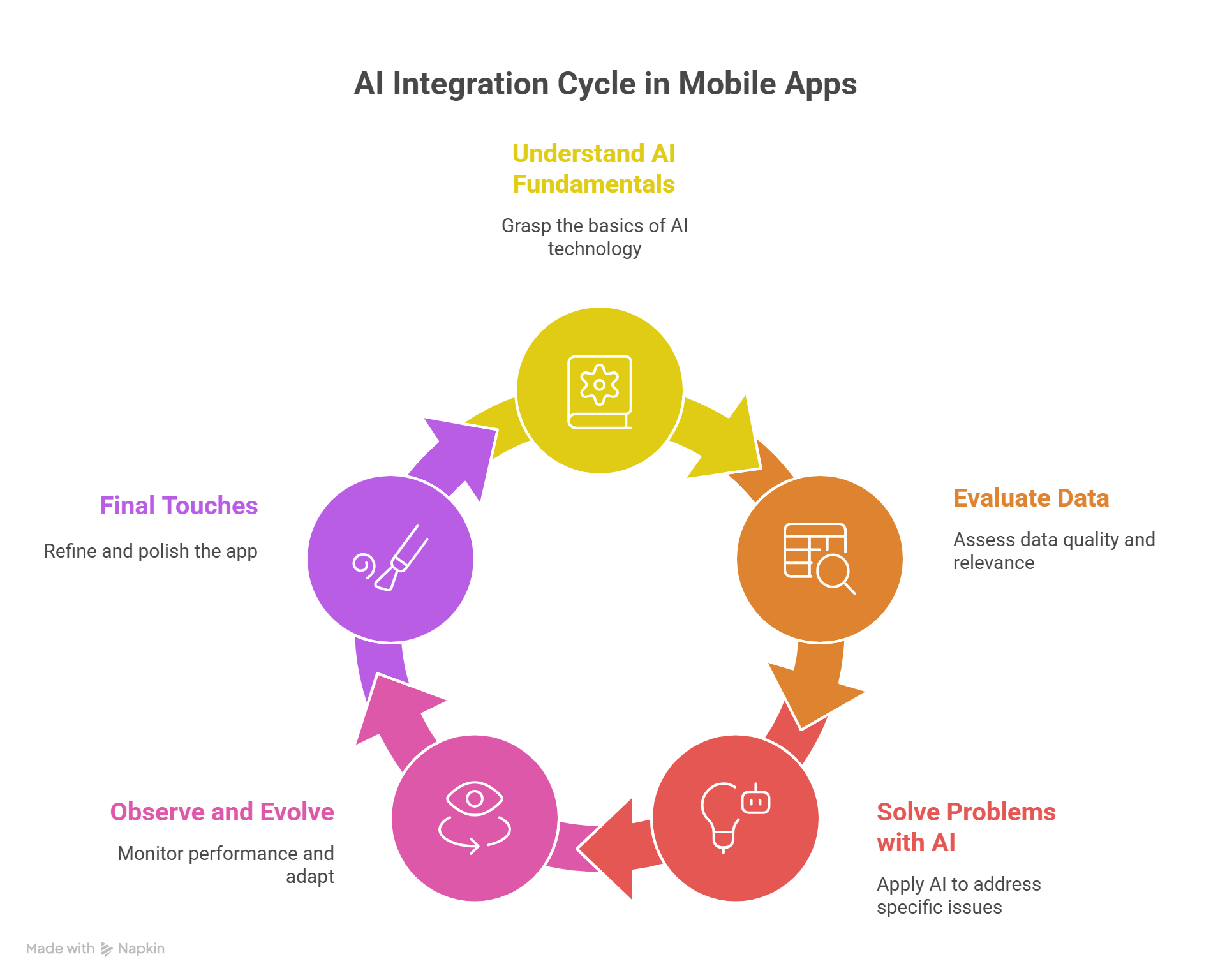
The process of integrating AI into your mobile app development is similar to other software implementations. However, it certainly has its nuances, which are important to consider for a favorable outcome.
1. Starting with the Fundamentals of AI Technology
The first step is to understand what AI technology is and its popular techniques used in various mobile apps, such as:
- Image recognition technology
- Voice recognition technology
- Chatbots
- Emotion recognition technology
- Biometrics
- Machine learning
- Text recognition technology, etc.
Then, you need to assess the day-to-day problems faced by users and how AI will help in solving these problems. Identifying and prioritizing these issues will allow you to avoid implementing unnecessary and overwhelming features, reducing your cost and making your app easy to develop and use.
Remember, before you make your app or hire mobile app development services, you must have a clear goal in mind.
2. Evaluating the Data
Analyzing and evaluating the collected data will largely affect the quality of your mobile app. Hence, it is a crucial step in mobile app development. Based on this, you can predict user behavior and offer personalized services to each user.
Using machine learning AI technology, which makes use of algorithms like regression and neural networks, as used by Netflix and Amazon, you can enhance the quality of your services. This will also help in detecting fraud in real-time in the finance industry.
Thus, with the help of AI, you can make apps to gain a competitive edge in the market.
3. Solving the Problem Using AI Technology
This is the most critical step in mobile app development. After identifying the issues customers face and evaluating the collected data carefully, you can now develop a custom AI app development model for your mobile app or use various pre-existing AI tools.
If you are using third-party tools to fetch data from other sources, you’ll have to implement APIs (Application Programming Interface) or turn to custom integration technologies.
It largely includes using the expertise of AI engineers and developers, as the process of integrating third-party tools is complex and time-consuming.
4. Observing and Evolving
After implementing the solution, it is necessary to see if it can solve the user’s problem effectively. You must also get feedback from the customers. It will help you to make the required changes and will improve the performance of your app.
You should also keep a tab on the metrics and make changes promptly to adjust the algorithm or any other part of the AI component. For better and refined performance, it is essential to measure and reduce model latency, traffic, and costs by code and infrastructure optimizations.
Refining your mobile app with the help of AI technology will benefit you by gaining a competitive edge in the market.
5. Give a Final Touch to Your App
After successfully integrating AI into your app and making the necessary optimizations to refine it, you will be able to deliver simple, safe, and intelligent solutions. Just keep in mind a few things, such as:
- As training data is the backbone of AI, curate quality training data for accurate results.
- Regularly test the model on new data and retrain to continue achieving high precision.
- Make sure that the user data is anonymized, encrypted, and stored securely. Additionally, authentication protocols should be implemented to ensure that only authorized users can have access to it.
Innovative Ways to Use AI in Mobile App Development
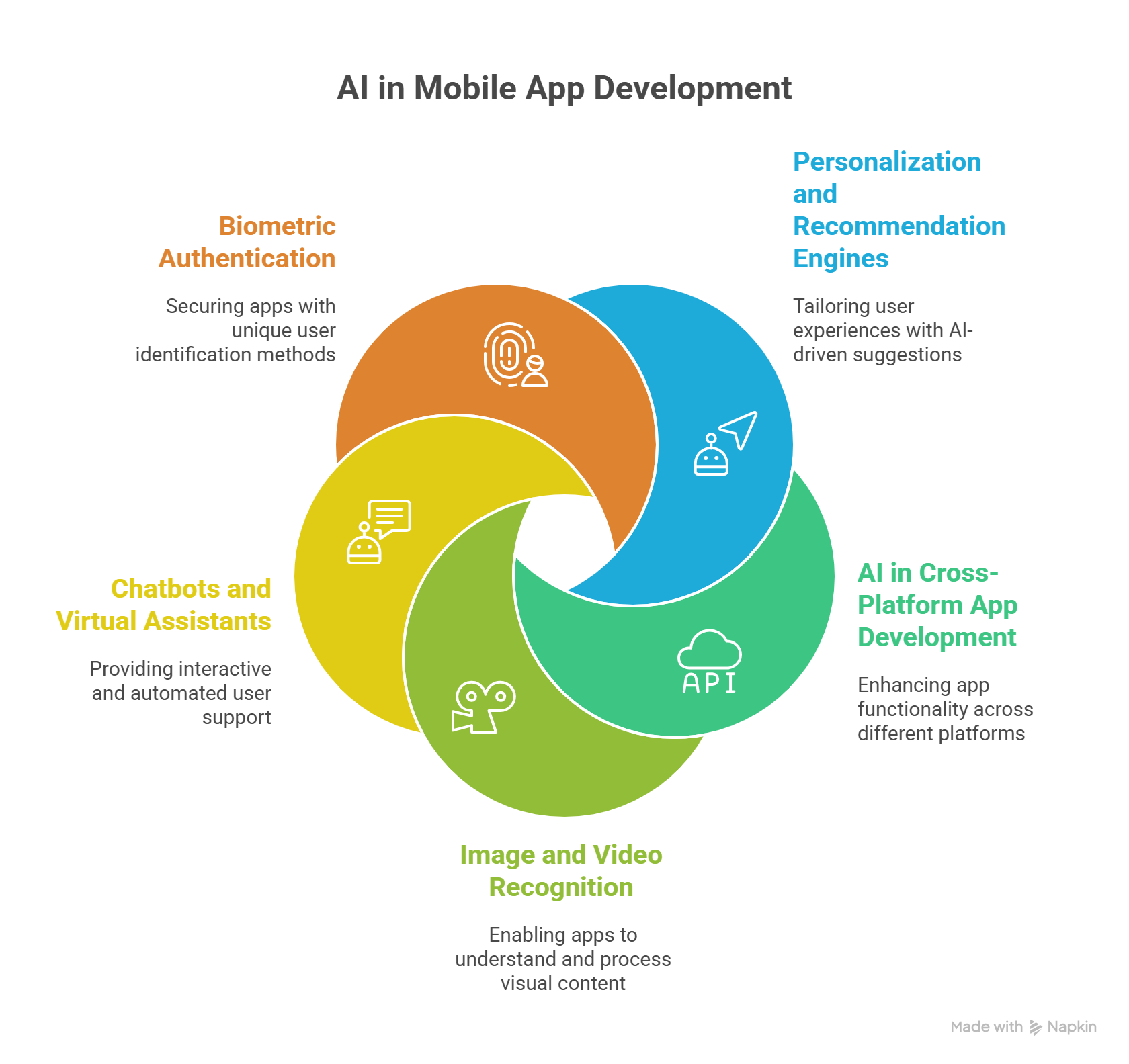
Artificial Intelligence is making significant inroads into mobile app development by transforming the way users interact with their devices and enhancing the capabilities of applications.
The following are the top five ways in which AI is paving its way into the mobile app development landscape:
1. Personalization and Recommendation Engines
Artificial Intelligence in mobile apps plays a pivotal role in enhancing user experiences through personalized content and recommendation engines. AI algorithms analyze user behavior within the app, including preferences, interactions, and historical data. By understanding individual user patterns, mobile apps can tailor content and recommendations to suit the user’s preferences.
A great example of this is e-commerce apps that utilize AI to analyze users’ purchase history, browsing behavior, and preferences to provide personalized product recommendations.
Similarly, streaming apps utilize AI in app development to analyze listening or viewing habits and recommend music, videos, or playlists that align with the user’s preferences. Recommender systems use machine learning algorithms to suggest products that align with the user’s tastes and needs.
Furthermore, AI-backed recommendation engines power personalized push notifications, delivering relevant updates, promotions, or alerts based on user preferences and behavior. Personalized notifications increase the chances of user interaction and app retention.
2. AI in Cross-Platform App Development
AI is a game-changer in cross-platform mobile development as it streamlines the entire process and improves user experiences. With machine learning-based code generators, AI simplifies the development cycle by automating code generation and optimization and significantly reducing time for cross-platform app development.
Secondly, predictive analytics and natural language processing (NLP) powered by AI enable personalized experiences. This includes adapting the app’s interface and features to user preferences across platforms.
Furthermore, AI-driven tools facilitate compatibility testing and ensure a smooth user experience on different devices. Dynamic user interface adaptation tailors visuals to various screen sizes, while AI aids in cross-platform communication and synchronization.
Lastly, security measures are strengthened through AI as it detects and responds to threats in real-time based on user behavior patterns. Moreover, automated updates and maintenance ensure the seamless deployment of features and security patches across diverse platforms.
3. Image and Video Recognition
AI technology is reforming image and video recognition in mobile apps, bringing about significant advancements in various industries. AI algorithms are often based on convolutional neural networks, which can detect and classify objects within images or video frames.
Mobile apps utilize these algorithms to identify and label objects and enable functionalities such as augmented reality, product recognition, and content categorization.
In addition to this, AI-powered facial recognition technology is employed in mobile apps for user authentication, security, and personalized experiences. Mobile devices can use facial recognition to unlock the device, and apps can utilize this technology for user verification.
One of the many applications of using AI in app development is that AI algorithms can interpret gestures captured through images or video frames, enabling users to interact with mobile apps through hand movements. This technology finds applications in gaming, virtual reality, and user interface design.
4. Chatbots and Virtual Assistants
AI technology is bringing forth a new era of intelligent and interactive user experiences with chatbots.
NLP allows virtual assistants to interpret user input in a manner that depicts natural conversations. Intent recognition further refines user interactions by enabling chatbots to discern the purpose behind user messages for more accurate responses.
Lastly, context awareness enables them to maintain continuity in conversations by understanding the user’s past interactions and responses, creating a more cohesive experience.
Beyond text-based interactions, AI extends the capabilities of chatbots and virtual assistants into the world of voice recognition, supporting voice commands and enhancing accessibility through hands-free interactions. Task automation is another facet that enables these intelligent assistants to automate routine tasks like setting reminders or fetching real-time information.
Finally, with the evolution of AI in mobile app development, the security of virtual assistants is enhanced through biometric authentication and voice recognition, which ensures a secure and personalized experience for users engaging with chatbots and virtual assistants in mobile apps.
5. Biometric Authentication
Biometric authentication, powered by AI, is transforming the security paradigm of mobile apps by implementing methods such as facial recognition, fingerprint scans, and iris authentication. These biometric techniques offer solid and secure means of verifying user identities, significantly reducing the risk of unauthorized access to mobile devices and apps.
Furthermore, AI’s expertise in behavioral biometrics further elevates mobile app security by creating unique user profiles based on individual behavior patterns. From typing speed to touch gestures, this approach adds a layer of authentication. It ensures that even if traditional credentials are compromised, the behavioral biometric signature acts as a personalized safeguard.
The incorporation of secure data encryption, real-time monitoring, and response mechanisms further cements the role of AI in mobile app development. Through these multifaceted approaches, AI empowers developers to create more resilient and adaptive security measures to ensure the integrity of sensitive user data in mobile apps.
Real-Life Examples
Let us witness firsthand the impressive capabilities of AI and Machine Learning and their immense impact on mobile app development through real-world examples.
- News apps like AP and sports apps like ESPN utilize machine learning to establish detailed user profiles based on predicted behavior. The main idea is that they can serve the hottest ads that are extremely relevant to the interests of the user, thus making sure every user sees content that they care about. It is a win-win situation: users get personalized experiences, and businesses reach the right audience.
- Spotify is a music streaming service that utilizes AI algorithms to analyze users’ listening patterns and create personalized playlists. By breaking down personal preferences, the well-known music streaming service provides a tailored musical experience for users, who are also guided in discovering new artists and songs that match their tastes. This data-driven approach establishes a strong bond between Spotify and its users, thus securing the company’s leadership in the music streaming industry.
- Netflix implements AI algorithms that take into account not only the user’s viewing history and ratings, but also their preferences, and then forecast the future desires of the user. The personalized recommendation tool on this platform can determine which movies and TV shows will interest the user the most, thereby increasing user engagement and satisfaction through highly personalized content discovery.
- Consider Uber, where AI utilizes historical data and patterns to predict the hours with the highest demand. The dynamic pricing introduced in connection with user patterns is a win-win situation, in which the business’s revenue is maximized while the users get a fair deal.
- Powered by AI and machine learning, Google Maps is more than just a navigation tool. Its AI brain is able to predict traffic patterns with great accuracy, thus offering real-time updates and the most efficient routes, both derived from the latest conditions and the most up-to-date data. In fact, this means that time is saved, navigation is smoother, and the chances of users getting frustrated are lower.
Takeaway
By reducing human intervention, AI technology helps mobile app developers complete monotonous tasks quickly. It also allows them to invest their time in doing something important and solving real-time issues. Thus, it increases their efficiency, which, in turn, leads to greater self-satisfaction.
Thus, implementing AI technology in your mobile app is the need of the hour. Mobile apps need to stay ahead in technological advancements in the competitive market, continuously innovating and evolving.
Hence, hiring a reliable mobile app development service is the answer to all your problems. Hurix Digital is one such company that has the experience and expertise required to deliver a top-notch mobile application using AI in mobile app Development, which is crucial for your success. It is one of the most trusted companies in the market to build a sophisticated and highly functional app with numerous features.
So, give us a call now and get started today!
Summarize with:

Vice President & SBU Head –
Delivery at Hurix Technology, based in Mumbai. With extensive experience leading delivery and technology teams, he excels at scaling operations, optimizing workflows, and ensuring top-tier service quality. Ravi drives cross-functional collaboration to deliver robust digital learning solutions and client satisfaction