 A Space for Thoughtful
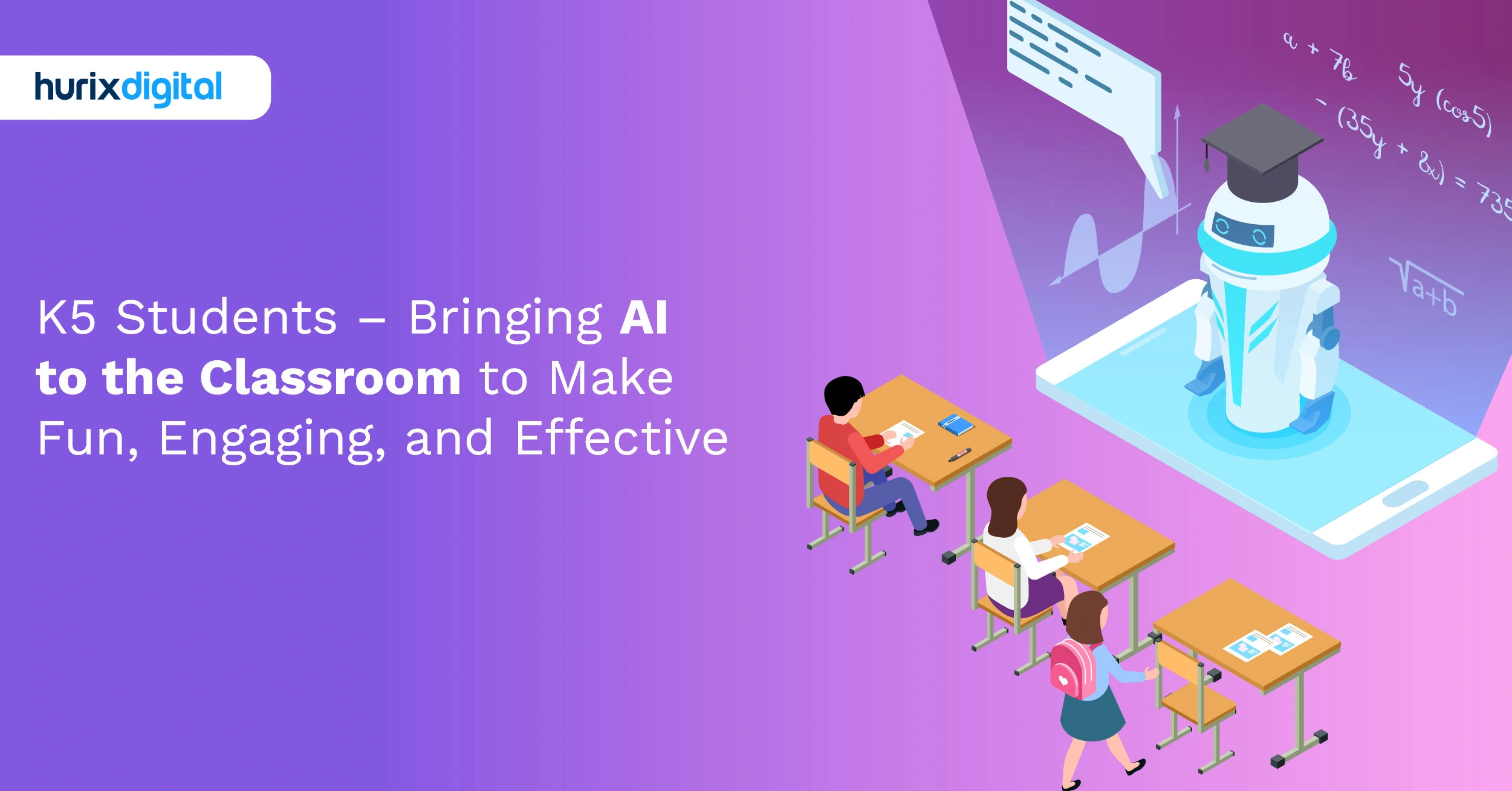
K5 Students – Bringing AI to the Classroom to Make Fun, Engaging, and Effective
Summarize with:
Artificial Intelligence (AI) isn’t just a concept from the future; it’s a current reality that continues to expand and improve. The generative AI in the gaming market, for instance, is estimated to grow from $922 million in 2022 to $7,105 million by 2032 at a compound annual growth rate (CAGR) of 23.3%. These figures highlight that AI games for K-5 student learners are the future wave in education.
In today’s rapidly evolving world of technology, preparing young minds for the future is imperative. Furthermore, reports suggest that AI could contribute up to $15.7 trillion to the global economy by 2030, which means our students will enter an increasingly AI-driven workforce. Integrating AI in curriculum planning is, therefore, crucial to equip students with the 21st-century skills necessary to thrive in the digital age.
This article will explore the importance of AI in the classroom and curriculum, what to teach in an AI curriculum for K-5 students, and how technology is revolutionizing the modern classroom.
Table of Contents:
- What is Artificial Intelligence for K-5 Students?
- The Role of AI in Assessments
- Importance of AI in Curriculum Development for K-5 Students
- How Technology Has Changed K-5 Education Positively?
- Use of Interactive Whiteboards Creates an Engaging Learning Experience
- Gamification Improves Student Motivation And Focus Level
- Virtual Reality and Augmented Reality Ensure Immersive Learning
- Incorporating Blended Learning Systems Enhances Retention Rate
- Wearable Technology Provides Children with Real-Time Feedback
- How Does AI Impact Math and Science Education?
- 6 Ways AI-Powered Learning is Helping K-5 Students Conquer Math and Science
- How to Enhance K-5 Education with AI Games?
- 5 Ways Effective AI Assessment Techniques Help K-5 Educators
- Top 5 AI-Powered Educational Games Your K-5 Students Will Love
- Wrapping Up
What is Artificial Intelligence for K-5 Students?
Artificial intelligence is the art of teaching computers how to make decisions. In essence, AI education helps students learn how to train computers through programming and testing. By using these methods, students can design art, program games, and even build robots. Through this progressive learning method, students can become the creators of their own realities. This foundational stage of education is critical, helping young learners develop academic skills, social abilities, and emotional intelligence.
The Role of AI in Assessments
Assessments are a key part of any learning program, serving purposes from motivating students to helping educators improve their teaching methods. While AI has already proved its efficacy in lesson enhancement and delivery, it now also fulfills the roles of accuracy and speed in assessments. As digital learning expands the size and scale of classrooms, the workload on teachers subsequently increases. Having to grade hundreds of assessments in a few days while maintaining the quality of assessment and grading is no easy task. This is precisely where AI-backed technologies can help teachers keep things running seamlessly. There are several AI assessment techniques that teachers can leverage for better outcomes.
Importance of AI in Curriculum Development for K-5 Students
AI education introduces school students to the fundamentals of robotics and AI. It allows students to reflect on their thinking, encourages them to solve complex problems, analyze data, and make informed decisions, which in turn nurtures their critical thinking abilities.
Let’s look at some other reasons why teaching AI to K-5 students is essential.
1. Future-Proofing Education
Just like numerous technological breakthroughs in history, the increasing adoption of AI will lead to the creation of new disciplines and jobs. Introducing AI tools, concepts, and applications early can better prepare students for the future job landscape. Subsequently, it will give them a foundational understanding of AI, which can be valuable for their careers.
2. Developing Digital Literacy
AI literacy is critical today, where algorithms drive online communication, content recommendations, and digital problem-solving. Integrating AI education into schools helps students develop essential digital literacy skills. Just as students learn to read and write, understanding AI is emerging as a vital component of modern literacy.
3. Social and Ethical Implications
The rapid progress of AI technology has raised several social and ethical questions. Teaching AI to K-5 students can instill values such as bias mitigation, fairness, and privacy from an early age. Moreover, students also learn to assess the ethical implications of AI technologies, guaranteeing ethical and diligent utilization in their future pursuits. This will empower them to be considerate and responsible AI creators and users.
4. Problem-Solving Skills
AI education helps foster critical thinking and problem-solving skills in K-5 students. For instance, it teaches students to break down complex problems, identify patterns, and create algorithms. These skills are valuable not only for AI but also for a wide range of challenges in life. Ignoring AI is akin to disregarding social media just a decade ago or neglecting the internet in the late 20th century.
5. Adaptive Learning
AI can personalize education by assessing each student’s learning pace and style, thus making learning more engaging and effective. Students can better appreciate and adapt to AI-driven educational tools by understanding AI. Furthermore, early exposure to AI can help bridge the diversity and gender gap in the tech industry. Encouraging all students to explore AI-related subjects can lead to a more inclusive tech workforce in the future.
How Technology Has Changed K-5 Education Positively?
While various eLearning solutions are paving the way for a new era of creative K-5 education, there is more in store for a promising future. Technology has transformed education, rendering it more interesting, effective, and accessible for both students and teachers thanks to innovations like the following.
1. Use of Interactive Whiteboards Creates an Engaging Learning Experience
Due to their capacity to improve student learning, smart boards are becoming increasingly prevalent in classrooms. These interactive whiteboards allow teachers to present educational material and involve students in practical learning exercises. For this reason, teachers can enhance conventional teaching techniques by using interactive multimedia tools, photos, and videos to develop an exciting atmosphere for K-5 education. Teachers can add visual aids to their classes and also offer interactive learning opportunities using smart boards. In addition, they give students a place to work together on group projects and demonstrations. Students can interact with the subject matter more experientially and perceptually if they can move objects around on the board.
2. Gamification Improves Student Motivation And Focus Level
Gamification can drastically alter educational experiences by using the potential of games. Gamified learning improves participation, motivation, and retention by combining game features, prizes, and obstacles. Game-based learning content or blended learning material is more relevant to actual situations than traditional learning materials. Because gamified content is easily customizable, teachers may give students a unique learning path. Moreover, instilling a sense of responsibility in the learners through even minor components like personalized game avatars or personal leaderboards inspires them to perform better during their educational journey.
3. Virtual Reality and Augmented Reality Ensure Immersive Learning
Virtual Reality (VR) is an excellent pedagogical tool for K-5 education. Kids can use VR headsets to engage in immersive learning that additionally stimulates their sense of hearing, sight, and more. Experiencing real-life scenarios in 3D models increases the retention rate and helps develop children’s cognitive skills, such as pattern recognition, information processing, and attention to detail.
Similarly, the application of augmented reality (AR) engages children’s minds and promotes conversation. Children are more inclined to recall what they have learned when they are emotionally driven. For example, story-reading AR apps can generate high-level interest in young minds, further improving their vocabulary and comprehension skills. Through immersive digital encounters, the application of augmented reality in education creates new eLearning opportunities. For instance, a teacher can offer students access to an augmented reality (AR) solar system model that allows them to discover space and planets while still being seated in the classroom.
4. Incorporating Blended Learning Systems Enhances Retention Rate
Blended learning is a way of teaching that integrates traditional classroom approaches with online learning resources and interactive possibilities. Every learner has a unique learning style and method. While some kids prefer to study just from text, others favor incredibly engaging classes. The main advantage of blended learning in K-5 education is that it can create customized, intentional, and distinct learning routes.
Blended learning allows for the creation of classes that are built on materials particularly tailored to the needs of each learner. Consequently, teachers can take advantage of this chance to learn how much the pupils have previously learned and how much more they need to acquire to advance. Learning can also continue outside of the traditional classroom setting. Students can access a wide range of eLearning information, games, quizzes, exercises, and e-books from the comfort of their own homes.
5. Wearable Technology Provides Children with Real-Time Feedback
New advancements in wearable technology have changed the teaching and learning processes, enabling students to engage with knowledge in an engaged, independent, and productive manner. Wearable technology can encourage children’s creativity and ingenuity as an educational tool while facilitating more straightforward and organic interactions between them and their environment. Keygloves, virtual reality (VR), smartwatches, e-textiles, Google Glass, and headsets are just a few instances of wearable technology that can be employed in the classroom and beyond. These tools can then help students improve their teamwork, interaction, problem-solving abilities, and virtual learning skills.
How Does AI Impact Math and Science Education?
Integrating AI tools in the classroom, like ChatGPT in math education, helps teachers foster students’ number sense by applying math concepts to real-life situations. AI tools’ ability to generate rich math problems encourages critical reasoning, deep mathematical thinking, and problem-solving skills among K-5 students.
AI platforms like augmented reality (AR) and virtual reality (VR) are increasingly used in K-5 digital classrooms to simulate real-world scenarios and environments. By bringing abstract science concepts to life, AI tools create immersive learning experiences that spark students’ curiosity. They also enable students to interact with complex concepts hands-on, deepening their grasp of the subject matter. Let’s explore how AI is supporting K-5 students.
6 Ways AI-Powered Learning is Helping K-5 Students Conquer Math and Science
We live in a digital age, and technology is pivotal in our everyday lives. The goal of modern education is to make students ‘AI Ready’. Here are six ways AI enhances Math and Science learning for 21st-century digital Learners.
1. Personalized Learning Paths
Over the last decade, teacher shortages have spread, and learner variability has increased. NAEP results revealed that across 26 districts in 2022, 18-77% of 4th-grade students performed below NAEP Basic in mathematics. The large city average was 36%. As the student population becomes more diverse, AI systems help execute the Sisyphean task of “meeting all students where they are.
With the help of AI, educators can personalize learning for each student, allowing them to progress at their own pace. Adaptive learning platforms powered by AI algorithms can identify students’ skills and weaknesses, helping them focus on areas that require additional attention. For instance, McGraw-Hill’s ALEKS, a digital supplemental science and math program for grades 3-12, leverages AI to enhance student learning outcomes. It accurately assesses students’ knowledge and determines their readiness to learn more complex concepts.
2. Intelligent Tutoring Systems
Just like learner diversity, the amount of available data has grown exponentially. Analyzing oceans of data to provide personalized support and inform instruction requires exceptional efforts. Here’s when AI-powered assistants come in handy. By analyzing student performance data, AI-created intelligent tutoring systems provide students with personalized feedback and guidance to navigate their learning journey. They also help educators gather, interpret, and respond to data to address students’ needs. These systems adapt to students’ learning styles and preferences, assisting them in real-time and helping them overcome challenges and build confidence.
3. Engaging and Interactive Lessons
AI technologies like AR and VR can significantly improve math and science education student engagement. For instance, students can visualize complex functions or explore three-dimensional geometric shapes in a dynamic virtual space. These visually engaging representations of abstract mathematical concepts make math more tangible and easier to grasp. The best part is that AI facilitates gamified learning. AI-powered learning platforms incorporate gamification elements like badges, leaderboards, and rewards, transforming math into an engaging and enjoyable activity. AR and VR also help students better understand intricate and abstract scientific concepts that may be challenging to comprehend or visualize. AI tools like virtual labs, for example, allow students to conduct experiments in a controlled and safe environment. This gives them a more interactive and hands-on experience that traditional classrooms cannot offer.
4. Improved Problem-Solving Skills
Math is inherently linked to problem-solving, and AI plays a pivotal role in honing students’ problem-solving skills. AI-driven tutoring platforms provide individualized guidance and support. These platforms use adaptive algorithms to analyze student responses, determine misconceptions, and provide targeted feedback and hints to enhance problem-solving abilities. Students can engage with diverse AI-generated problem sets encompassing various difficulty levels and real-world applications. By providing step-by-step guidance and real-time feedback, these systems help turn students into self-reliant learners and proficient problem solvers.
5. Accurate Assessments and Grading
To err is human. Educators who create or evaluate standardized assessments can inadvertently make errors, affecting a student’s education. On the contrary, AI programs consistently demonstrate remarkable accuracy in practical applications. For instance, McGraw-Hill’s Actively Learn, a digital supplementary curriculum platform designed for grades 3-12 in science, social studies, and English Language Arts (ELA), leverages AI to grade short-answer responses. By eliminating biases in grading, AI ensures students are assessed based on their actual understanding and knowledge. Timely, valuable comments from human instructors and AI help students get back on the right track.
6. Greater Accessibility and Inclusivity
Ensuring fair access to AI technologies is critical to fostering a more inclusive educational environment. Thanks to AI, students with learning disabilities or those unable to attend in-person classes can now access educational materials. With the growth of AI-powered tutoring tools, students worldwide can now access high-quality education regardless of their financial background, location, or other barriers.
How to Enhance K-5 Education with AI Games?
The brilliance of AI-infused games for kids is that they turn learning into a captivating adventure. They help K-5 students practice skills, learn new concepts, and enjoyably engage with subjects like language and math. What’s more, AI games adapt to a child’s level of understanding, creating personalized and immersive learning experiences.
Here’s how they can transform screen time into an enriching experience:
1. Boosting Critical Thinking and Creativity
AI in the classroom through education tools for K-5 learning offers exciting game worlds where students can play, explore, and express their creativity. When students interact with the game environment, they are encouraged to make logical decisions and think outside the box. As a result, they begin identifying different solutions and possibilities, fostering innovative thinking.
2. Improving Problem-Solving Skills
AI-powered educational games often pose challenges that students must resolve to progress. When students engage in these tasks, they learn to identify problems, observe patterns, and develop solutions, enhancing their problem-solving abilities. These are all critical skills in today’s digital era. The best part is that AI games adapt the difficulty level based on the student’s performance. They also provide real-time feedback, aiding both enjoyment and learning in equal measure.
3. Enhancing Memory Retention and Cognitive Abilities
AI games can be designed to improve concentration or test memory retention. As students navigate different AI-powered K-5 learning activities with diverse challenges or levels, their cognitive abilities, including memory, attention, and processing speed, receive a beneficial workout.
5 Ways Effective AI Assessment Techniques Help K-5 Educators
While AI is helping the education sector improve its pedagogical approaches and transform for the better, it also strongly impacts how teachers conduct assessments. There are several AI assessment techniques that K-5 education can leverage to ensure that the feedback is as high in quality as the lesson delivered.
1. Elimination of Biases
No matter how pragmatic a teacher is, biases can cloud their judgment while grading K-5 students’ tests. Being in the elementary grades, students are strongly impressed by everything a teacher does and says. When biases enter an assessment, the learning curve for some may become steeper. Consequently, AI-based assessments can help remove teacher biases, delivering more objective feedback to parents/guardians. This feedback is a true reflection of the student’s performance, not considering any aspects of the student outside of the scope of the assessment.
2. Reduction in Grading, Improvement in Assessment Quality
Since the size of classrooms has increased, so has the workload on teachers. In K-5, it is extremely important to thoroughly grade each assessment with equal care and attention to ensure the students’ foundational learning is sound. However, consistency is bound to drop with each test graded because teachers can experience burnout. By leveraging AI assessment techniques, it is possible to maintain the quality and consistency of test grading and enhance the speed of grading. The best part is that computers do not get tired and do not make compromises. Therefore, whether it is 100 tests or 1,000, the assessments will always be graded with the same standards. Plus, AI can deliver instant feedback, helping students resolve their queries sooner and acquire resources for supplemental learning.
3. Predictive Analytics
AI analytics in K-5 education can help teachers identify at-risk students early through assessments. The smart algorithms can collate a variety of student data to present a complete analysis of test score history, attendance, participation in assessments, and more. This has the potential to help teachers identify students who are at risk of falling behind or failing their tests. Subsequently, predictive modeling has tremendous applications in assessments for K-5, as it can model student history to identify patterns that lead to disengagement or factors that help boost their performance. This is a classic example of data-driven assessment strategies.
4. Adaptive Assessments
Adaptive learning assessments with AI are by far the most effective assessment technique that teachers can leverage for K-5 education for two key reasons:
- It enables teachers to spend their time teaching rather than developing standardized assessments.
- It enables students to be assessed in a highly personalized manner according to their capabilities to produce more accurate and holistic results.
Adaptive AI modules adjust the test difficulty and subject matter according to the student’s skill level. This technology draws from the student profile—their attendance, class participation, historical scores, comprehension, learning capacity, etc.—to generate tests where students can effectively assess how much they have truly learned. It also helps teachers understand the learning gap and design further curricula accordingly.
5. Power to the Students
Much like everyone today prefers personalization, students also like to be able to decide for themselves when it comes to assessments or lessons. The modern classroom is often hybrid or online, and students want to select their lessons and learn accordingly. With AI-based assessment techniques, students can set their own goals when taking an assessment. They can also use AI-based curative services to help them prepare better for an assessment. Furthermore, the feedback is immediate, and AI-based evaluations can provide students with further reading material or learning suggestions to help improve their scores.
Top 5 AI-Powered Educational Games Your K-5 Students Will Love
There are a ton of AI games out there, especially for helping K-5 students practice and learn math and literacy skills. Out of those hundreds of games, we’ve picked the best ones that will keep the students educated and entertained.
Below are the top AI-powered educational games that are not just fun to play but also provide valuable learning opportunities:
1. Minecraft: Education Edition
Minecraft Education Edition has transformed the popular block-based game Minecraft into a powerful educational tool. From Science to Math to the Roman Colosseum to History, the tool offers 500+ lesson plans to engage students in game-based learning across the curriculum. Students can explore historical recreations, engage in collaborative building projects, work on problem-solving topics, and experiment or make mistakes during learning.
- Highly engaging platform with tons of K-5 learning activities across subjects.
- Personalized games that are adaptable to any subject area. Excellent accessibility features for all learners.
- Great teaching tools with tutorials and features to support educators.
- Available for iPad, Mac, Windows, and Chromebook.
2. Duolingo
Duolingo is a widely used language-learning app that offers creative and free courses for K-5 students. With delightful stories and innovative phonics lessons, the tool helps students learn listening, writing, reading, and speaking skills. As students complete bite-sized lessons, they earn points and unlock new levels, making learning fun and effective.
- Research-backed teaching methods that help students acquire real-world communication skills.
- Employs game-like features and fun challenges to keep students motivated and develop a language learning habit.
- Available on the App Store and Google Play.
- From English tests to fun Math lessons, the tool offers personalized learning to help students learn at the right pace and level.
Price: Accessing lessons on Duolingo is completely free.
3. Kahoot!
Kahoot! is an interactive platform that allows educators to create and share engaging and educational quiz-style games. The platform also offers 100+ million ready-to-play games for learners of all ages, including K-5 students. The AI algorithms behind this platform continuously analyze student performance, adapting the difficulty of questions to meet each student’s unique needs.
- It fosters a competitive and collaborative learning environment, promoting teamwork and active participation in the classroom.
- Teachers have access to visual reports with valuable insights into class progress.
- Educators can share games and student-paced challenges directly to Google Classroom, Microsoft Teams, Apple Schoolwork, and Remind.
Price: Kahoot! EDU Standard School & District plan starts at $12.49 per teacher per month.
4. Osmo – Genius Starter Kit
The Osmo Genius Starter Kit brings AI-powered educational games to life by merging physical and digital interactions. Designed for children aged 5 to 12, Osmo includes various games that cover subjects like math, drawing, spelling, and problem-solving.
- The game uses AI to track and respond to a student’s actions and movements in real-time.
- The kit includes everything your students require for a hands-on learning experience. They can experience digital fun in 5 different ways—Tangram pieces, Osmo Base for Fire or iPad, Numbers Tiles, Stackable Storage, and Words Tiles.
- Available on iPhone and iPad.
Price: $99 per unit.
5. Zoombinis
Zoombinis is a puzzle-based game that combines critical thinking, logic, and math skills to solve challenges. The game has won numerous awards for its educational value and is particularly suitable for K-5 students. The platform fosters experimentation and creative thinking, making it an excellent choice for cultivating necessary problem-solving skills in young learners.
- Zoombinis offers 12 math-based logic puzzles, each featuring four progressively challenging levels.
- It cultivates powerful thinking skills, decision-making, and resilience through immensely enjoyable gameplay that keeps students returning for more.
- The AI algorithms behind Zoombinis adjust the complexities of the puzzles as the student progresses, making for a cognitively powerful playtime.
Price: Available for download on the App Store at $2.99.
Wrapping Up
The AI curriculum for K-5 students should be engaging, age-appropriate, and hands-on. This is important to help students comprehend AI’s fundamentals and societal impact. Educators, parents, and society are responsible for empowering the next generation with the knowledge and skills they need to navigate and shape the AI-driven world. However, transforming the curriculum is a significant task that often demands valuable time and resources.
The good news is that you can seek the services of digital curriculum providers to develop the perfect AI curriculum. With access to 4000+ digital learning objects, Hurix Digital is one of the best curriculum providers that can help transform your educational experience. We specialize in tailoring learning solutions for elementary to high school students, offering an array of engaging tools, including multilingual multimedia-rich content, game-based learning, and simulation-based learning.
Connect with us today to expedite your AI curriculum development process.
Summarize with:

Senior Vice President – Business Development
at Hurix Digital, with over 25 years of experience in EdTech and workforce learning. He excels in business development, customer relationship management, and scaling digital learning solutions, driving global growth through innovative content, simulations, and AI‑driven training offerings