 A Space for Thoughtful


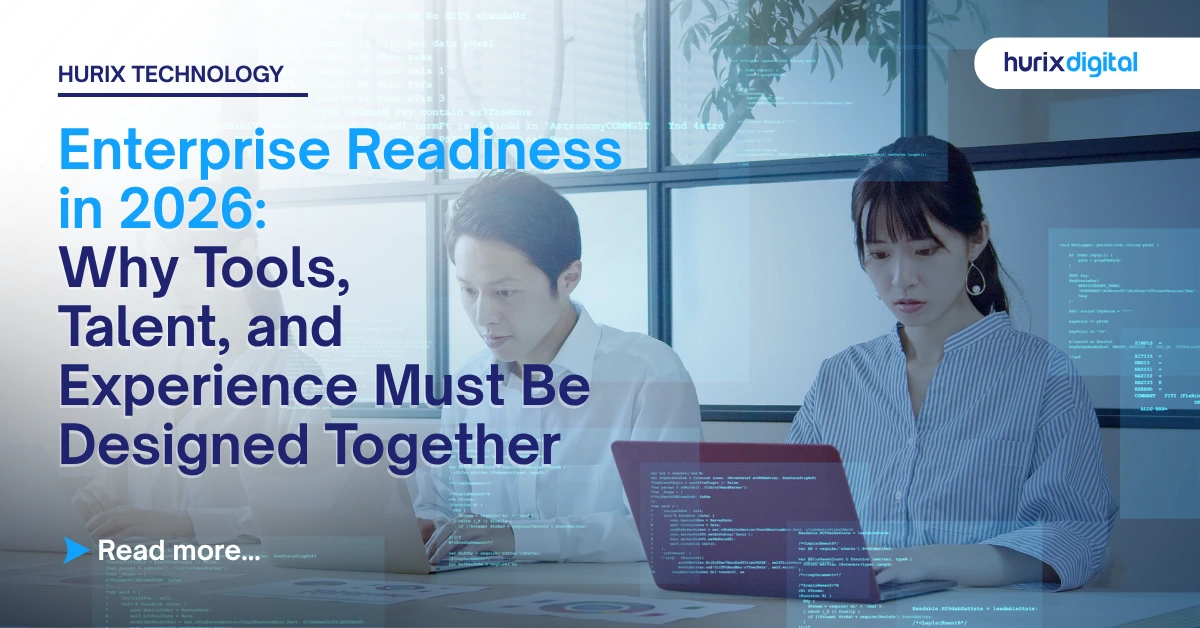
The Enterprise Experience Stack: Where UX, Talent, and Learning Converge in 2026
Summarize with:
Here’s something nobody warned us about when we started building enterprise systems: the real problem was never the technology. It was the people trying to use it.
We watched a Fortune 500 company roll out its shiny new talent platform last year. Beautiful interface. AI-powered recommendations. Cost them millions. Three weeks later? The adoption rate was in the mid-teens. Employees called it “another system to ignore.” HR was frustrated. The C-suite wanted answers. Sound familiar?
Maybe we shouldn’t have been surprised. Enterprises have built silos around UX, talent management, and learning systems for decades. UX designers, HR consultants, and learning strategists rarely speak the same language. Instead of one unified system that employees love to use, we’ve created three completely different ones. We’ve realized, however, that a cohesive Enterprise AI Solution—an integrated ‘Experience Stack’—is now the deciding factor between acquiring top talent and losing them to a competitor.
Table of Contents:
- Why is This Shift Inevitable?
- Why UX Professionals Are Suddenly Critical to Talent Strategy?
- Where AI Actually Helps (And Where It’s Just Noise)
- The Financial Case That Executives Understand
- A Final Word
- FAQs
Why is This Shift Inevitable?
Start with a basic truth: AI is the front door for enterprise content management, and traditional ERP’s grip is fading. According to Constellation Research, agentic enterprise license agreements will become the norm as executives push back against unpredictable consumption models. Translation? The old playbook of buying separate systems and hoping they’ll work alright is dead.
Easy to see. Harder to realize is that your UX designer, talent acquisition lead, and L&D manager have all been building solutions to the same problem from different angles. How do people work here? How do we make that better?
Watch what happens when those three lenses collide around a cohesive architecture—one that prioritizes integrated enterprise AI solutions. The friction magically evaporates. New hires ramp up more quickly because the learning interface aligns with where and how they work every day. Top talent sticks around longer because growing your career feels intuitive.
Why UX Professionals Are Suddenly Critical to Talent Strategy?
Walk into any enterprise and ask who owns employee experience. You’ll get blank stares or twelve different answers. That ambiguity is killing productivity.
The UX job market is cooling off after years of wild inconsistency. UX practitioners who want to excel will focus on treating UX as a strategic problem-solving approach instead of merely producing deliverables. What’s changed? Companies are recognizing that talent retention is a user experience problem.
Think about exit interviews. People don’t usually leave because of salary. They leave because work feels harder than it should be. Forms that don’t make sense. Approval processes that require three managers and a blood sacrifice. Learning platforms that crash during mandatory training. Talent problems disguised as UX failures. Smart companies are embedding UX researchers directly into talent and L&D initiatives. They’re running usability tests on performance review interfaces.
Where AI Actually Helps (And Where It’s Just Noise)
AI is in every vendor pitch these days. Much of it is hype. While AI features will certainly impact the look and feel of a platform. Its influence goes deeper than that. Think about how AI changes the fundamentals of your architecture and how it enhances the effectiveness of modern enterprise AI solutions through data unification.
What does matter: AI can surface enterprise-wide UX problems by analyzing thousands of employee interactions. Stuff you’d never find through qualitative UX studies. It can pinpoint skill gaps across the organization and suggest personalized courses of action to close those gaps. It can even identify which high performers are likely to jump ship (by analyzing engagement levels) and surface development opportunities before they start job searching.
What AI can’t do: Magic up a coherent strategy. Clean up crappy data. Break down organizational silos. Or substitute for leadership that only views technology as a shortcut rather than putting in the effort to change your culture.
The Financial Case That Executives Understand
Speaking of return on investment, ROI is what frees up budget. Enterprises will use AI agents as a new user interface to abstract legacy sunk costs from old enterprise systems. You can improve the employee experience without replacing every legacy system brick by brick, provided you design carefully.
What does fragmented experience cost you? How many hours do your employees lose every day, context switching between systems, re-entering data, or waiting on data that should be readily available? Times that by headcount. Times that by the average salary. You’ll be horrified by the math.
Then do the talent math: How much does it cost you to hire someone? What’s your turnover expense (productivity loss + recruiting + training costs)? If a better experience stack can decrease turnover by just 5%, what’s that worth?
Factor in learning efficiencies in employee training programs: People learn and retain more when workforce training is contextualized and part of the flow of work. They’ll use skills sooner. New hire ramp-up time decreases. Revenue per employee rises.
We have numbers to back this up. Companies that’ve embraced linking UX, talent, and the learning experience see clear gains in engagement scores, retention rates, and internal movement. The metrics are out there. Just most companies aren’t seeing the connections.
A Final Word
Stop siloing these efforts. Bring your UX, talent, and L&D leaders together for your next quarterly planning meeting. Provide them with a common challenge: what is the biggest friction point in the employee experience, and how would we eliminate it through more cohesive enterprise AI solutions?
Map your data lakes. Where is information about your employees (their skills, ambitions, and daily work) currently stored? What holes are present? Where are the highest value integration points?
Looking to build a cohesive Enterprise Experience Stack that actually works? Hurix Digital specializes in creating integrated learning, talent, and UX solutions for enterprise organizations. Our expertise in digital learning platforms and talent development can help you turn fragmented systems into unified experiences. Schedule a discovery call to explore how we can support your transformation.
Frequently Asked Questions(FAQs)
Q1: How can we audit our existing “Experience Stack” without starting from scratch?
Start by mapping the “Employee Journey” for a single high-value process, such as onboarding or a mid-year promotion. Track every platform an employee must touch, every login required, and where they typically “drop off” or seek manual help. If an employee has to leave their primary workflow more than twice to complete a learning module, your stack is fragmented.
Q2:Who should lead the convergence of UX, Talent, and Learning?
While HR usually “owns” the talent, the most successful shifts are led by a Cross-Functional Steering Committee. This includes the Head of L&D (for content), the Product/UX Lead (for the interface), and a Data Architect (to ensure the backend systems “talk” to each other). This prevents one department’s priorities from overshadowing the user’s actual needs.
Q3: Does “Sovereign AI” play a role in the Enterprise Experience Stack?
Absolutely. For the Experience Stack to be effective, AI agents must have access to sensitive employee data (skills, performance history, and career goals). By using Sovereign AI—keeping that data within your private cloud—you ensure that personalized career coaching and automated learning paths remain secure and compliant with global privacy laws.
Q4: How do Enterprise Learning Solutions reduce “Context-Switching” fatigue?
Modern solutions use API-first architectures to push learning content directly into the tools employees already use (like Slack, Microsoft Teams, or specialized ERPs). Instead of the employee going to a separate portal to “learn,” the “Enterprise Learning Solution” meets them where they work, delivering micro-learning at the exact moment a friction point is detected.
Q5: Can a better Experience Stack actually lower recruitment costs?
Yes. When your UX and Learning systems are unified, the “ramp-up time” for new hires drops significantly. This means you can confidently hire “high-potential” candidates who may lack one or two niche skills, knowing your internal Enterprise Learning Solutions will close those gaps quickly. This widens your talent pool and reduces the “premium” paid for perfectly-matched external candidates.
Summarize with:

Vice President & SBU Head –
Delivery at Hurix Technology, based in Mumbai. With extensive experience leading delivery and technology teams, he excels at scaling operations, optimizing workflows, and ensuring top-tier service quality. Ravi drives cross-functional collaboration to deliver robust digital learning solutions and client satisfaction