 A Space for Thoughtful

Is AI in K12 Education the Biggest Learning Shift Since the Internet?
Summarize with:
With the growing importance of artificial intelligence in our daily lives, it’s no wonder that educational institutions are racing to catch up with the need to leverage intelligent systems that are helping students learn better and achieve their learning objectives.
AI or Artificial intelligence: the ability of a computer program to do human tasks such as thinking and learning: is transforming the concept of both K12 learning and higher education alike. A Technavio report about the AI market in the US education sector also predicts a nearly 48 percent growth rate for AI tools over the next three years.
So, where and how does AI fit into K12 learning?
This blog will explore the impact of AI in K12 education and feature the top ways schools can channel the power of AI to enhance the learning journey for students and educators alike.
Table of Contents:
- How Can AI in K12 Education Improve?
- How is AI Used in Education?
- Key AI Guidelines for the Integration of AI in K12 Education
- Challenges in AI Implementation for K12 Education
- What are the Benefits of AI for K12 Education?
- Why Do Educational Organizations Need Ethical Principles for Artificial Intelligence in K12 Education?
- Wrapping Up
How Can AI in K12 Education Improve?
K12 education is on the brink of a technological revolution, with AI in K12 education ready to redefine the way students learn and educators teach. Having said that, the digital divide remains a challenge in American education, with disparities in access to resources.
AI is swiftly becoming an integral part of the educational fabric, particularly in K12 settings where its impact is both transformative and multifaceted.
According to Forbes, over 47% of learning management tools now incorporate AI functionalities, which significantly enhance educational delivery and administration. This integration signifies a major shift towards K12 digital transformation, making educational experiences more engaging and personalized.
An example of this is Carnegie Learning’s MATHia software, which boasts improvements in math scores among K12 students. Similarly, AI tutors, such as those developed by Century Tech, provide:
- Personalized tutoring sessions.
- Using data to pinpoint students’ strengths and weaknesses.
- Effectively supporting AI for student success.
In this regard, heads of online learning and education administration are increasingly looking to integrate AI tools to enhance educational outcomes and streamline administrative tasks. These tools aid in routine classroom management, freeing teachers to focus more on pedagogy. It also helps to make learning continuous, data-driven, and closely connected with AI applied within school curricula.
How is AI Used in Education?
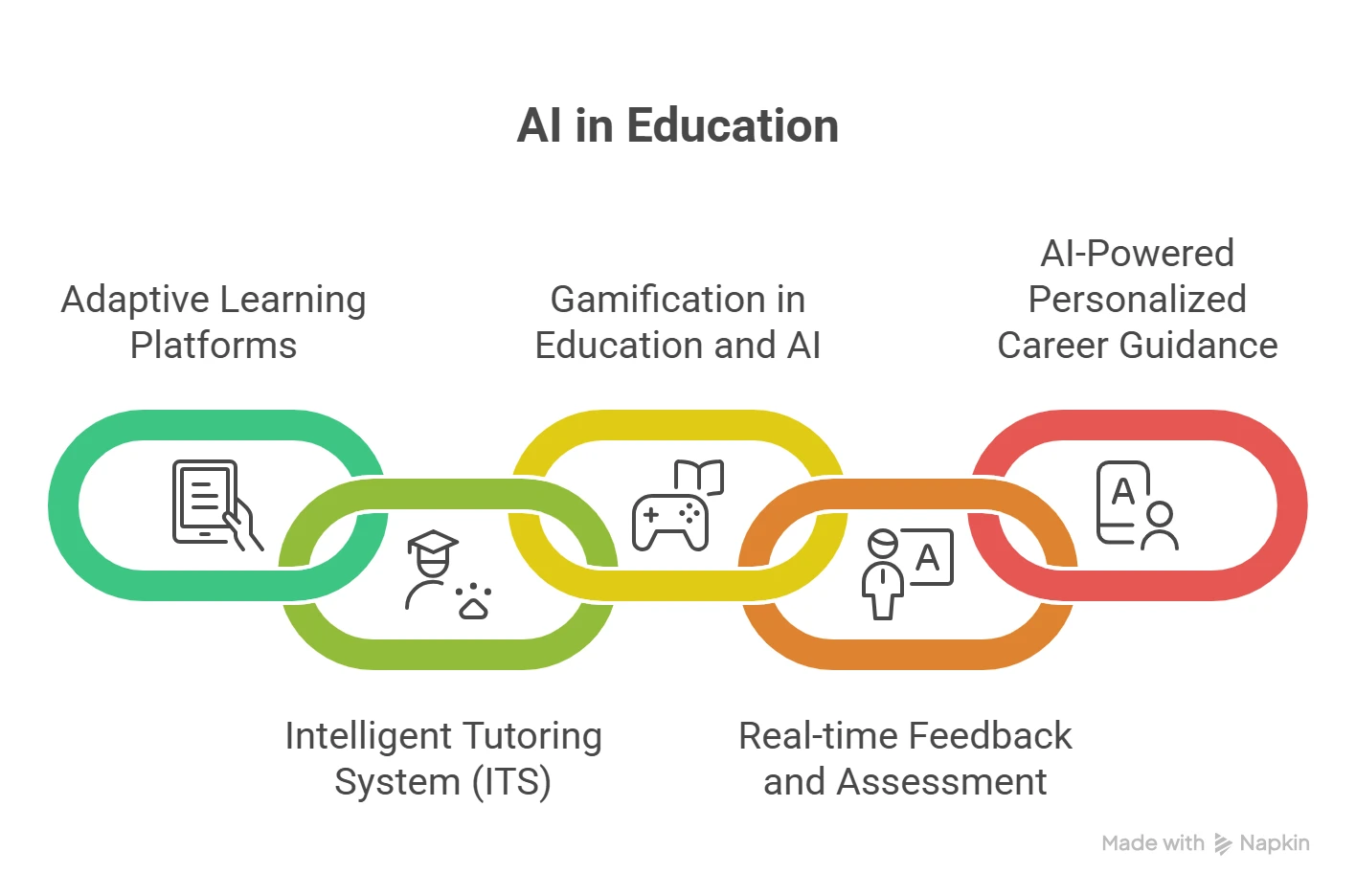
Here are the top five ways AI in K12 education can be utilized to enhance the overall learning experience:
1. Adaptive Learning Platforms
Traditional education systems often struggle to accommodate the diverse learning needs of students within a single classroom. Enter adaptive learning platforms, a groundbreaking application of AI in K12 education that addresses this challenge head-on, and the results are phenomenal.
The heart of adaptive learning lies in its ability to adjust the delivery of content dynamically. If a student excels in a particular area, the platform may advance them to more challenging material. Conversely, if a student struggles, the platform adapts by providing additional explanations or practice.
In short, adaptive learning platforms contribute to creating a more inclusive educational environment. They cater to diverse learning styles and provide a personalized curriculum, ensuring that students with different needs receive the support they require.
2. Intelligent Tutoring System (ITS)
ITS represents a sophisticated application of AI in education, aiming to emulate the personalized support provided by human tutors. The goal is to create a virtual tutor that adapts to the needs of the students and is as accurate as a human tutor.
Not only that, ITS often incorporates various modes of interaction, such as text-based explanations, multimedia presentations, and interactive simulations for conversational interactions. This multi-modal approach allows the system to adapt to the preferences of individual students.
In addition to supporting students, Intelligent Tutoring Systems generate valuable insights for educators. By aggregating and analyzing data on student performance, these systems provide educators with a comprehensive view of class-wide and individual progress.
3. Gamification in Education and AI
Incorporating elements of gamification into educational experiences, coupled with the power of AI, is an innovative way to engage and motivate learners. Gamification involves applying game design principles to non-game contexts, and when combined with AI in K12 education, it creates an interactive environment that captivates students.
AI enables gamified educational platforms to adapt challenges and rewards based on individual performance. Tailored rewards and recognition systems, such as badges, points, or virtual currency, provide immediate feedback and motivation, reinforcing positive learning behaviors.
Lastly, AI-powered gamification can facilitate collaborative learning experiences. It can also provide insights into group dynamics and individual contributions. Students can work together to overcome challenges within a game, fostering teamwork, communication, and problem-solving skills.
4. Real-time Feedback and Assessment
One of the transformative aspects of integrating AI in K12 education is the capability to provide real-time feedback and assessment. The integration of AI into assessment processes allows for instantaneous feedback, creating a dynamic and responsive learning environment.
Published in the peer-reviewed journal Educational Evaluation and Policy Analysis in May 2023, a recent study led by Stanford revealed that an AI-powered automated feedback tool enhanced instructors’ utilization of the teaching practice called uptake.
The study also presented evidence that the tool positively impacted students, increasing their assignment completion rates and overall satisfaction with the course.
AI-based assessment tools can evaluate students’ responses to quizzes, assignments, and other learning activities in real time. Apart from providing automated feedback in real-time, AI also simplifies the grading and assessment process for educators and can help teachers spend 70% less time on grading.
5. AI-Powered Personalized Career Guidance
Schools can implement Artificial Intelligence to provide personalized career guidance for students. By analyzing students’ academic performance, interests, and aptitudes, AI systems can offer tailored insights into potential career paths, recommended courses, and skill development opportunities.
Personalized guidance also helps students explore diverse career options and adapt their learning paths accordingly, cultivating a sense of purpose and direction in their academic pursuits.
This personalized approach empowers students to make more informed decisions about their educational and career journeys, ensuring that their academic pursuits align with their long-term goals.
Key AI Guidelines for the Integration of AI in K12 Education
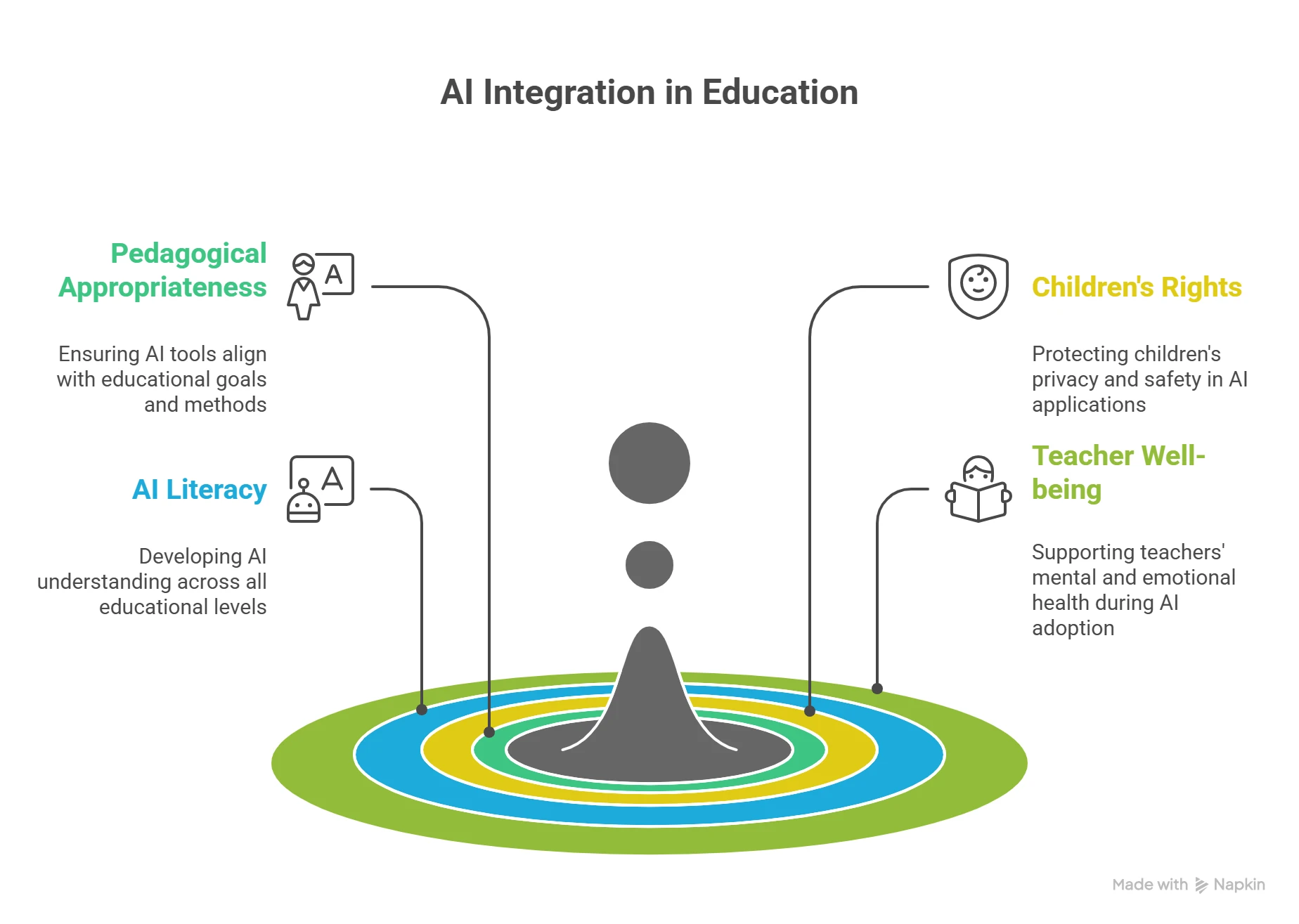
Several AI guidelines must be adhered to with the greater role of AI in the K12 education model. These are described below.
1. Institutes Must Ensure Pedagogical Appropriateness
Pedagogy refers to how teaching is disseminated to students in a learning environment. However, while the term traditionally refers to the methodology used, it also covers the wider aspects of what, why, when, and how to teach something.
Just like schools and teachers distinguish between the right and the wrong way to reach, with the best interests of the child or student in mind, the same applies to the application of AI in K12 education. Teachers and other relevant stakeholders must remember that while AI and technology can help in proactive learning and the overall development of a child, they can diminish the development of other aspects.
For example, while AI might help with a more individualistic and child-centric approach to teaching, it can also compromise their social or moral development, given the vast scope of the internet and AI as a tool. On the other hand, several studies have shown the impact of mobile devices and technology on children’s mental health.
As a result, while AI can be used to deploy useful tools like chatbots and interactive games, its utility must be balanced with the potentially harmful effects of technology and AI on children’s development.
2. AI Must not Violate Children’s Rights
The United Nations Convention on the Rights of the Child (1990) details the child’s right to a happy, healthy, and safe childhood. This is to be ensured with a lack of discrimination towards the child or their parents based on race, sex, color, language, origin, disability, politics, and so on.
With these guidelines in mind, UNICEF suggests that children can be malleable to values, attitudes, and ideas, and that these can be potential concerns when considering using AI in education. It’s essential that AI be explained in an age-appropriate manner and that it not be overused to hinder the child’s socio-emotional development. This can be achieved by limiting the use of tutor bots and ensuring that the teacher remains the primary medium of instruction.
Further, the use of AI must not trample on the child’s right to privacy, a crucial aspect of technology of any form today. However, while the right to be forgotten or the right to erasure is still to find its way into the various conventions dealing with AI and child development, the ethics of using AI concerning a child’s rights and privacy are clear.
Last but not least, the use of AI must not further the digital divide that already exists. Institutes must ensure that the implementation of AI in education benefits every single student and not a select group that happens to have access to the devices needed to leverage this technology.
3. Ensuring AI Literacy Through Every Stage of a Child’s Educational Journey
AI literacy refers to understanding the knowledge, skills, and ethics of using AI in one’s life. Aside from being able to use AI, AI literacy also refers to understanding how it can be developed, understanding biases in data, and one’s rights as a user.
The importance of AI literacy can thus be highlighted in the need for institutes to educate children on the various aspects of AI as a technology, thereby equipping them with the skills and understanding to be able to make sound decisions about the use of AI in their own lives further down the line.
However, the key aspect to remember is that a child’s AI literacy ultimately depends on their teacher’s understanding of the technology and its positive and negative implications. As a result, the inclusion of AI in K12 education must be simultaneously carried out with training and educating teachers in the use of this technology.
4. The Inclusion of AI Must not Trample on Teachers’ Well-Being
A student’s success at school is directly proportional to their teacher’s well-being. The COVID-19 pandemic revealed the stresses of changes in the workplace and the burden that the sudden imposition of technology can have on teachers across the globe.
A teacher’s well-being is often described as their ability to balance resources and challenges, be they mental, physical, social, or psychological. This balance was deeply disturbed during the sudden changes brought on by the pandemic, which now serve as an important lesson for educational institutions.
It urges educational institutions to ensure teachers are gradually equipped with the tools and resources to understand the changing technologies being used in education, such that it doesn’t disproportionately burden them and affect their well-being.
The introduction of AI in K12 education will undoubtedly increase teachers’ workload as it will be a diversion from their traditional pedagogy and individual relationships with students, while also increasing their preparation time, potentially leading to technological unemployment.
Institutes must thus ensure that teachers are well equipped to deal with these changes in a manner that prioritizes their mental health and work-life balance, so they can better help students adapt to AI. This must be integrated into their curriculum designs.
Challenges in AI Implementation for K12 Education
The introduction of artificial intelligence into K12 education, notwithstanding all its promises, faces several challenges and ethical considerations:
- Data Privacy Issues: Since AI systems require bulky data to function ideally, the problem of student data privacy arises at the top. Safeguarding such data from all sorts of breaches dictates great care in data protection and open data use policies.
- Ethical Issues: The same application of Artificial Intelligence in education will, however, come with ethical issues, most importantly regarding bias and fairness. Such systems could actually continue the existing biases. This has to be managed correctly so that the algorithms within an AI system are transparent and open to audits for bias at regular intervals.
- Bridging the Digital Divide: The digital divide remains a serious challenge when students hailing from under-resourced communities have slightly less access to AI-driven tools.
- Comprehensive Training: Effective AI integration demands that educators undergo comprehensive training. Without proper knowledge and skills, educators may struggle to utilize these technologies effectively.
- Ensuring Inclusive Technology Access: Another major challenge is developing strategies to ensure equitable access to technology. All students must have the necessary resources to benefit from AI advancements.
What are the Benefits of AI for K12 Education?
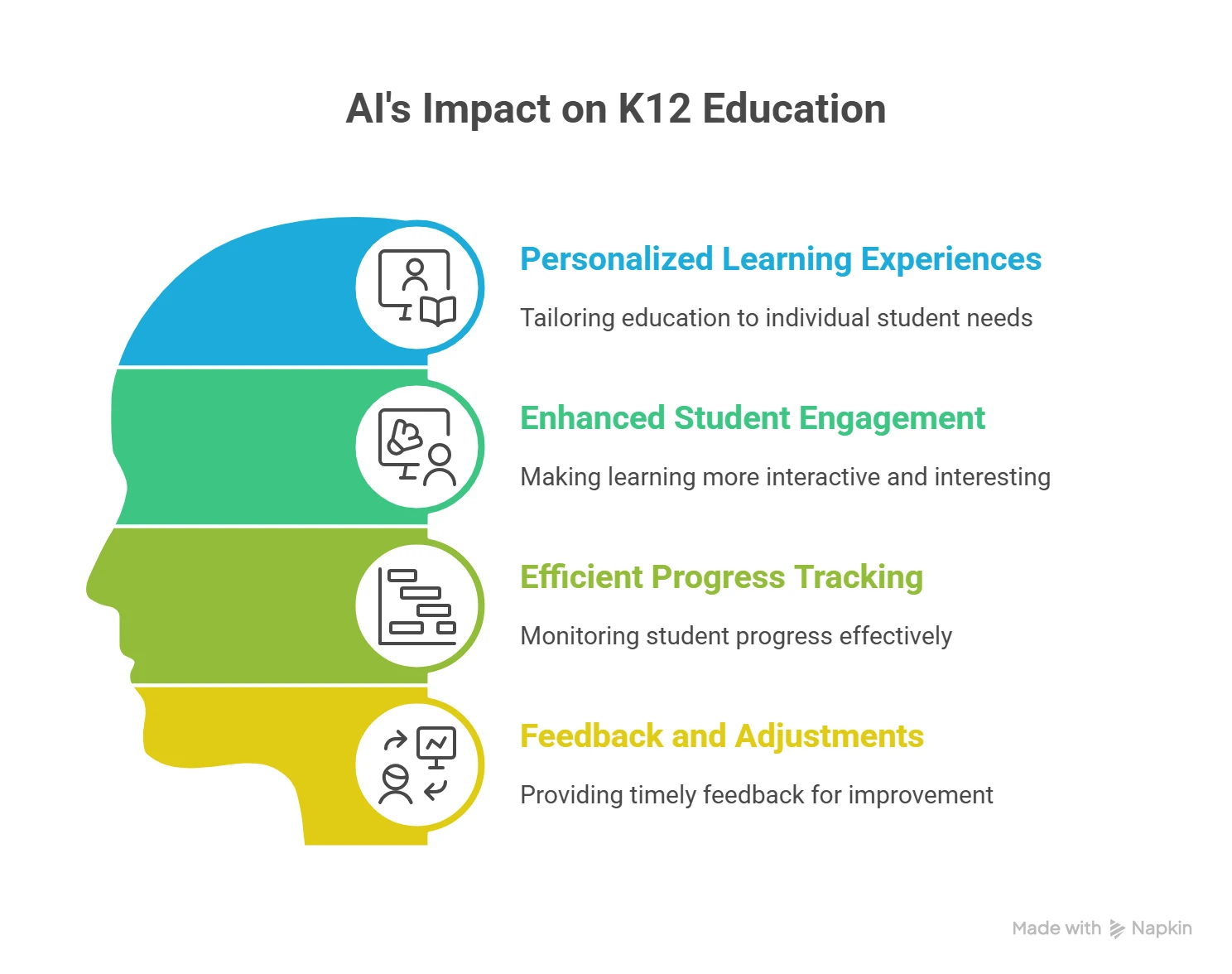
The integration of artificial intelligence into K12 education presents several transformative benefits that cater specifically to the needs of today’s digital learners and educators:
1. Personalized Learning Experiences
AI technologies stand out in their ability to create highly personalized learning paths for students. Few learning platforms use AI to adapt lessons based on a student’s responses and learning speed.
2. Enhanced Student Engagement
AI also plays a crucial role in boosting student engagement. Tools equipped with gamification elements and interactive content can turn traditional lessons into more engaging learning experiences.
3. Efficient Progress Tracking
With AI-powered education tools, educators can now track student progress in real-time with far greater accuracy than traditional methods. Tools like IBM’s Watson Education, for instance, analyze data points from student interactions to provide educators with detailed insights into learning patterns. This helps to identify areas where students might be struggling.
4. Feedback and Adjustments
AI tools keep students engaged and motivated by providing instant feedback. This immediate response to their inputs makes learning more interactive and less of a passive experience. Students are more likely to stay interested when they see that their actions have direct consequences on their learning journey.
Why Do Educational Organizations Need Ethical Principles for Artificial Intelligence in K12 Education?
As of 2024, just 52% of people surveyed by YouGov felt that K12 institutions should focus on teaching students how to use AI appropriately.
AI has the potential to revolutionize experiences and outcomes in K12 education. K12 education systems must collaborate and provide guidelines for applications of AI that are fair without foul play. Here are some key considerations:
1. Fairness and Equity
K12 education AI systems should guarantee equal opportunities to all students, irrespective of their background. K12 education AI tends to mitigate the biases present in the educational outcomes. Ethical principles guarantee educational organizations the right to design AI systems that bring about fairness by eliminating all forms of disparities in access, representation, and outcomes.
2. Student Privacy and Data Protection
With AI’s enhanced use, student data collection has skyrocketed, with concerns about privacy and security. Among these ethical principles for artificial intelligence in K12 education, sensitive information must be protected. By adopting AI-driven standards, organizations can ensure that data protection measures are robust, hence bringing faith among students, parents, and educators.
3. Promote Transparency and Accountability
The rationale behind the transparent nature of AI systems is necessary for developing trust and ensuring proper functioning in educational settings. Ethical principles provide transparency regarding how AI systems work, the data they rely on, and what decision-making logic applies. Taking such guidelines into place can be supportive in making AI processes explainable to educational organizations and stakeholders accountable for their outcomes.
4. Advocating Inclusivity and Accessibility
AI can potentially support diverse learning needs if only inclusivity is made its design core. This guidance ensures AI in K12 schooling is accessible to students with different abilities, learning styles, and languages. Ethical principles guide organizations in developing AI materials that encourage connections rather than exclusion and are suitable for an inclusive learning environment.
5. Instructing the Development of Awareness Among Students in Ethics
The ethical considerations related to AI call for the facilitation of education among students since they will face their futures. By embedding ethical principles regarding artificial intelligence into K12 curricula, schools can take forward responsible AI use while laying the foundations for students to critically examine how such artificial intelligence is applied and impacts society.
Wrapping Up
The integration of AI in K-12 education is no longer a revolution. It is rather an innovation that would change learning environments all over the world.
AI personalizes learning experiences, enhances student engagement, and streamlines administrative tasks; therefore, it enables a more inclusive, effective, and engaging educational system. As we stand on the brink of this transformative era, the opportunity for educational leaders to pioneer these advancements is immense.
To explore how AI can redefine your educational strategies and contribute to the success of your institution, visit Hurix Digital today. With cutting-edge technologies and expert solutions, we make sure your institution stays ahead in integrating AI for education, enhancing learning outcomes, and student engagement.
Connect with us to learn more!
Summarize with:

Senior Vice President
A Business Development professional with >20 years of experience with strong capability to sell new solutions and develop new markets from scratch. New Market Entry Specialist with experience working in the largest emerging markets. Exceptional experience in conceptualizing, ideating and selling new learning technologies like VR AR, etc. across multiple industry verticals.