 A Space for Thoughtful


7 Roles of Artificial Intelligence (AI) in Learning and Development (L&D)
Summarize with:
The research firm Markets and Markets predicts the AI market will grow to a $1,339.1 billion industry by 2030. So, AI is slowly becoming omnipresent in our lives. Some people are even scared of a complete AI win over humans! While that is undoubtedly an exaggeration, we have woven AI into our daily lives and activities. Even a simple search on Google now has AI providing you with answers.
AI has improved numerous businesses by performing translations, research, art creation, fraud detection, logistics optimization, and many other jobs. Hardly any industry has not profited from artificial intelligence. For instance, AI has been applied in medicine to identify fractures, cancer, and strokes. Businesses also utilize it extensively for staff training. AI tools for training and development are already widely used by companies in their learning strategies.
With such varied applications, it is no surprise that AI has been impacting the learning and development sectors. This blog will explore these impacts and how they can change the future of learning and development.
Table of Contents:
- Why is AI Important in Learning and Development?
- What Does Being “AI Ready” for Learning and Development Really Mean?
- What is the Role of Artificial Intelligence (AI) in Learning and Development?
- Practical Applications of AI in Learning and Development
- Successful Case Studies of AI in L&D
- Challenges in Integrating AI With Current Learning Platforms
- How Do You Safeguard Learner Trust and Privacy?
- How Will AI Reshape the Core Roles of L&D Professionals?
- What Does a Practical Roadmap for AI in L&D Look Like?
- Final Thoughts
- FAQS
Why is AI Important in Learning and Development?
AI is important in learning and development because it enables personalized, data-driven training at scale. By analyzing learner behavior and skill gaps in real time, AI improves engagement, accelerates upskilling, automates learning processes, and aligns workforce capabilities with evolving business goals.
AI, or artificial intelligence, is the computer system simulation of human intelligence processes. The sync between AI and learning and development can improve and augment learners’ educational experiences. For anyone navigating corporate learning, the question often boils down to this: what’s the immediate payoff for bringing in AI?
The most immediate return often manifests as a noticeable gain in efficiency and a surprising increase in learner engagement. Before AI, the default training module was often a broad, one-size-fits-all approach. Everyone sat through the same hour, regardless of what they already knew. The immediate impact of AI changes fundamentally.
Here is the contribution of AI for Learning and Development functions:
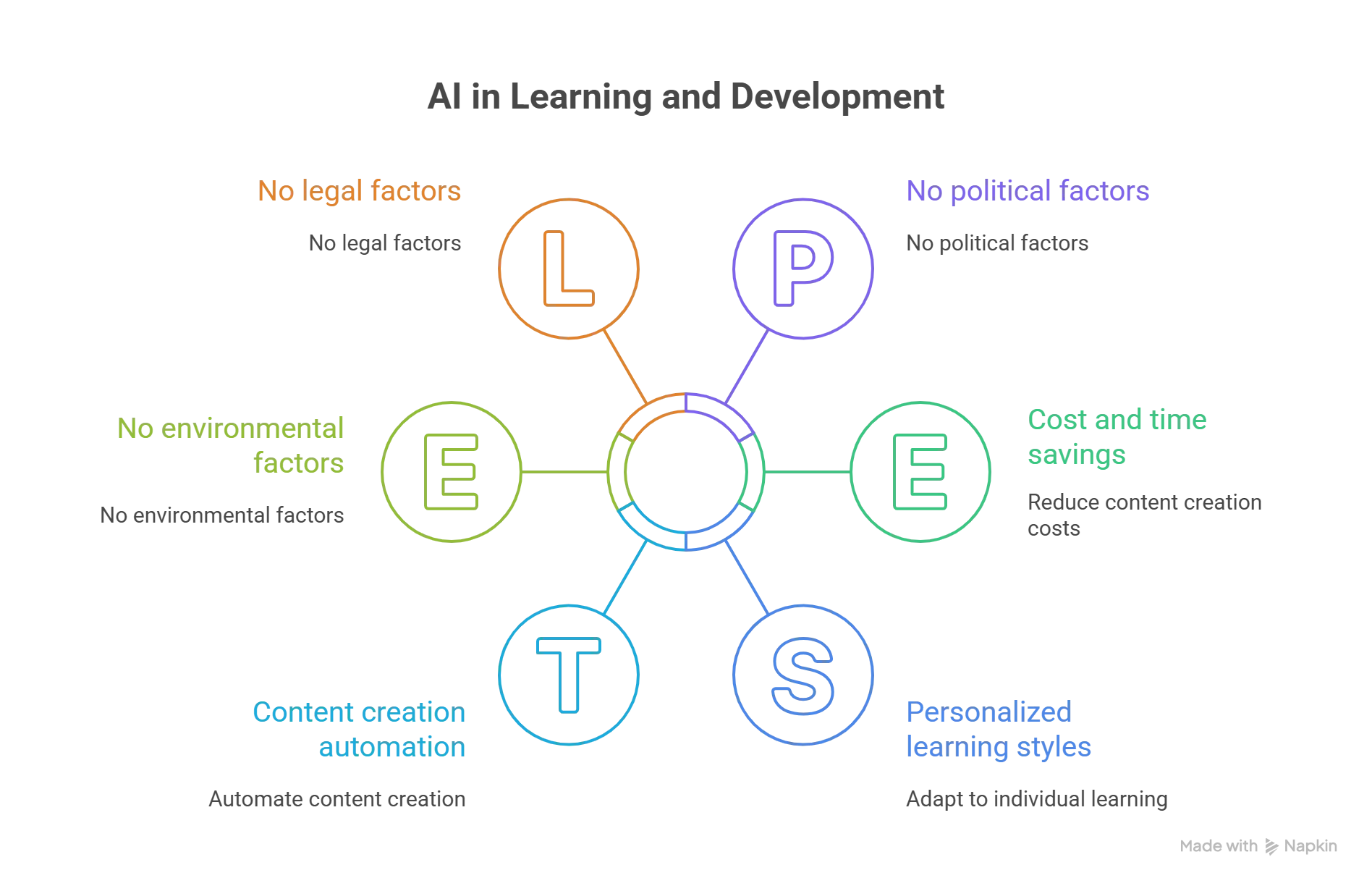
- Personalized Learning: AI makes creating unique learning experiences for every student possible. This can be achieved by evaluating students’ performance and modifying the course material or curriculum to suit their interests and requirements.
- Intelligent Tutoring Systems: AI-powered tutoring systems can provide learners with personalized feedback and guidance as they work through the curriculum. These systems can also analyze learners’ performance and adapt the instruction to their needs.
- Automated Content Creation: AI can create educational content, such as videos, quizzes, and other interactive materials. Using AI in training and development can save educators and trainers time and resources.
- Adaptive Testing: AI for Training & Development can create adaptive tests that adjust the difficulty of the questions based on the learner’s performance. This can provide a more accurate assessment of the learner’s knowledge and skills.
- Chatbots and virtual assistants: AI-powered chatbots and virtual assistants can provide learners with 24/7 support, answering their questions and providing guidance on the material.
- Predictive analytics: AI in Learning and Development can predict student performance, identify at-risk students, and provide personalized interventions to help them improve.
AI in Learning and Development is a fast-growing field, and new uses of AI in education are always being developed. AI enhances student learning, boosts training efficacy, and gives students a more individualized and effective education.
What Does Being “AI Ready” for Learning and Development Really Mean?
People toss around the phrase “AI-ready” as if it were a badge. In reality, it is less a badge and more a bundle of practical conditions. You are “ready” when adding intelligent automation, prediction, or personalization layers produces clearer workforce capability gains at a lower marginal cost than current methods, without eroding trust.
Break it down into eight observable pillars:
- Direction: An agreed set of priority capability shifts tied to revenue, risk, margin, growth, or compliance outcomes.
- Data spine: Clean, mapped, de-duplicated employee profile, role, performance, content, and skill signal feeds.
- Content shape: Modular, tagged, current, rights-cleared assets that a model can index or remix without stepping on licensing landmines.
- Common vocabulary: A pragmatic, living skill, and role taxonomy that stays coherent and maintained rather than perfect.
- Governance: Clear rules for data use, retention, model evaluation, escalation, and bias review.
- Stack extensibility: APIs, event capture, and identity management that allow orchestration rather than fragile one-off scripts.
- Change muscle: A track record of rolling out workflow-altering tools with adoption above baseline.
- Proof discipline: A habit of isolating variables and calculating contribution to business indicators, not stopping at participation counts.
If three or more of those pillars are weak, a fancy personalization engine will likely stall. AI feeds on structure and signal density. Without them, it produces plausible fluff. Mature firms treat readiness like staging a building site: clearing debris, laying drainage, and marking boundaries. It is unglamorous, yet it prevents rework.
What is the Role of Artificial Intelligence (AI) in Learning and Development?
1. Identifying Knowledge Gaps
Most enterprise learning strategies depend on holistic teaching. This means having the same course materials for all employees. However, not all employees are the same. Some may already have a skill that the job needs. So, forcing them to learn what they already know is not a very effective strategy.
AI in Learning and Development can analyze huge data sets and derive conclusions about employee training needs using machine learning and predictive analysis technologies. AI can also create learner profiles combining disparate data sources, which would take days if done manually. This automatically identifies the skills missing in your employees in a very short span.
Skill gaps in enterprises are stubborn beasts, often widened by rapid tech shifts. AI promises to bridge these gaps by identifying deficiencies and delivering targeted fixes. Its effectiveness, however, boils down to accuracy. AI excels at analyzing vast datasets and predicting needs before they arise. One content provider noted that AI can sometimes push generic content, missing industry-specific nuances, which leads to incomplete upskilling. To make it work, it’s crucial to integrate human oversight. Combining AI diagnostics with manager input helps gain a more comprehensive picture.
2. Suggesting the Most Appropriate Content
AI can identify knowledge gaps and automatically scan for the most appropriate content for the learner. We all know how that works, as we have all used Google to search for information.
Just like Google, AI can scan the Internet, LMS, your proprietary content, and other sources to auto-suggest the most relevant content. This approach saves learners time, as they don’t have to manually go through multiple pages of search results for hours. If your content stays trapped in hour-long modules with barely any useful tags, your recommendation system becomes pretty useless. It ends up suggesting broad topics like “leadership skills” instead of delivering the precise, bite-sized learning someone actually needs right now.
3. Creation of Digital Content
Creating educational content is time-consuming and challenging. For this reason, most enterprises outsource their content creation at a high cost. AI can help organizations save time and money.
We discussed how AI can source information snippets and digital resources from the Internet and other connected platforms. The same AI technology can also consolidate and present them in an easy-to-understand manner.
AI, through natural language processing, can even convert videos into text. You can convert whole podcasts, webinars, and lectures into written words without any effort. This is similar to the way YouTube provides automatic subtitles in videos.
4. Personalize Learning According to the Learner
AI can personalize learning according to the pace, age, gender, and demographics of the learner. It can also gradually release materials to the employee as she/he finish a chapter or a module.
For example, you want to train an experienced employee in customer management. AI can automatically scan the employee’s skills and skip the basic training materials to suggest advanced resources. An AI-powered system can quickly gauge a learner’s existing knowledge through a brief pre-assessment and then dynamically serve up only the specific topics that the individual truly needs. When a salesperson has mastered a product’s features, they can skip those modules and jump directly into advanced negotiation tactics.
AI technology also aligns learning with the employee’s learning style. Research has shown that each of us learns in a different style. AI can track and identify employee learning styles and optimize the learning experience for the best results. Personalized learning leads to greater retention, higher recall, and improved learning.
5. AI as a 24/7 Digital Tutor
AI eliminates the need for a human trainer to some extent. Your employees may have many questions while training or taking a new course. Most of these queries are common and standard for all learners. In traditional approaches, employees would have to ask the trainer to resolve their queries and wait for the trainer’s availability.
AI helps address these queries and even provides accurate answers. Enterprises can use AI-based chatbots to help learners get answers to the most common questions. The entire process is conducted through human conversation, just as you would with a customer care representative.
6. Seamless Assessments and Instant Feedback
With AI, enterprises do not need human efforts to assess learning. AI-driven tools can gather information, evaluate performance, check answer sheets, and provide accurate results. Employees can get feedback instantly and learn how they perform.
AI can be used to deliver any assessment as long as it’s digital. You can develop various assessment techniques and deliver them to your employees. Additionally, AI can even help personalize assessments. Most tests or quizzes are created based on a ‘one-size-fits-all’ approach. They don’t consider IQ, skills, or other such factors.
Using AI, employees can take tests based on their capabilities, skills, and learning levels. This creates a more accurate performance evaluation system and eliminates situations where some find the test too hard and others too easy.
7. Developing Crucial Insights
Here’s how AI can gain important insights for you:
- AI can mine LMS data and employee performance, collect feedback, and facilitate a range of analytics.
- Enterprises can use the data to form insights into their learning and development.
- AI finds out the effectiveness of courses, areas for improvement, and crucial trends and patterns.
- The insight gained from using AI in training and development helps you refine your content and courses.
- AI collects data continuously so that you can always make informed business decisions.
Practical Applications of AI in Learning and Development
Artificial intelligence in training and development has revolutionized the operations of L&D departments, allowing for more efficient, personalized, and scalable solutions. Discover some of the practical applications where AI is making a significant impact:
1. AI for Content Personalization
AI tailors learning paths to fit each employee’s unique profile, assessing their progress and recommending personalized content that aligns with their learning needs. Platforms like LinkedIn Learning use AI for learning and development, suggesting courses tailored to job roles, past learning experiences, and skill gaps.
2. Enhanced Learning Analytics
The power of AI to analyze extensive datasets enables organizations to uncover valuable insights into learner behavior, engagement, and outcomes. Moodle, an AI-powered learning management system, can predict learner performance and provide suggestions to enhance their experiences.
3. Training in Virtual Reality (VR) and Augmented Reality (AR)
AI for training and development helps create immersive training experiences using VR and AR technologies. Companies like Walmart employ VR headsets to create immersive real-world scenarios for employee training, boosting learning retention and readiness.
4. Automated Content Creation
AI in training and development makes it easier to produce training materials by streamlining tasks like quiz generation, content summaries, and assessments. Many platforms empower L&D teams to produce AI-generated videos for employee training, significantly cutting down on content creation time.
5. Language Translation and Accessibility
AI-powered translation tools like Baidu make learning accessible by overcoming language barriers. These tools use deep learning to precisely translate training materials, allowing organizations to connect with a worldwide audience.
Successful Case Studies of AI in L&D
Numerous organizations have successfully harnessed AI for learning and development, highlighting its transformative potential.
1. Cohesity’s AI-Powered Training Videos
Cohesity, a data management company, used an AI called Synthesia AI to produce training videos efficiently and at scale. They automated the video production process, leading to an incredible 200% increase in viewer engagement. On the flip side, the company significantly reduced its production timelines. Such an innovative AI-driven approach allowed subject matter experts within the company to easily create videos. As a result, retention rates improved, and training cycles were shorter.
2. Microsoft’s Accessibility Solutions
Microsoft has designed tools such as Seeing AI to assist individuals with disabilities in participating in more inclusive learning environments. With its help, visually impaired users can learn about their surroundings, texts, and people. Of course, the tool has also assisted its users in successfully participating in digital training.
Challenges in Integrating AI With Current Learning Platforms
Legacy learning management systems weren’t built for AI. They’re databases with user interfaces, designed to track completions and serve content. The technical hurdles start with data formats. Most LMS platforms store information in ways that make sense to humans, not machines.
APIs present another headache. Modern AI tools expect to exchange data freely with other systems. In many learning platforms, APIs are limited and outdated, restricting the flow of data. IT departments find themselves building custom middleware to translate between systems. It works, but it’s fragile and expensive to maintain.
Then there’s the mismatch in user experience. Employees expect AI to work seamlessly and intuitively. Instead, they often get AI-based features that are disconnected from their day-to-day activities. Performance issues compound these problems. AI processing demands significant computational resources. Learning platforms designed for occasional logins struggle when AI constantly analyzes user behavior. Response times slow down, and systems can crash during peak usage.
How Do You Safeguard Learner Trust and Privacy?
Trust is earned by design, not by reassurance emails. Learners worry: “Who sees my assessed gaps? Will this label freeze my progress?” Address those fears concretely. Here’s a blueprint:
- Data Minimization: Collect only signals with a clear link to defined use cases. Document the linkage publicly: “We capture search queries to improve relevance. We do not store them with performance ratings.”
- Layered Consent: Provide opt-in toggles with plain language for sensitive categories (e.g., manager comments ingestion).
- Bias Review Loop: Define protected attributes and run periodic disparate impact analysis on recommendation exposure and assessment outcomes. Include a mitigation playbook.
- Explainability: Expose “Why recommended” snippets referencing explicit attributes (“Suggested because you completed X and your role requires Y”).
- Human Override: Allow managers to annotate or correct inferred skill levels; these overrides can feed back into model tuning.
It’s also essential to address specific fears directly. Worried about job displacement? Show how AI augments rather than replaces human roles. Concerned about data misuse? Demonstrate robust privacy protections. Anxious about performance monitoring? Clarify that AI supports development, not surveillance. When people feel in control, resistance drops dramatically.
How Will AI Reshape the Core Roles of L&D Professionals?
When we talk about AI seeping into the core of L&D, it’s not about machines taking over. This feels more like a quiet evolution, a recalibration of what learning professionals spend their days doing.
Think about the instructional designer. For years, their craft has been about building modules and writing scripts. Now, imagine AI handling the first draft of a basic compliance course. Their energy shifts from content creation to curating, refining, and ensuring the tone lands right—injecting the human element. The goal becomes less about churning out content and more about architecting profound learning experiences.
AI can handle repetitive FAQs or deliver standardized micro-learning bursts. But picture a challenging workshop where emotions run high or group dynamics derail a discussion. That’s where the human facilitator shines. They’re the empathic guide, the intuitive coach who reads the room and fosters real relationships. AI frees them from the rote delivery of content, allowing them to focus on coaching and the messy, human interactions essential to transformative learning.
What Does a Practical Roadmap for AI in L&D Look Like?

A pragmatic roadmap sequences groundwork, credibility wins, scale moves, and refinement loops. Below is a pattern for firms moving from fragmented experimentation to a recognized internal value engine.
Months 0-3 (Foundation)
- Run a candid maturity assessment.
- Map data and create a remediation plan (deduplicate employee records, baseline tag coverage).
- Select two high-probability use cases (e.g., semantic search uplift).
Months 4–6 (Pilot & Proof)
- Deploy semantic search with a clear success metric (query success rate).
- Launch an adaptive practice pilot for a targeted skill set.
- Establish model/prompt version control.
Months 7–9 (Trust & Expansion)
- Publish the first impact brief (e.g., search time reduction).
- Begin skill inference enrichment using work artifacts.
- Build a living skills graph service (ingest baseline taxonomy).
Months 10–12 (Integration)
- Embed recommendations inside one core workflow tool.
- Extend adaptive logic to a second role family.
- Launch a dashboard showing capability movement.
Months 13–18 (Scale & Optimization)
- Expand skill inference coverage to broader roles.
- Introduce path pruning to reduce redundancy for experienced employees.
- Pilot real-time workflow micro-coaching in a limited domain.
Months 19–24 (Pioneering)
- Integrate predictive early warning signals (e.g., plateau alerts) into manager dashboards.
- Launch adjacent skill growth pathways for internal mobility.
- Refine governance with annual external reviews.
Final Thoughts
No one can doubt the potential of Artificial Intelligence (AI) in revolutionizing the learning and development sector. Many enterprises are already capitalizing on its power to speed learning and enhance engagement. AI allows rapid knowledge transfer and boosts efficiency, interaction, and recall, making it a game-changer. With AI capabilities, companies can create personalized and dynamic learning experiences, leading to higher knowledge retention and a more skilled workforce.
The organizations winning this game won’t be those throwing money at every shiny AI tool. They are the ones who will start small, learn fast, and scale smart. Most importantly, they’ll partner with providers who understand that behind every algorithm is a human trying to grow. At Hurix Digital, we’ve been helping enterprises navigate this exact journey with our workforce learning solutions.
Get in touch with us to implement AI-based workforce learning solutions and future-proof your organization’s learning ecosystem.
Frequently Asked Questions (FAQs)
Q1: How can organizations measure the return on investment (ROI) of using AI in L&D?
While AI promises efficiency and personalization, measuring its impact is key. Organizations can evaluate ROI through metrics such as reduced time to competency, improved assessment scores, increased course completion rates, time saved on administrative tasks, and correlations between learning outcomes and business performance indicators like productivity or retention.
Q2:What skills do L&D professionals need to effectively leverage AI tools?
To work effectively with AI in L&D, professionals should develop skills like data literacy (interpreting analytics outputs), AI tool fluency (understanding how to operate and integrate AI platforms), instructional design with AI augmentation, and ethical awareness to ensure fair, unbiased learning experiences. Insights from practitioner communities emphasize that AI complements existing expertise rather than replacing it.
Q3: What are the data privacy and security considerations when using AI in corporate training?
Using AI in L&D often involves processing learner data (e.g., performance metrics, behavioral insights). Organizations must ensure compliance with data protection regulations by implementing secure storage practices, anonymizing sensitive data where possible, obtaining learner consent, and regularly auditing models and data flows for risk. Clear governance frameworks help safeguard learner privacy and build trust.
Q4: How does AI impact the role of instructional designers and human trainers?
AI is not meant to replace instructional designers or trainers but to augment their capabilities. Designers can leverage AI to speed up content creation, generate adaptive pathways, and analyze learner data. Human trainers can focus on complex facilitation, mentoring, and strategic learning initiatives that AI cannot handle effectively, such as emotional engagement and contextual nuance.
Q5: What are some common implementation challenges when integrating AI into existing learning platforms and LMSs?
Common obstacles include data silos that prevent effective personalization, lack of AI-ready content tagging, resistance from learners or trainers unfamiliar with AI tools, integration difficulties between legacy LMS systems and AI engines, and ensuring that AI recommendations align with strategic learning goals. A thoughtful implementation roadmap with pilot phases and governance helps overcome these.
”
Summarize with:

Chief Learning & Innovation Officer –
Learning Strategy & Design at Hurix Digital, with 20+ years in instructional design and digital learning. She leads AI‑driven, evidence-based learning solutions across K‑12, higher ed, and corporate sectors. A thought leader and speaker at events like Learning Dev Camp and SXSW EDU