 A Space for Thoughtful

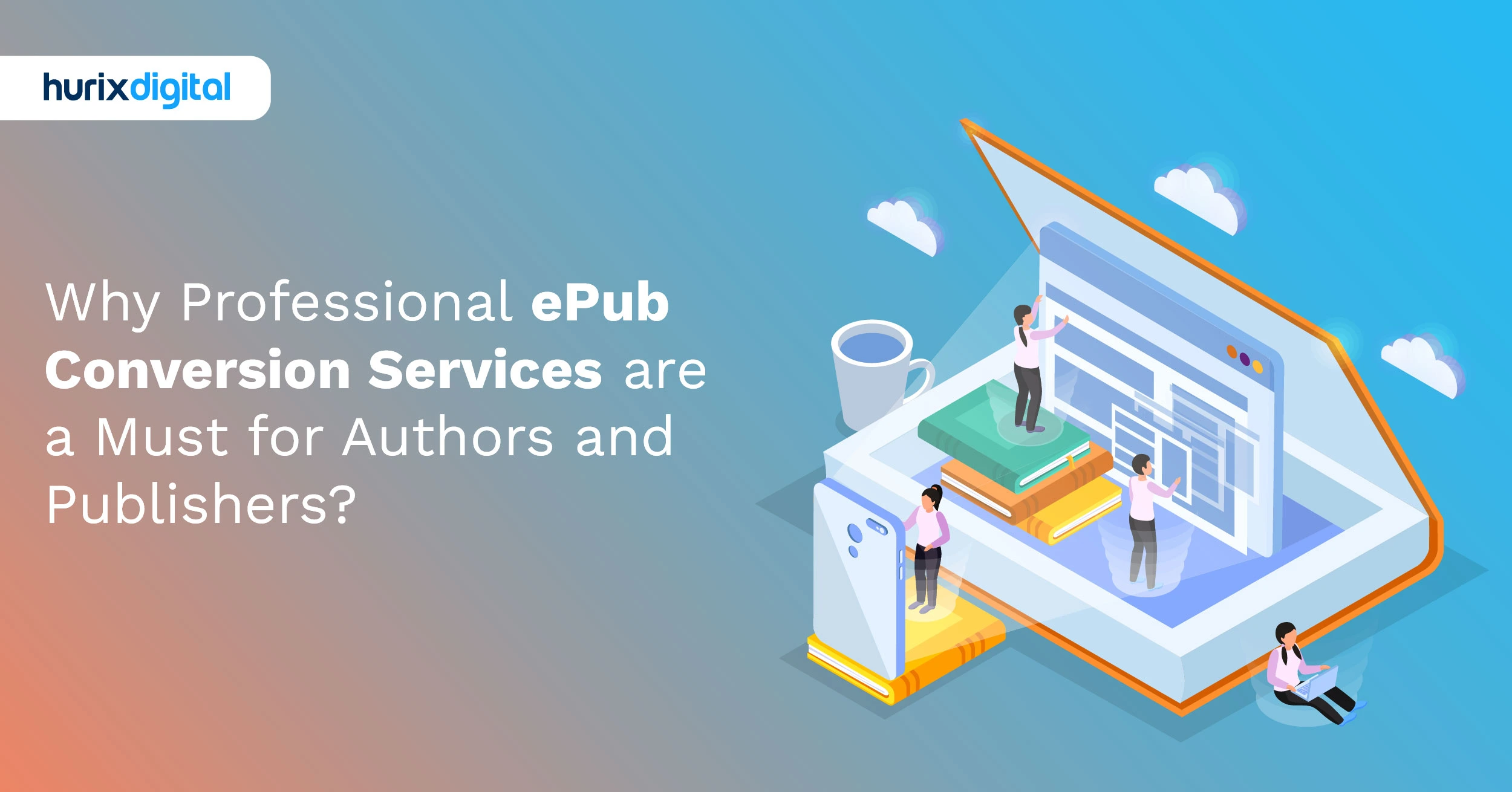
Why Professional ePub Conversion Services are a Must for Authors and Publishers?
Summarize with:
ePUB is now a standard electronic publication format that is compatible across devices. The final stage of its development is ePUB3 conversion, which offers more interaction, accessibility, and integration with multimedia files. You generally use epub3 conversion services for this.
The publishing industry is revolutionizing, and digital formats are becoming the preferred format of learners and readers worldwide. The global eBook market is expected to grow by $12.40 billion from 2023 to 2028, growing at a CAGR of 10.08%. EBook readers are expected to grow to 1.1 billion by 2027.
This shows the increasing demand for high-quality eBooks, which makes ePUB conversion services indispensable for publishers.
Outsourcing ePUB conversion services empowers publishers to manage extensive backlists, improve multimedia and integration, and launch new titles to convert content economically and with high quality.
Let us explore the leading benefits of outsourcing ePUB conversion services and the differences between ePUB and ePUB3!
Table of Contents:
- About ePUB Evolution
- What is an ePUB File?
- What is a PDF File?
- What are eBook Conversion Services?
- Why Do You Need ePUB Conversion Services as a Publisher?
- How Can Existing Content Be Converted Into the ePUB3 Format?
- A Comprehensive Guide to ePUB3 Conversion Services
- How to Choose the Best ePUB Conversion Services for Publishers
- Advantages of Outsourcing ePUB Conversion Services for Publishers
- Conclusion
About ePUB Evolution
The International Digital Publishing Forum (IDPF), which merged with the W3C, developed and maintained the EPUB format. Here are the different phases of ePUB evolution
- EPUB 1.0 (2007) was introduced as a successor to the Open eBook format.
- This was followed by ePUB 2.0 (2007-2011), the most popular version adopted to better support reflowable text.
- In 2011, ePUB 3.0 was launched to support modern web technologies.
- In 2017, ePUB 3.1 was established, with minor refinements from 3.0 and enhancements to accessibility features under WCAG standards.
- ePUB 3.2 in 2019 is the latest version of the book, which has improved backward compatibility.
What is an ePUB File?
ePUB, which is short for electronic publication, is an eBook format that uses the ‘.epub’ file extension. It is highly flexible and adjusts the font and page size automatically depending on the reading device in use.
This allows readers to have a tailor-made reading experience regardless of the device they are using. This same flexibility is not offered by PDF files; hence, one of the main reasons publishers and readers are constantly on the lookout for ePUB conversion services.
What is a PDF File?
PDF, which is short for portable document format, is a globally recognized format for digital documents. However, PDF files are not reflowable, i.e., they cannot adjust themselves to the reading device and screen.
For instance, if you read a PDF designed for a laptop screen on your tablet, you will need to pinch and zoom the document to read it. On the other hand, an ePUB file will automatically resize itself.
What are eBook Conversion Services?
A comprehensive method of converting physically published books into online books is called eBook or ePUB conversion services.
eBooks have gained immense predominance in recent times, and their demand is constantly increasing as people move from physical to online or digital forms.
In addition, books are extensive learning materials that influence every person’s life and provide a wealth of knowledge and enlightenment to help readers cope with their active lives.
So, to help people gain valuable insight, various publishing houses have now started releasing their eBooks and physical books simultaneously. While many think eBooks miss the feel factor, this is not the reality. eBooks published in various formats make things much more uncomplicated.
Moreover, scrolling through pages is much more seamless than turning each one individually. Due to the relatively simple production process, eBooks are also far less costly than physical books in terms of price.
Given eBooks’ countless benefits, many online platforms have urged seasoned and beginner writers to showcase their writing aptitudes by writing and distributing their eBooks.
However, no matter how compelling and engaging your eBook’s content is, badly formatted eBooks and texts may not be worth the time and investment for many readers.
In worst-case scenarios, you can also lose readers if they are not interested in examining your eBook’s design. Thus, the ideal option is to work with corporations that have vast experience in formatting eBooks and are renowned for their expertise in eBook design.
When you work with reliable providers for ePUB conversion services, you can be sure to offer a delightful experience to readers. Due to their technical expertise, a good eBook design service provider can assist you in improving the audio and video content of eBooks, enhancing their quality. They make reading the eBook seem engaging and memorable for the reader.
Furthermore, companies can rely on ePUB service providers to convert a book or business manual into eBooks. The best part? The eBook formats designed by the ePUB outsourcing service providers are compatible with Android and iOS devices.
Why Do You Need ePUB Conversion Services as a Publisher?
Statistics reveal that the eBook industry is expected to grow by 3.7% annually. Hence, as a publisher, you need to offer reflowable content to your readers.
The market is huge and highly competitive. It takes very little for readers to switch their services, costing you a customer. Hence, ensure you offer customers what they need, especially reading files that adjust according to their screen size.
Here are some other benefits you must keep in mind regarding ePUB conversion services.
1. Add Interactive and Fun Functionalities
An ePUB file offers not only screen size adjustability but also many other customization options. You can add interactive and fun elements, like URLs, audio, videos, stickers, GIFs, etc.
This feature is highly beneficial if you are in the business of publishing eBooks in the education sector for students. Through this feature, you can make learning and teaching fun for students and teachers.
Even PDF files offer some of these extendable features, but the output with ePUB files is much smoother and glitch-free.
2. SEO-Friendly ePUB Files
As we mentioned above, ePUB files are highly customizable, allowing you to add as many internal and external links as you want. This way, you can make your ePUB content SEO-rich.
In the long run, it will benefit your publishing business and allow users to search for your books easily and quickly. Recognizes Multiple Languages. The world is a diverse place, and numerous languages coexist. ePUB files allow you to reach this diverse audience seamlessly by providing global language support.
As they can handle multiple flows and alignments, every language can be adapted to ePUBs. If you are especially planning to tap into the international market, you need to find efficient and reliable ePUB conversion services. High Security and Safety DRM, i.e., Digital Rights Management, ensures legal access to all digital content. It uses software testing tools, compliance guides, and access control technologies to guarantee a fair distribution of copyrighted work in the digital universe.
How Can Existing Content Be Converted Into the ePUB3 Format?
You can refer to this guide, which provides a step-by-step process for designing accessible ePUB files. However, if you want to convert your existing files in MOBI or PDF to ePUB3 format, you do not need to start building from scratch; follow those easy steps.
This is how an ePUB3 conversion tool can be of help in converting your existing content into the ePUB3 format:
1. Choose an Appropriate Conversion Tool
Several tools are available today to help you convert your content into ePUB3 format. The top ePUB3 conversion tools are HurixDigital, KITABOO, Calibre, Sigil, and Adobe InDesign. Some of these tools are free, while others require a paid subscription or a one-time purchase.
2. Get Your Content in the Right Format
Before converting your content, it’s essential to ensure that it is properly formatted and structured. This may include fixing formatting issues, adding headings and subheadings, and ensuring that images and multimedia content are correctly embedded.
Some ePUB3 conversion tools can only convert particular formats into the ePUB3 format. For example, converting XML to ePUB3 will require different processes and tools.
Therefore, make sure you choose software that allows you to convert multiple formats into ePUB3. This may include converting PDF, Microsoft Word files, XML, scanned copies, manuscripts, hard copies, and others to ePUB3 so that it can be used for a range of use cases.
3. Convert Your Content
Once you have designed your content and chosen a conversion tool, you may begin the conversion process. The steps will vary from one tool to another, but you will typically need to upload your content and follow the prompts provided by the tool as it converts your content into ePUB3 format.
4. Check and Edit Your ePUB3 File
After converting your content, it is important to check the output for errors and formatting issues. Ideally, you should make edits to the content and ensure it is error-free and formatted as per your requirements. It is also recommended to utilize an ePUB3 formatting service to ensure proper formatting on multiple devices so that it is easy to read and interact with.
5. Publish and Distribute your ePUB3 File
Once your ePUB3 file is error-free and well-formatted, you can publish and distribute it on digital platforms. These include Amazon Kindle, Apple Books, KITABOO, and Google Play Books. A good practice includes checking each page for being optimal for the chosen platform, and an unlikely error can sometimes be introduced when one uploads the file to these platforms.
Overall, converting existing content into ePUB3 format can be relatively simple with the right tools and preparation. However, it is essential to remember that the quality and effectiveness can vary, making it vital to thoroughly check it before publishing it.
A Comprehensive Guide to ePUB3 Conversion Services
As ePUB3 attempts to become the norm in e-publishing, maintaining accessibility and readability across platforms and devices is becoming a challenge.
- ePUB3 supports global language support, an important functionality in a connected world.
- It also supports fixed-layout content, which makes it the perfect format for graphic-heavy publications like comics and magazines.
- It can embed fonts, which render consistently across devices and reading apps.
All in all, it is the ideal candidate for the publishing industry, which is striving to be more and more inclusive.
So what are the steps one can take to ensure consistency in ePUB3 conversion services? Let’s find out.
1. Adherence to Standards
ePUB3 conversion services should adhere to the International Digital Publishing Forum (IDPF) standards.
IDPF is the forum that developed and is charged with maintaining ePUBcontent publication standards. Following their rules allows for interoperability across devices and platforms.
2. Source Formats
Formats such as MS Word, PDF, Quark, InDesign, RTF, 3B2, XML, HTML, and a few others are heavily relied on across reading communities all over the world.
All ePUB3 conversion services need to adhere to these formats.
3. Reflowable Content
ePUB3 conversion services should ensure that the content is reflowable. Reflowable content means that text, images, and other media will fit across different-sized screens and devices.
This offers a seamless reading experience across a spectrum of devices.
4. Flexible Text Formatting
ePUB3 conversion services need to have a dynamic text formatting option.
- This will allow a reader to change fonts, font size, line spacing, etc., based on personal needs and preferences.
- Changing font sizes and being able to change color and contrast are essential assistive technologies for those with visual disabilities.
5. Responsive Images
Responsive images can adjust their dimensions without losing clarity. This is exactly what ePUB3 needs as a format that is used across various devices and screen sizes.
6. Hyperlinks and Navigation
Preserving and enhancing hyperlinks and other navigational elements is key to maintaining proper navigation.
- This includes elements like tables of contents, chapter connections, cross-references, and internal and external hyperlinks.
- Navigation also means allowing users to forward or rewind multimedia elements and perform other actions on them.
7. Accessibility Features
15% of the world’s population has some sort of disability. To ensure accessibility for all, ePUB3 needs to have features in addition to responsive texts for visual disabilities.
- This includes allowing text-to-speech capabilities for the hearing impaired or alt text to describe visual multimedia elements, such as images, to those who cannot properly see them.
- Maintaining separate style sheets that sync interactive features like audio and video is essential to supporting those with cognitive disabilities.
8. Logical Reading
ePUB3 conversion services should ensure logical reading by maintaining the flow and structure of the original document. What that essentially means is:
- The conversion preserves the structure of the original documents, such as chapters, sections, and subsections.
- The sequence of elements is always preserved.
- The formatting for headings, subheadings, paragraphs, bullet points, image borders, etc. is consistent throughout the ePUB3 file.
- A table of contents, bookmarks, and hyperlinks are maintained for easy navigation.
- Finally, all interactive multimedia elements in the document are preserved to provide the same experience in ePUB3 format.
9. Quality Control
Strict quality control is the norm for every finished product today. A thorough quality check can only ensure accuracy, consistency, and security for accessible and readable ePUB3 conversion services.
Validation tools such as ePUBCheck 3.0, which is also the official conformance checker for ePUBpublications should be used before publishing any manuscript.
10. Web Accessibility in ePUB3 Conversion
The World Wide Web Consortium (W3C) is the body that publishes standards in digital publishing. ePUB3 was also published by then.
They have laid out some standards to ensure web accessibility for ePUB3 through a few specific guidelines:
- Semantic HTML should be used whenever possible to assist text-to-speech. Semantic information can be added using the “EPUB: type.”
- UTF-8 should be used for the interoperability of characters and MathML to represent complex equations for screen readers.
- Appropriate metadata must always be added.
- All text must be organized in a logical reading order.
- Relying only on visual cues is not acceptable, as it is not disability-friendly.
- Alt-text descriptions must be used for images.
- An ePUBAccessibility Audit must be conducted to ensure that your ePUBfiles meet accessibility standards and requirements, such as Section 508, WCAG 2.0, WCAG 2.1, WCAG 2.2, or ADA3.
Check out EXCLUSIVE: HurixDigital Converts XML Files to HTML and Publishes 250,000 Backlist Titles
How to Choose the Best ePUB Conversion Services for Publishers
Selecting the right ePUB conversion services is critical to provide quality, efficiency, and dependability. There is a set of criteria on which this depends:
1. Expertise and Experience
Choose ones who are proven in eBook conversion and have experience in delivering ePUB3 conversion. Ask about their exposure to complex file formats and mega projects.
2. Technological Capabilities
Ensure the provider uses the latest tools and technologies for ePUB optimization. Check if they can integrate multimedia, DRM capability, cloud-based services, accessibility compliance, and validation testing.
3. Portfolio and Client Testimonials
Review previous projects, case studies, and client feedback to assess the reliability and quality of the service.
4. Accessibility Compliance
Select a provider who complies with accessibility standards all over the world such as WCAG 2.0, providing the benefit of accessible reading.
5. Customization and Flexibility
Choose suppliers who provide personalized services according to your needs. It may be a reflowable format, fixed layout, or interactive ePUB3 features.
6. Delivery Time and Support
Consider their speed in delivering orders and their level of support after the initial order in case of revisions or technical issues.
7. Price Transparency
The price quotes should be clear and have no hidden costs. Compare quotations and evaluate value for money.
Considering all these factors, a publisher can join hands with the best ePUB conversion services provider to facilitate smooth workflows and deliver advanced and secure eBooks to the audience.
Advantages of Outsourcing ePUB Conversion Services for Publishers
With ePUB conversion services, publishers can streamline production workflows and deliver enriched digital content to readers and learners worldwide. Here are the key benefits of ePUB optimization:
1. Cost-Effectiveness
Conversion of ePUBs into other formats through outsourcing reduces the cost of operation since:
- Specialized ePUB conversion tools are very costly to license for publishers. Professional ePUB3 conversion services use their resources.
- Training in-house personnel on complex ePUB standards, such as ePUB3 conversion for interactive eBooks, is time-consuming and costly. Outsourcing means the publisher only pays for the work rather than hiring dedicated ePUB professionals.
2. Focus on Competencies
Outsourcing empowers the publisher to focus on high-level priorities, such as:
- Creation of superior, top-quality, and attractive content for readers.
- Promoting eBooks to audiences using advanced strategies through digital marketing, social media, and other advertisements.
- Reaching markets worldwide on various platforms.
3. Speed of Delivery
Outsourcing companies have a skilled workforce that can work on tight schedules without compromising quality. Their optimized workflows ensure publishers that:
- Their scripts are converted into ePUB formats faster.
- Large back catalogs can be digitized in weeks, rather than months.
4. Latest Technology
Outsourcing agencies use the latest technology software, tools, and platforms, and offer the following benefits:
- Support rich multimedia, interactivity, and responsive designs.
- Process automated quality checking, indexing, and error detection for accurate formatting.
- Ensure eBook optimization and compatibility across multiple formats – ePUB, MOBI, and PDF ensure enhanced reading experiences on varied devices.
5. Scalability and Flexibility
Outsourcing is scalable and flexible and helps publishers in adjusting the production volume depending on demand.
For instance, a publisher launching a new series globally can scale up operations without needing temporary staff by outsourcing ePUB conversion services to a professional. This saves him time and overhead costs.
6. Higher Quality and Reliability
Seasoned ePUB outsourcing partners produce error-free eBooks with advanced software for:
- Removing layout problems, incorrect fonts, and image placement.
- Ensuring ePUB files pass industry-standard checks, like IDPF guidelines.
7. Increased Accessibility
Accessibility features are integrated to ensure the provision of products according to international standards, including WCAG 2.1 and Section 508. Such features include:
- Screen reader compatibility
- Alt text for images
- Structured navigation
8. Specialized Skills and Expertise
Outsourced ePUB conversion services provide:
- Complex content such as scientific journals, mathematical formulas, or interactive children’s books.
- Content in multiple languages, ensuring international accessibility.
9. DRM Capabilities
Security of eBooks is utmost. Professional outsourcing providers for ePUB conversion services can protect content from piracy, cyber theft, and unauthorized usage. Here are some benefits:
- They follow strict data security protocols and protect content during conversion and delivery.
- They use encryption, watermarking, and others to protect the content and build monetization capabilities for publishers.
Conclusion
ePUB evolution and significance of ePUB vs. ePUB3 conversion has transformed the publishing industry. It now brings interactive and accessible content to learners and readers. Outsourcing ePUB conversion services allows publishers to focus on their operations and costs and ensure quality output.
Through Hurix Digital, you can ensure the highest-grade ePUB conversion solutions customized to your needs. With expertise in advanced technologies, accessibility compliance, and multimedia integration, Hurix Digital provides publishers with enriched digital delivery.
Talk to the experts to find out how eBook conversion services can help in growing your publishing business.
Summarize with:

Vice President – Content Transformation at HurixDigital, based in Chennai. With nearly 20 years in digital content, he leads large-scale transformation and accessibility initiatives. A frequent presenter (e.g., London Book Fair 2025), Gokulnath drives AI-powered publishing solutions and inclusive content strategies for global clients