 A Space for Thoughtful

How to Keep K12 Students Engaged in Online Learning Environments?
Summarize with:
The shift to online and blended learning has presented educators worldwide with new challenges and opportunities. While virtual education offers numerous benefits, a primary concern for many teachers is maintaining high levels of student engagement. Distractions are plentiful in a digital environment, making it crucial to create an immersive and motivating learning experience. This comprehensive guide explores the importance of engagement in K12 online learning, addresses common challenges, and provides proven strategies, activities, and best practices to captivate young learners and elevate your teaching.
Table of Contents:
- The Importance of Engagement in K12 Online Learning
- Common Challenges in Engaging K12 Students Online
- Best Practices for Engaging K12 Students in Online Learning
- 10 Engaging Online Learning Activities for K-12 Students
- Conclusion
The Importance of Engagement in K12 Online Learning
Creating an environment of high engagement is essential for successful online education. When students are actively involved, they are more likely to succeed academically and develop a positive association with learning. Here’s why fostering engagement is so critical:
- Boosts Motivation: Higher levels of engagement are crucial to keeping students motivated. The more a learner is invested in a lesson, the more driven they are to participate and perform well. Motivation is a direct byproduct of high engagement.
- Enhances Learning and Retention: An engaged student absorbs information more effectively, leading to better retention of concepts. This is vital for helping them progress smoothly through a course without needing to frequently revisit topics.
- Improves Assessment Performance: Better engagement leads to better performance on assessments. It enhances a student’s concentration and focus, which in turn strengthens their critical thinking and problem-solving skills.
- Lowers Absenteeism: When lessons are engaging, students are motivated to attend every class. This reduces absenteeism and promotes a more consistent and effective learning journey.
- Promotes a Positive Learning Environment: High engagement helps create a nurturing and supportive classroom atmosphere that encourages participation and fosters a genuine interest in learning.
Common Challenges in Engaging K12 Students Online
While the benefits of interactive learning are clear, integrating digital tools like educational video games can present obstacles. Understanding these challenges is the first step to overcoming them.
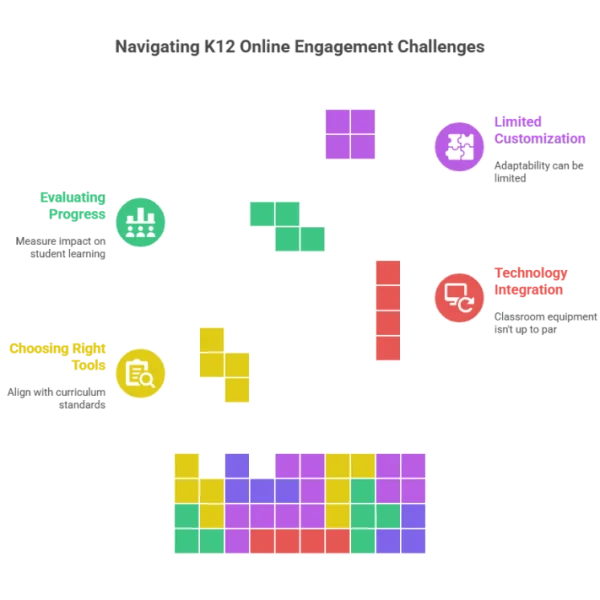
Challenge 1: Choosing the Right Educational Tools
For digital games and activities to be effective, they must align with the subject matter and curriculum standards. Educators often spend significant time evaluating whether a tool is suitable for their specific learning objectives. There may not always be a high-quality game or simulation that covers the exact concept you need.
The solution is to thoroughly vet potential tools. Play the games yourself to see if they support your instructional goals. You can also seek recommendations from fellow educators and work with digital curriculum providers who can offer guidance on effective, curriculum-aligned resources.
Challenge 2: Facilitating Seamless Technology Integration
Technology can be a hurdle if the classroom equipment isn’t up to par. Educational games with demanding tech requirements may fail to load or operate correctly. To avoid this, look for digital learning games that have low-tech requirements and don’t need the fastest internet connection or the latest operating systems. Confirm with providers if they offer technical support to ensure a smooth integration process.
Challenge 3: Evaluating Student Progress
To justify using a game or tool, you must be able to evaluate its impact on student learning. High-quality educational video games often include in-game assessments that make it easy to measure and track student progress. If a game lacks useful assessment features, it may be worth finding an alternative. Educators should test these assessment tools themselves, perhaps by intentionally scoring low, to see what kind of feedback and data the game provides.
Challenge 4: Limited Customization or Adaptability
Many educational video games adapt to a student’s skill level, but this adaptability can be limited. Some students may find the game too easy and become bored, while others might find it too difficult and get discouraged. Furthermore, not all games are designed to be accessible for differently-abled students. The solution is to work with digital curriculum providers to identify games designed to respond to each student’s unique skill level and accessibility needs.
Best Practices for Engaging K12 Students in Online Learning
Navigating the world of K12 online learning requires a student-centered approach. Here are six key best practices educators can implement to enhance student engagement in online learning.

1. Create an Inclusive and Supportive Online Environment
Remote learning can sometimes lack the personal interaction of a physical classroom. To counter this, educators should focus on building an inclusive, supportive, and encouraging online community. Simple practices like starting or ending class with a brief, informal chat session can help. By encouraging students to share their thoughts and experiences, you create a more familiar and supportive environment.
2. Utilize Modern Technology Effectively
Educational institutions should partner with reliable technology providers to build the necessary digital infrastructure for K12 online learning. Look for platforms that are easy to integrate and consider additional services like course building and staffing. By using modern technologies, you can empower students to take control of their educational journey, which naturally enhances engagement.
3. Employ Gamification in Education
Gamification turns educational modules into interactive, game-like experiences. It fosters healthy competition and uses a rewards-based system that works exceptionally well to enhance engagement. You can gamify lessons by introducing pop quizzes, displaying progress bars, or offering milestone-based rewards. For younger students, game-based learning for fundamental skills like counting or learning the alphabet can be highly effective.
4. Design Organized and Cohesive Online Courses
An ill-designed or disorganized course is a major source of disengagement. The flow of lessons, activities, and assessments must be seamless and logical. This structure helps students stay focused on the material instead of getting lost trying to find relevant information. A well-designed course that covers all necessary topics in a logical progression is key to keeping students engaged.
5. Personalize the Learning Experience
Personalization is a powerful tool for creating high engagement. Classrooms are diverse, with students from different backgrounds and with varying learning capabilities. Providing personalization tools like translators, read-aloud features, or self-paced learning options empowers students to learn in a way that works best for them. Personalization powered by AI can enable adaptive learning, allowing the lesson difficulty to adjust based on a student’s progress and capacity.
6. Introduce Interactive Elements
Incorporate a variety of interactive materials into your courses. Use videos, images, audio, animations, and graphics to present lessons from multiple perspectives. Interactive elements encourage active participation, which is the cornerstone of engagement. These tools transform passive observers into active learners.
10 Engaging Online Learning Activities for K-12 Students
Here are some of the best online learning activities and strategies to engage students, build community, and encourage participation.
1. Case Studies Based on the Real World
To make learning engaging, connect concepts to real-world applications. Instead of using generic case studies, challenge your students to find real-life examples online. This strategy works for nearly any subject. For instance, mathematics students can find examples of math in daily life, while history students can report on real-world events that shaped the past. This allows students to explore, engage, and present unique findings that help them better absorb the lesson.
2. Virtual Gallery Walk
Gallery walks are just as effective in a virtual setting as they are in a physical classroom. They generate excitement and help students build background knowledge. Create a virtual gallery walk by adding images or text excerpts to a slideshow presentation. Students can then answer questions asynchronously in a shared document or during a live session. This keeps them engaged and facilitates both small-group and large-group discussions. Interactive videos can also be used to make learning more exciting.
3. Digital Polls
Digital polls are an excellent way to connect students with the lesson. Use a poll creation tool to survey students before, during, or after a class. Display the results and lead a quick discussion about their opinions, making them active participants in the learning process.
4. Self-Assessment
Encourage students to periodically reflect on their learning, focus, and participation. This self-assessment helps them see their progress over time and gives them more control over their education. Students can provide feedback through a graphic organizer or an online assessment tool. Fun and interactive formative assessment tools can also help you gather instant data on what students do and don’t understand.
5. Classroom Newspaper
Use a blogging platform to create a dedicated classroom newspaper. The instructor can act as the editor, assigning stories to students or allowing them to pitch their own ideas. This activity is adaptable for any subject. History students can recreate a historical newspaper, while science students can report on the latest scientific news.
6. Online Debates
Choose a topic related to your subject and pair students for an online debate. Assign one student or group to argue the “pro” side and another to argue the “con” side. Using video meeting software, students can engage in a lively debate that sharpens their critical thinking and research skills. This activity also helps build empathy by requiring students to understand multiple viewpoints.
7. Designing a Comic Strip
Inject some humor and creativity into your classroom by asking students to create comic strips and post them to a discussion channel. This is an excellent activity for subjects like art, English, history, and foreign languages. Students can explore their creativity by making memes, animated comics, and other innovative visuals.
8. Virtual Experiments and Labs
For STEM subjects, hands-on experience is crucial. Virtual experiments allow students to apply theoretical knowledge in a practical setting. There are several ways to facilitate this remotely:
- Video Demonstrations: Use platforms like YouTube for practical video demonstrations of science experiments. You can also record yourself experimenting and ask students to analyze the results.
- Online Simulations: Interactive simulations for physics, chemistry, and biology provide an open-ended exploratory environment. These game-like activities are proven to improve engagement.
- Student-Led Experiments: Divide students into groups and have them collaboratively design experiments using common household materials. You can then perform the chosen experiment in a live virtual session, pausing to ask students for their predictions and analysis.
- Virtual Labs: Virtual labs foster the development of students’ laboratory skills in a virtual environment. As one of the most important e-learning tools, they allow K-12 students to conduct various experiments without the constraints of a real lab, facilitating better learning of theoretical concepts through visual and active learning.
9. Encourage Collaboration and Discussion
Use tools like interactive forums and virtual classroom discussions to encourage students to work together. These platforms allow students to share ideas, debate course material, and build a sense of community. Real-time or asynchronous discussions guided by a moderator can help students develop communication skills while learning from one another.
10. Provide Feedback and Recognition
Regular, constructive, and timely feedback is essential for engagement. When students know their efforts are being noticed and appreciated, they are more motivated. Personalize feedback to each student’s learning style, whether through written comments, verbal input, or one-on-one conversations. Recognition can also be a powerful motivator, whether it’s public praise or private acknowledgment.
Conclusion
As virtual learning becomes a permanent fixture in education, K-12 educators must continue to find innovative ways to keep students engaged. While challenging, the strategies and activities discussed above provide a strong foundation for building a dynamic, participatory, and effective online learning environment. By leveraging interactive tools, personalizing the experience, and connecting learning to the real world, you can keep students interested in the curriculum and set them up for success.
Implementing these strategies is easier when you partner with the right technology providers. Hurix Digital empowers educators with innovative K-12 content solutions that enhance student learning, increase engagement, and improve outcomes. To learn more about how Hurix can help, book a discovery call with us today.
Summarize with:

Senior Vice President – Business Development
at Hurix Digital, with over 25 years of experience in EdTech and workforce learning. He excels in business development, customer relationship management, and scaling digital learning solutions, driving global growth through innovative content, simulations, and AI‑driven training offerings