 A Space for Thoughtful

Competency-Based Education in Undergraduate Prelicensure Nursing Education Programs
Summarize with:
The pandemic caused several societal and medical disruptions, which led to an acute shortage in the nursing workforce. Further, there was ongoing concern about upgrading and replenishing nursing education programs specifically for candidates facing financial constraints.
Competency-based nursing education (CBE) in undergraduate prelicensure nursing education programs was introduced to address these challenges. CBE in nursing offers a flexible learning approach that empowers students to expedite their education and manage costs more effectively. It encompasses innovative approaches in prelicensure nursing education and addresses key concerns such as rising tuition fees, prolonged time to graduation, and maintaining program quality.
Competency-based nursing education is a promising solution that can streamline nursing education. Competency-based nursing education programs vary across institutions, and program quality is measured primarily by NCLEX pass rates. These measures can help candidates better understand the potential of CBE in addressing the existing challenges.
Table of Contents:
- Top Specialized Nursing Education Fields
- Fast-Growing Advanced Nursing Programs
- What is an Online Nursing Education?
- Key Advantages of Online Nursing Education
- Highlights of Competency-Based Nursing Education in Undergraduate Prelicensure Nursing Education Programs
- Overview of the Undergraduate Prelicensure Nursing Education Programs
- About the Nursing Curriculum
- About Nursing Skills Assessment
- Nursing Process Overview
- Nursing Licensure Exam Preparation – Standards and Criteria
- Nursing Licensure Exam Preparation
- National League for Nursing Pre-Admission Exam (PAX)
- Nursing Entrance Test (NET)
- Kaplan Nursing School Admission Test
- Test of Essential Academic Skills Exam (TEAS)
- Health Education Systems, Inc. Admissions Assessment (HESI A2)
- PSB Aptitude for Practical Nursing Exam
- PSB Registered Nursing School Aptitude Exam
- PSB Health Occupations Aptitude Exam (PBS HOAE)
- Revamping Nursing Curriculum Development for Modern Healthcare Trends
- Our Two Cents
Top Specialized Nursing Education Fields
Here are the top online nursing education fields that healthcare professionals can consider:
1. Pediatric Nursing
Pediatric nursing specializes in providing care for children. It requires specific skills to address the health challenges of young patients.
As a pediatric nurse, professionals need to do the following:
- Maintain trust with patients and manage their physical and emotional needs.
- Administer vaccinations
- Conduct wellness checks
- Educate families on preventive care.
- Focus on neonatal care.
2. Oncology Nursing
Oncology nursing is about caring for cancer patients. Professionals need to be thorough with the following:
- Diagnosis through treatment and collaboration with other specialists
- Assessing patient health conditions
- Understanding of chemotherapy and its side effects.
- Offering emotional support.
- Specializing in various cancer-related areas.
3. Critical Care Nursing
Critical care nursing means managing critically ill patients in intensive care environments like ICUs. They should be well-versed with:
- Delivering urgent medical interventions
- Monitoring patient conditions closely
- Possessing strong analytical skills and quick decision-making abilities
- Showcasing resilience under pressure
4. Orthopedic Nursing
Orthopedic Nurses must hold a Bachelor’s degree in Nursing and an RN license to focus on:
- Musculoskeletal conditions
- Physical care
- Disease management.
5. Public Health Nursing
Public Health Nurses educate societies on health issues and need an RN license or an Associate’s or Bachelor’s degree in Nursing. Their key responsibilities include:
- Offering medical care in public hospitals and community clinics.
- Indulging in community health and disease prevention.
Fast-Growing Advanced Nursing Programs
Here are some of the fastest-growing nursing specialties:
| Registered Nurse | Provides patient care in various healthcare settings. |
| Nurse Midwife | Specializes in pregnancy care and postnatal care. |
| Perioperative Nurse | Prepares patients for surgery and offers post-operative care. |
| Cardiac Nurse | Specializes in heart-related conditions. |
| Clinical Nurse Specialist | Provides direct patient care in leadership roles |
| Geriatric Nursing | Specializes in the care of elderly patients. |
| Certified Registered Nurse Anesthetist | Specializes in anesthesia during surgical procedures. |
| Travel Nurse | Works on contract assignments and requires an RN license who take care of patients on the go. |
| Mental Health Nurse | Helps patients who suffer from psychological disorders. |
| ER Nurse | Provides immediate care in emergency rooms. |
| Family Nurse Practitioner | Offers primary healthcare across all ages. |
| Nurse Educator | Teaches and mentors nursing students. |
| Nurse Manager | Oversees nursing teams and ensures efficient patient care. |
What is an Online Nursing Education?
Online nursing education is an online model of education that offers learners a flexible, cost-effective, and superior learning experience. The curriculum is typically a hybrid one, which combines traditional offline methods with tech-enabled online learning.
Nursing educators can use a superior Artificial Intelligence (AI) powered Learning Management System (LMS) to deliver high-quality eLearning in nursing.
In turn, learners can log in to a single, unified learning platform to attend online classes, access on-demand learning resources, and take assessments.
Key Advantages of Online Nursing Education
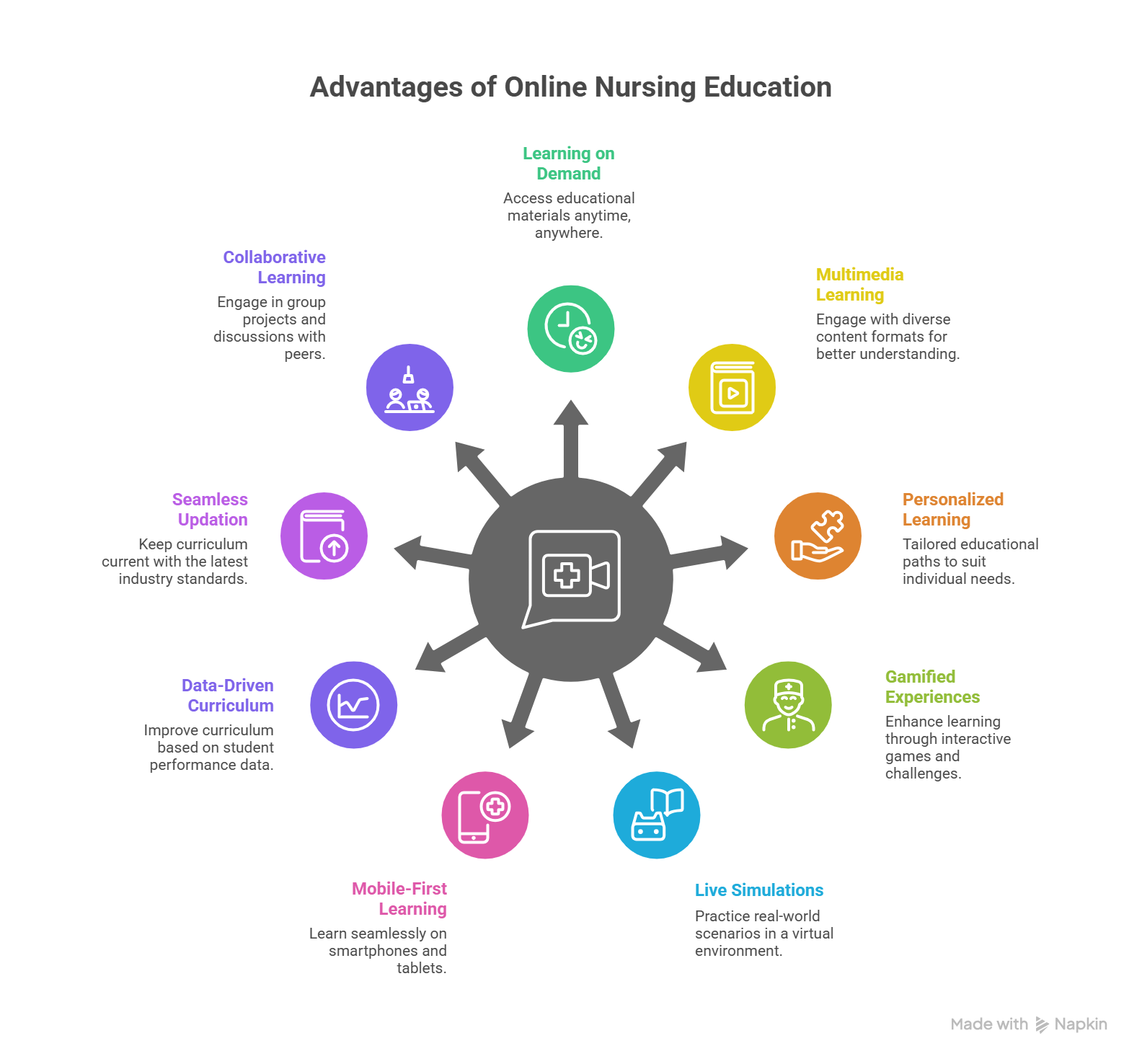
Today, technology in nursing education is playing an innovative role in plugging gaps that exist in traditional nursing classrooms. Here’s a snapshot of how educators can craft a superior program for nursing students:
1. Learning on Demand
One of the top advantages of online nursing education is the opportunity for students to learn as per their schedules. Online programs give students access to a well-equipped library of digital resources that are accessible on demand. These resources can be accessed anytime, anywhere.
2. Multimedia Learning Experience
Learners can enjoy an engaging learning experience through the introduction of multimedia learning resources. Rather than merely referring to physical textbooks, learners can watch videos, listen to audio representations, learn from interactive eBooks, watch slides, and engage with 3D models. The use of multimedia enables higher perception and retention of newer concepts.
3. Personalized Learning
Educators can automate the creation of personalized learning pathways for nursing students. A personalized pathway is a curated learning process that is based on the progress of individual students, as opposed to catering to a collective standard.
This approach helps learners with learning material recommendations that are more relevant to their progress. They can have access to practice modules that help them master concepts throughout their learning journey.
4. Gamified Experiences
The introduction of gamification helps students develop a competitive edge through healthy competition with peer learners. Game elements such as challenges, rewards, and leaderboards add an engaging dimension to the learning process. Thus, they can learn more faster and stay motivated during challenging phases. By the end of 2026, the global game-based learning market is estimated to be worth $29.7 billion.
5. Live Simulations
A profession such as nursing requires extensive practical training and experience. A key challenge is that there isn’t enough scope to practice in practical environments such as hospitals.
However, technology is a game-changer. For instance, the use of Augmented Reality and Virtual Reality in nursing education enables learners to build skills during live simulations of operating theatres, Intensive Care Units (ICUs), and other environments. This approach streamlines costs while making the training more interactive.
6. Mobile-First Learning Experience
Today, learners aspire to access courses from the comfort of one’s smartphones. A research study indicated that 91.35% of learners pursuing online nursing used their smartphones for online learning, and only 8.70% used laptops.
Online nursing programs are embracing this trend by offering a mobile-first learning experience. The content is designed to be compatible with a range of smart devices.
This trend has further given rise to microlearning, which enables learners to access byte-sized content, which can be viewed within seconds. Thus, learners spend a significant amount of time conveniently learning every day.
7. Data-Driven Curriculum Development
Superior nursing education tools come with a superior AI-based predictive analytics engine. Educators can track the engagement of learners, which resources have higher and lower engagement, what time the learners log in, and learner progress.
Educators can customize dashboards and derive detailed reports. Predictive analytics also enables educators to predict future learner behavior and revise learning resources and the curriculum accordingly.
8. Seamless Updation of Curriculum
Updating physical textbooks is next to impossible and a long-winded process. On the other hand, nursing education software enables educators to update the curriculum swiftly and effectively. They can update existing learning resources, add new content, and delete outdated content seamlessly and cost-effectively. This is an important pillar in ensuring that nursing content is relevant and that it captures innovations and discoveries in the field.
9. Learn Collaboratively
In the world of work, nurses work in teams alongside doctors and other healthcare professionals. Online learning enables nurses to build team skills through collaborative projects.
The use of a superior LMS enables nursing students to collaborate seamlessly online. These opportunities equip them to be more accountable, transparent, and collaborative in their work ethic.
Highlights of Competency-Based Nursing Education in Undergraduate Prelicensure Nursing Education Programs
- There are more than 200 competency-based programs available across the United States.
- These programs are offered in various formats – traditional, hybrid, and radical approaches.
- CBE allows students to meet competencies by learning at their own pace, gaining credit for prior experience, and retaking assessments.
- CBE nursing programs meet accreditation standards like the NCLEX-RN, baccalaureate essentials, and QSEN.
- CBE nursing students exhibit higher academic performance and better mastery of core competencies, while educational institutions and faculty are experiencing evolving academic roles and accreditation requirements.
Overview of the Undergraduate Prelicensure Nursing Education Programs
CBE in Undergraduate Prelicensure Nursing Education Programs is for students with varying educational backgrounds. It is a five-semester program that includes classroom instruction, laboratory work, and clinical experiences guided by experienced faculty.
Applicants must face a competitive selection process separate from general university admission. Completing a pre-licensure BSN degree helps students become registered nurses. This degree provides the essential skills and knowledge required to pass the NCLEX-RN exam and excel in the nursing profession.
About the Nursing Curriculum
Transitioning from the existing nursing curriculum to a CBE model may appear difficult. This transition requires the involvement of faculty members with diverse expertise. Modern institutions offer sample templates for curriculum mapping and resources for activities and assessments.
Nursing education has evolved to meet the demands of healthcare reform. The program curriculum emphasizes:
- Primary care settings -This requires nurses to possess effective primary care skills and collaborate within interprofessional teams.
- Students can expect to work closely with nurse preceptors in clinical settings. They must focus on providing care for various medical conditions.
- The program incorporates primary care modules to reinforce foundational nursing knowledge and prepare students for real-world scenarios.
- Collaborative practice, multimedia-rich interactive content, and simulation play vital roles in nursing education. Such practices address challenges and provide diverse learning opportunities for students across different care settings.
About Nursing Skills Assessment
In competency-based nursing education, more consistent assessments and a structured curriculum are needed to alleviate faculty burdens. Nurse educators must balance the broader professional role of education with the preparation for licensure exams, a challenge also posed by CBE.
It presents an innovative approach to nursing education, enhancing clinical judgment and facilitating integration with Interprofessional Education IPE.
In nursing skills assessment, four types are recognized:
- Initial: The initial assessment occurs shortly after admission, involving gathering primary and secondary information and interpreting and validating data to establish patient needs and health problems. This forms a basis for ongoing focused assessments and future comparisons.
- Focused: Focused assessments target specific problems and can occur during the initial assessment or as part of ongoing data collection.
- Emergency: Emergency assessments aim to identify life-threatening issues during crises.
- Time-Lapsed Assessments: Time-lapsed assessments involve reassessing a patient’s health status against baseline data, which is crucial for long-term care planning.
Assessment prioritization and data collection structuring are vital for effective nursing practice. Following a comprehensive nursing assessment, health problems guide future nurse-patient interactions and assessment priorities.
Nursing Process Overview
Here is a 6-step program that completes the Nursing Process Education:
- Assessment: Gather comprehensive data, including subjective and objective information, family, surgical, medical, and medication history, as well as psychosocial aspects.
- Analysis or Diagnosis: Candidates should formulate nursing diagnoses relying on clinical judgment to identify patient issues.
- Planning: Develop a care plan with goals, outcomes, and interventions customized according to the patient’s needs.
- Implementation: Execute interventions as per the care plan.
- Evaluation: Assess the success of interventions and adjust care plans accordingly.
- Documentation: Ensure culturally competent and linguistically appropriate care and evaluate patient response to treatment. Consider community support and conduct regular assessments after admission.
Nursing Licensure Exam Preparation – Standards and Criteria
The accreditation standards align with the ACEN Standards for educational quality. Candidates need to prepare for NCLEX-RN with a Pre-Licensure Nursing Degree. Here, they will acquire the comprehensive knowledge necessary to excel in the NCLEX-RN licensing exam and work on a career opportunity as a nurse generalist.
This Nursing licensure exam preparation demands critical thinking skills and a firm grasp of ethical nursing principles. The curriculum aligns with the NCLEX-RN test plan, covering essential topics such as health assessment, adult health, mental health, pediatrics, obstetrics, pharmacology, informatics, research, ethics, and policy.
Furthermore, aspirants gain insight into caring for individuals across the lifespan, from newborns to elderly clients.
1. Hands-on Learning through Nursing Simulation
Immersive simulation experiences that offer meticulously designed clinical scenarios that foster student growth. Sun simulations feature a control room, nurses’ station, hospital rooms, and debriefing spaces.
Upon enrollment in the pre-licensure program, you’ll access these simulation suites during your third and fourth years of study. Students develop clinical skills and critical thinking in a risk-free environment that prepares them according to real-world healthcare settings.
2. Career Opportunities after Graduation
Upon graduation, Prelicensure Nursing degree holders are eligible to sit for the NCLEX-RN exam. It paves the way for them to become registered nurse RNs.
A BSN offers RNs advanced training and leadership prospects, and this degree helps them further a master’s degree in nursing.
If you want to make a difference through nursing, you must explore the benefits of competency-based nursing education in Undergraduate pre-licensure nursing Education Programs today.
Nursing Licensure Exam Preparation
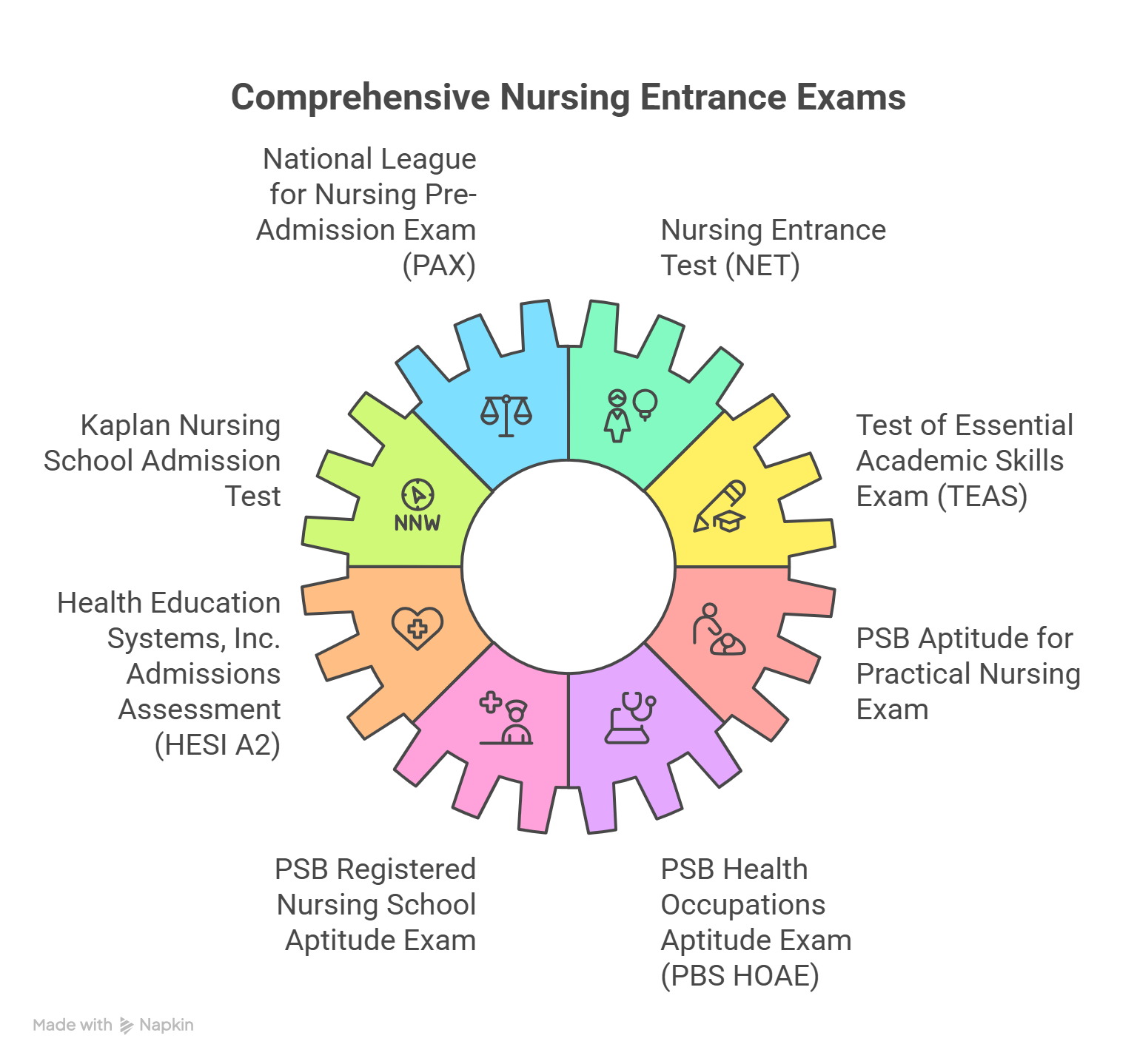
If you’re considering nursing school, you may need to sit for a nursing school entrance exam. Here is an overview of common nursing entrance exams:
1. National League for Nursing Pre-Admission Exam (PAX)
This exam assesses verbal and non-verbal skills along with comprehension of scientific concepts. It consists of 160 multiple-choice questions, and students are given two hours and five minutes to complete the exam.
2. Nursing Entrance Test (NET)
This test comprises six sections, and the test duration is 155 minutes. It focuses on high school-level math concepts and general academic skills.
3. Kaplan Nursing School Admission Test
This test of 180 minutes evaluates various skills and consists of four sections with 91 multiple-choice questions.
4. Test of Essential Academic Skills Exam (TEAS)
This test covers 170 questions on Reading, Math, English, and Science, and the test duration is 209 minutes.
5. Health Education Systems, Inc. Admissions Assessment (HESI A2)
It consists of 9 sections and focuses on high school-level knowledge, especially in science subjects.
6. PSB Aptitude for Practical Nursing Exam
This exam is intended for candidates pursuing practical and vocational nursing programs. Tests academic aptitude in various subjects. The exam duration is 105 minutes.
7. PSB Registered Nursing School Aptitude Exam
This test is designed for aspiring RNs. It consists of five sections, including academic aptitude, spelling, reading comprehension, natural sciences, and vocational adjustment. The test duration is 105 minutes.
8. PSB Health Occupations Aptitude Exam (PBS HOAE)
This exam is used to assess students entering healthcare training programs, including nursing. The duration of this exam varies, and it evaluates verbal, non-verbal, and academic aptitude.
Preparing for these exams means studying high school-level topics and using study guides and practice tests.
Revamping Nursing Curriculum Development for Modern Healthcare Trends
The nursing curriculum is rapidly evolving according to the latest advancements in the medical and healthcare industries. It aims to enhance students’ skills and readiness according to recent industry demands.
The focus is on refining the curriculum’s readability and relevance to real-time standards. Thus, the Refined Curriculum with Internet Information Analysis RC-IIA method has been introduced. Here are its core features:
- The RC-IIA method integrates distributed internet resources, scholarly journals, and existing curriculum data into an active nursing syllabus, eliminating redundancies and ensuring the inclusion of pertinent information.
- Additionally, it employs classification learning to enhance knowledge-based representations.
- It uses refined information and a recommendation-based curriculum tailored to various standards. This approach ensures the use of existing and distributed information for comprehensive curriculum coverage.
- The revamped curriculum is designed to meet the end-of-program student learning outcomes across various nursing program types.
- It addresses role-specific nursing competencies for undergraduate programs. Furthermore, it adheres to safe practice standards in contemporary healthcare environments.
Significance of the Undergraduate Prelicensure Nursing Education Curriculum Development
- Alignment with Contemporary Professional Standards
- Progressive Learning Outcomes
- Faculty Development and Curriculum Review
- Comprehensive Program of Study
- Integration of Contemporary Concepts
Our Two Cents
The nursing education system focuses on quality, cost-effectiveness, and timely completion. Competency-based nursing education is an innovative approach related to undergraduate nursing programs that streamlines program durations and maintains educational rigor. The emphasis of nursing education remains on preparing competent, skilled professionals equipped to meet the challenges of modern healthcare.
At Hurix Digital, you can learn everything about competency-based nursing education in undergraduate pre-licensure nursing education programs. Our comprehensive solutions and expert team help aspirants advance their careers in nursing and positively impact the healthcare industry.
Contact us today!
Summarize with:

Senior Vice President
A Business Development professional with >20 years of experience with strong capability to sell new solutions and develop new markets from scratch. New Market Entry Specialist with experience working in the largest emerging markets. Exceptional experience in conceptualizing, ideating and selling new learning technologies like VR AR, etc. across multiple industry verticals.