 A Space for Thoughtful

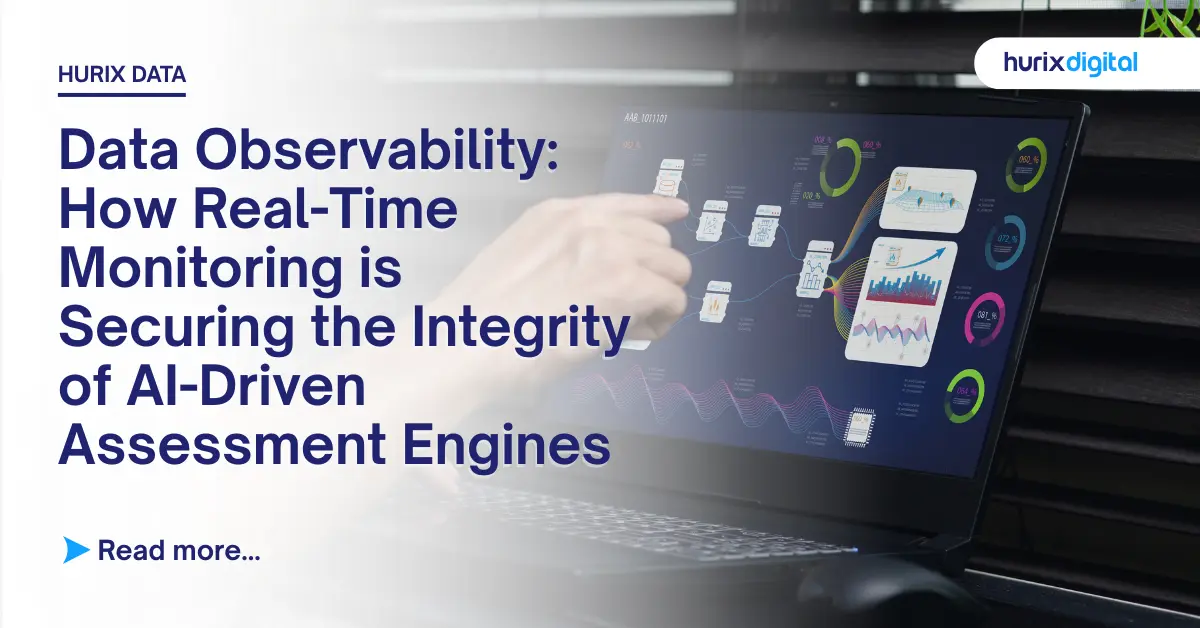
Data Observability: How Real-Time Monitoring is Securing the Integrity of AI-Driven Assessment Engines
Summarize with:
Have you ever wondered if the AI grading your certification exam or filtering your job application is actually “thinking” straight? It’s a bit of a chilling thought. We’ve handed over the keys to some of our most life-altering decisions to algorithms, yet we often treat these models like magical black boxes that never tire or become biased.
Spoiler alert: they do. AI models can “drift,” lose their way, and start making calls that make zero sense. This is where data observability steps in. It’s not just about keeping the lights on; it’s about making sure the engine isn’t steering us off a cliff. By integrating AI model training services with real-time monitoring, organizations are finally finding a way to keep these digital evaluators honest and accurate.
What is the Role of Data Observability in AI Integrity?
At its heart, data observability is about answering one simple, nagging question: “Is my data okay?” For an assessment engine, the data is the fuel. If you put low-grade, “dirty” fuel into a high-performance engine, you’re going to stall. Observability goes beyond traditional monitoring by examining the health of data throughout its journey, from ingestion to scoring.
It tracks things like freshness (is this data from 2010 or 2026?), distribution (is the model suddenly failing everyone from a specific zip code?), and lineage. When an assessment engine starts acting up, observability tools act like a forensic team, tracing the glitch back to the source. This is why many companies pair these tools with professional AI model training services to ensure that once a problem is found, the model is retrained on high-quality, human-verified data to get back on track.
Table of Contents:
- Why is Real-Time Monitoring Critical for AI Assessments?
- How Do AI Model Training Services Improve Data Reliability?
- 5 Reasons Your Assessment Engine Needs an Observability Layer
- The Hurix Advantage: Securing Your AI Future
- Frequently Asked Questions(FAQs)
Why is Real-Time Monitoring Critical for AI Assessments?
If you only check your car’s oil once a year, you’re asking for trouble. AI assessments are no different. Real-time monitoring allows institutions to catch “silent failures.” These are the bugs that don’t crash the system but slowly warp the results. Imagine an AI proctoring tool that slowly starts flagging students for “suspicious behavior” just because they have a specific home lighting setup.
If you aren’t watching the system in real-time, those biases can quietly slip through and mess up thousands of results before anyone notices. Think of live insights as your safety net. They give you the chance to jump in the second things look off. Usually, that means bringing in AI model training services to tweak the settings and feed the model fresh, diverse examples. It’s the only way to ensure the entire process remains fair for everyone.
How Do AI Model Training Services Improve Data Reliability?
Monitoring is great for spotting smoke, but you still need a fire department to handle the flames. That’s the role of AI model training services. When observability tools flag that a model’s accuracy is dipping, it’s usually because the real world has changed and the model hasn’t.
These services provide the “Human-in-the-Loop” (HITL) expertise needed to clean up datasets and re-teach the AI. They grab that messy, raw data your monitoring tools flagged and actually turn it into something useful. By constantly pumping fresh, accurately labeled data back into the mix, AI model training services ensure your engine doesn’t just “work”, it actually stays smart and relevant. It’s basically a non-stop loop of spotting problems, fixing them, and evolving on the fly.
5 Reasons Your Assessment Engine Needs an Observability Layer
1. Eliminating Bias
It catches skewed results before they become a legal or ethical nightmare.
2. Maintaining Trust
Stakeholders need to know the scores are legitimate. Observability provides the audit trail to prove it.
3. Cost Efficiency
Finding a data error early is significantly cheaper than retraining an entire model from scratch after it’s completely broken.
4. Regulatory Compliance
With new AI laws popping up everywhere, having a “paper trail” for your data is no longer optional.
5. Scaling with Confidence
You can deploy your engine to millions of users, knowing that if something breaks, you’ll be the first to know.
When Should You Audit Your AI Data Pipeline?
The short answer? Yesterday. But the more practical answer is that you should be auditing whenever you see a shift in your “Ground Truth.” If your pass rates suddenly spike or plummet without a logical explanation, that’s a red flag.
Using AI model training services during these audit phases is a game-changer. They can run deep-dive “sanity checks” on your datasets to make sure those labels still hold up in the real world. Regular audits mean your data observability isn’t just some boring dashboard gathering digital dust; it becomes a living, breathing part of your quality assurance strategy.
The Hurix Advantage: Securing Your AI Future
Building a smart assessment engine is really only half the battle. The real grind starts when you have to keep it that way. At Hurix Digital, we’re all about bridging that gap between raw tech and results you can actually trust. We don’t just hand you a tool and walk away; we bring the expertise to make sure that tool does exactly what it’s supposed to do, every single time.
Our AI model training services are built to work hand in hand with your data observability strategy. We supply the high-quality, human-verified data your models need to stay sharp and unbiased. Beyond AI, we help organizations thrive through Custom eLearning Solutions, Digital Content Transformation, Higher Education Solutions, and Enterprise Content Management.
Ready to secure your AI integrity? Don’t let data drift compromise your institutional reputation. Partner with the experts to keep your models sharp, fair, and future-proof. Book a discovery call with us to get started.
Frequently Asked Questions(FAQs)
Q1: How does data drift specifically impact AI-driven assessment engines?
Data drift happens when the input data changes over time, making the model’s original training obsolete. In assessments, this might mean an AI trained on formal academic essays fails to accurately grade more modern, conversational writing styles. This leads to unfair scoring and a total loss of system integrity.
Q2: Can data observability prevent AI hallucinations in grading?
While it can’t stop a hallucination in the millisecond it happens, observability identifies the patterns that lead to them. By monitoring confidence scores and output distributions, it flags when the AI is guessing too often, allowing AI model training services to intervene and retrain the model on those specific edge cases.
Q3: What is the difference between data monitoring and data observability?
Monitoring tells you when something is wrong, like a “server down” alert. Observability tells you why it’s wrong by looking at the internal state of the data. It’s the difference between seeing a “Check Engine” light and having a full diagnostic report that points to a specific faulty spark plug.
Q4: Is human intervention still necessary if I have real-time monitoring?
Absolutely. Monitoring is an alarm system, not a repair crew. Human experts are needed to interpret anomalies, determine whether the model needs a pivot, and provide nuanced labeling that automated systems miss. This “Human-in-the-Loop” approach is the gold standard for high-stakes AI assessments.
Q5: How do AI model training services ensure the “fairness” of an engine?
These services use diverse teams of human annotators to identify and remove biased labels in the training set. By deliberately introducing diverse datasets and checking for balanced outcomes across demographics, they train the AI to ignore irrelevant factors such as age, gender, or location during the assessment process.
Summarize with:

Vice President – Content Transformation at HurixDigital, based in Chennai. With nearly 20 years in digital content, he leads large-scale transformation and accessibility initiatives. A frequent presenter (e.g., London Book Fair 2025), Gokulnath drives AI-powered publishing solutions and inclusive content strategies for global clients