 A Space for Thoughtful

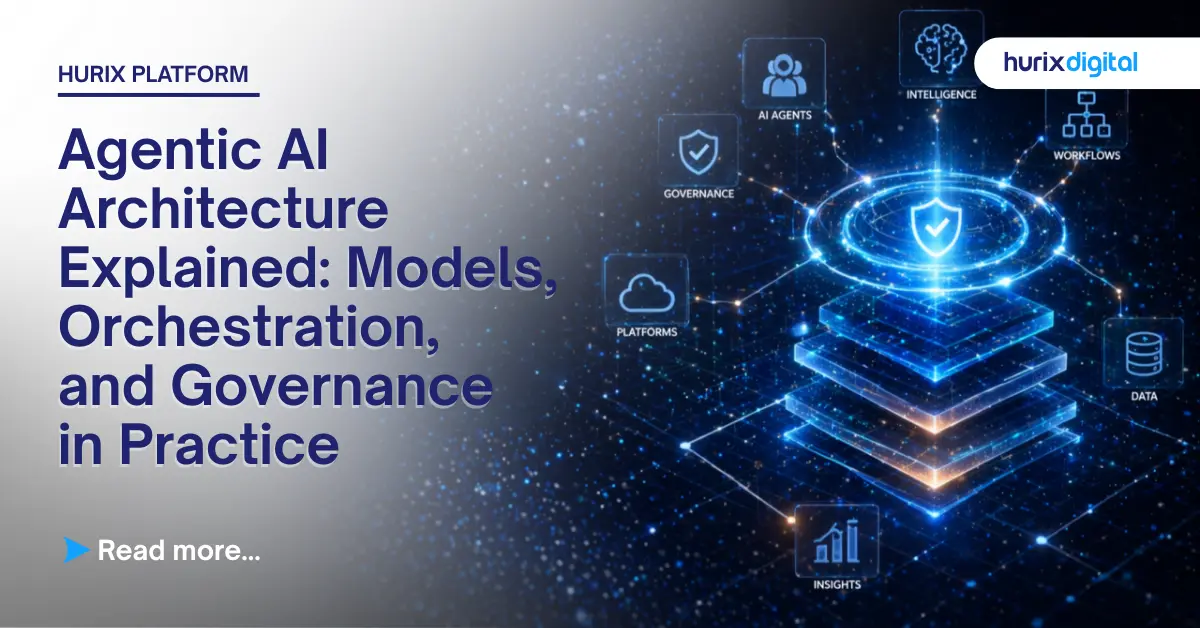
Agentic AI Architecture Explained: Models, Orchestration, and Governance in Practice
Summarize with:
We spent a couple of years asking chatbots to write poems or summarize emails. That era is ending. It’s 2026 now, and the conversation has upgraded. The question is no longer “What can AI say?” The real question for any CTO or digital leader is simple: “What can AI do?”
We are moving from generative systems to agentic ones. These are digital workers who plan, reason, and execute. For an enterprise leader, this is a big shift. It changes how you build software and how you govern it. It demands a fresh look at your infrastructure.
This article explores the fundamentals of agentic AI architecture. We will look at how to build it, how to control it, and why your current data strategy might fail you.
Table of Contents:
- What is the “Agentic Loop” and Why Does It Matter?
- How Do You Manage Multiple AI Agents at Once?
- Who is Actually in Control: The Human or the AI?
- Why is Your Current Data Strategy the Biggest Risk?
- In Conclusion
- Frequently Asked Questions
What is the “Agentic Loop” and Why Does It Matter?
Traditional automation worked like a relay race. You passed a baton from step X to step Y. If someone dropped the baton (say, the data format changed), then the race stopped.
Agentic AI architecture works differently. It functions more like a soccer player. The player has a goal (score a point), but the path to reach it changes dynamically. The player must understand the field and its dimensions, decide on his move, and finally act. If a defender blocks the way, they try something else. This cycle is called the agentic loop.
In technical terms, we are moving from linear chains to recursive loops. An agent perceives the environment. It thinks. It acts. Then it observes the result of that action. If the result is wrong, it tries again. This creates a need for “inference time.” You are paying for the model to think before it answers. A standard Large Language Model (LLM) responds instantly. An agent might take ten seconds to plan its approach. For a business, this latency is the price of autonomy.
Strategic Reasoning: Moving Beyond Simple Chatbot Responses
The model is at the heart of this system. But we are seeing a change in 2026. We rarely use one giant model for everything anymore. Instead, we use a mix. A high-intelligence model acts as the “router.” It understands the user’s request. Then it delegates the work to smaller, faster models. One model might be great at writing Python code. Another might excel at summarizing legal text.
Using specialized models reduces costs. It also improves accuracy. A generalist model tries to know everything and often fails. A specialist model knows its job and sticks to it.
The Hands: Tools and AI-Driven Process Automation
A brain in a jar cannot change the world. It needs hands. In software, these hands are “tools.”
Tools are simply functions or APIs that the agent can call. A calculator is a tool. A Google Search API is a tool. A connection to your Salesforce database is a tool.
The magic happens when the agent figures out which tool to use. You do not tell it “Use the calculator.” You ask it “What is 50 times 40?” This capability is the core of AI-driven process automation. We are no longer writing rigid scripts. We are giving agents a toolbox and a goal. They figure out the rest.
How Do You Manage Multiple AI Agents at Once?
One agent is useful. But a dozen agents working together? That is powerful. But then it tends to become chaotic. If five agents try to update the same database, you get a mess. You need a way to manage them.
The most popular design pattern for 2026 is what OpenAI calls the “Manager Pattern.” Visualize a construction site. You have a plumber, an electrician, and a carpenter. They do not talk to each other directly. They talk to the general contractor.
In our software, the manager agent plays this role. It takes a complex user request. It breaks that request into small tasks. It assigns those tasks to the worker agents.
- The research agent finds the information.
- The coding agent writes the script.
- The review agent checks for errors.
The manager collects the work and presents the final result. This keeps the system organized. It also makes debugging easier. If the code is wrong, you know exactly which agent failed.
This structure allows for IT transformation services to scale. You can add new worker agents without breaking the whole system. You simply introduce the new worker to the Manager.
Who is Actually in Control: The Human or the AI?
Power without control is dangerous. In an enterprise, you cannot let software do whatever it wants. What if an agent decides to delete a production database? What if it sends an email to a client leaking sensitive information?
You need governance. But traditional rules do not work here. You cannot predict every path the agent will take. The solution is progressive disclosure of autonomy. Start with a human-in-the-loop. The agent does the work, but a human must approve it. The agent drafts the email. You decide to send it. The agent writes the code. You review it.
As the system proves itself, you loosen the reins. You move to “human in the loop.” The agent acts, but you get a notification. You can stop it if things look wrong. Eventually, for low-risk tasks, you allow full autonomy. But you never remove the “stop” button.
Building Guardrails in Agentic AI
You also need hard rules. We call these guardrails. They are simple code checks that run before and after the model acts.
- Input Guardrails: Check whether the user is requesting a forbidden action.
- Output Guardrails: Check if the agent’s answer makes sense.
- Tool Guardrails: Limit what the agent can touch. An agent should seldom have “delete” permissions.
For the head of information security, this is the most critical part. Trust is hard to gain and easy to lose. Robust guardrails safeguard the business while allowing to experiment with agentic AI.
Why is Your Current Data Strategy the Biggest Risk?
We have talked about models and agents. But we have ignored the elephant in the room: data. AI data quality is the fuel for this engine. Unstructured data (PDFs, emails, chats) is often where the value lies. But machines struggle to read it. You need to turn that swamp of documents into clean, structured knowledge.
This is where the concept of “Service-as-a-Software” comes in. You are buying outcomes. But those outcomes depend on the quality of your digital foundation.
In Conclusion
This brings us to our philosophy. Content, data, and platforms are inseparable. Building an agentic system is confusing. There are too many choices. Too many models. Too much risk.
At Hurix Digital, we help companies build the bedrock. We clean the data pipelines. We structure the unstructured content. We ensure that when your agent looks for an answer, it finds the truth.
If you’re weighing how to move your agentic AI initiative from pilot to production with the rigor your board, your regulators, and your customers expect, we’d welcome that conversation. Schedule a call with an AI transformation expert now.
Frequently Asked Questions(FAQs)
Q1: What is the difference between Generative AI and Agentic AI?
Generative AI focuses on content creation; it predicts the next word or pixel to summarize text or generate images. Agentic AI focuses on execution. While Generative AI waits for a prompt to produce a result, Agentic AI uses reasoning to break down a goal, choose the right tools, and perform multi-step tasks autonomously.
Q2:How does an “Agentic Loop” actually work in a business process?
The Agentic Loop is a four-step recursive cycle: Perceive (gathering data), Plan (deciding the steps), Act (executing via tools/APIs), and Evaluate (checking if the result met the goal). Unlike traditional automation, which follows a rigid “If-This-Then-That” script, the loop allows the AI to self-correct when it encounters an error or a change in data.
Q3:What are “AI Guardrails” and why are they necessary for enterprise security?
AI Guardrails are programmable safety layers that sit between the AI and your business systems. They include Input Guardrails (filtering malicious or irrelevant prompts), Output Guardrails (ensuring answers are accurate and brand-safe), and Tool Guardrails (restricting the AI’s ability to perform high-risk actions like deleting databases or accessing sensitive payroll info).
Q4: Can Agentic AI work with my existing legacy software and APIs?
Yes. Agentic AI uses “Tools”—essentially API connectors—to interact with your existing stack. By treating your legacy software as a set of functions the agent can call, you can modernize your workflows without a complete “rip-and-replace” of your current infrastructure.
Q5:Why is data quality more important for AI agents than for standard chatbots?
A standard chatbot only needs to find a document to summarize it. An AI agent, however, uses your data to make operational decisions. If your data is unstructured, outdated, or “dirty,” the agent will make incorrect plans or execute flawed actions. High-quality, structured data is the only way to ensure the agent’s reasoning is grounded in reality.
Summarize with:

Vice President & SBU Head –
Delivery at Hurix Technology, based in Mumbai. With extensive experience leading delivery and technology teams, he excels at scaling operations, optimizing workflows, and ensuring top-tier service quality. Ravi drives cross-functional collaboration to deliver robust digital learning solutions and client satisfaction