 A Space for Thoughtful

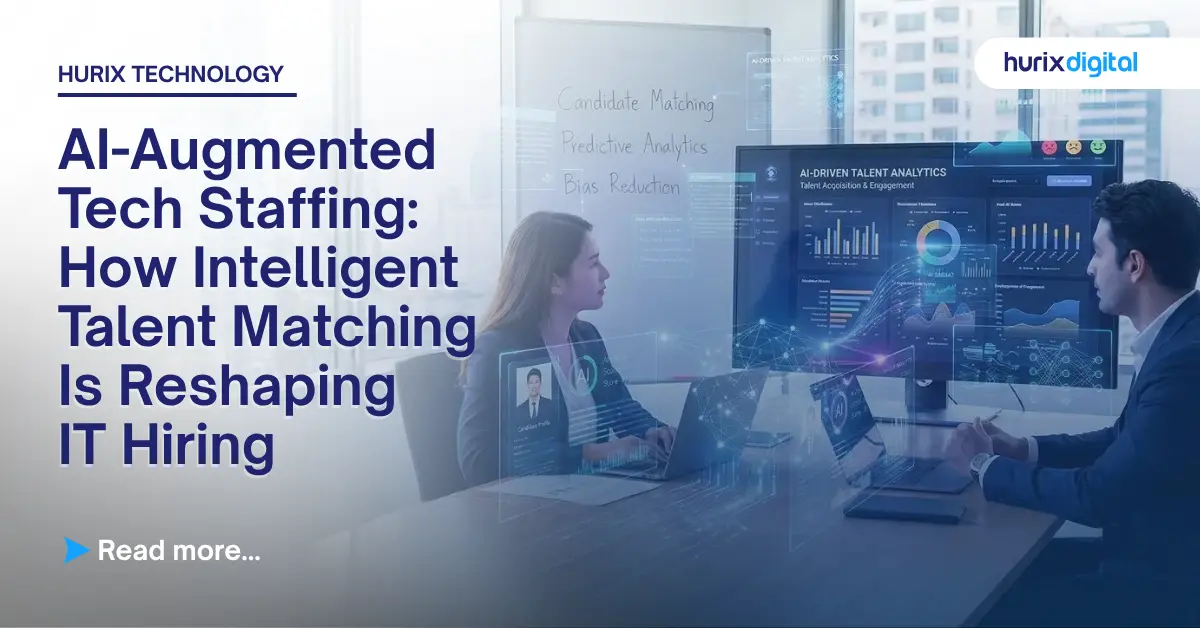
AI-Augmented Tech Staffing: How Intelligent Talent Matching Is Reshaping IT Hiring
Summarize with:
There’s some frustration brewing behind the doors at many large technology companies. Hiring leaders will nod in agreement if you say this: hiring quality engineers, data scientists, and cloud architects repeatedly feels like trying to find needles in a haystack. The tools we had five years ago feel obsolete now. Candidates either flood in en masse with generic credentials or trickle into the specialized pools enterprises truly need.
And here’s the twist: the same technology that made it harder to find great candidates. This shift, which we are living through right now in 2026, has profound consequences for anyone responsible for workforce training strategy, tech staffing budgets, or delivery timelines.
AI‑augmented staffing is not another HR fad. It is steadily becoming a core operational pillar for companies that have to hire or scale technical talent under tight timelines and shifting requirements.
Table of Contents:
- Why Traditional Tech Recruiting Companies Are Struggling
- What Intelligent Talent Matching Really Means
- Talent as a Service (TaaS): Predictive Hiring for Tech Teams
- Inside AI-Augmented Hiring
- Staff Augmentation Services in the AI Era
- A Final Word
- Frequently Asked Questions
Why Traditional Tech Recruiting Companies Are Struggling
Hiring technical talent used to distort into a familiar pattern. A role opens. Recruiters post it widely. Recruiting teams sift through applications. Internal stakeholders debate which candidates to filter. Time to hire drags on. Hiring managers get frustrated. Recruiter burnout creeps in.
This approach has two predictable outcomes. One, it places too much weight on titles and school pedigrees. And two, it forgets that modern software projects demand skill alignment more than pedigree. If a platform engineer has deep experience building resilient services on Kubernetes but lists it under a different job title, old‑fashioned screens might miss them entirely.
The result is slow progress and inconsistent quality of hire. And in 2026, employers face a market that’s simultaneously flooded with AI‑generated applications and lacking in dependable specialized skills. 53% of recruiters said automated applications make it harder to identify genuinely skilled candidates, adding noise to an already complex process. Recruiters aren’t rejecting AI. They’re trying to use AI to sift through AI‑generated noise.
What Intelligent Talent Matching Really Means
There’s a difference between automating actions and building intelligence. Parsing resumes with pattern recognition is automation. Predicting the likelihood that someone with a certain project history and outcomes will thrive in your environment? That’s intelligence. That distinction lies at the heart of intelligent talent matching.
A mature, intelligent tech staffing system learns, refines, and scores talent against patterns that matter to an organization. It absorbs signals from:
- Actual project outcomes
- Skill clusters drawn from real team performance
- Internal mobility pathways
- Market signals from talent platforms and skills databases
Without this deeper context, even the best keyword match risks being surface-level accurate without functional relevance.
Talent as a Service (TaaS): Predictive Hiring for Tech Teams
One of the most striking developments heading into the future is the influence of predictive workforce signals on hiring decisions. A growing number of companies now use talent-as-a-service (TaaS) platforms like Hurix Digital that do more than just sift CVs. These platforms:
- Surface candidates whose actual skills align with job demands
- Identify internal employees ready to grow into new roles
- Measure hiring quality by outcomes like retention and performance
- Improve diversity metrics by reducing superficial bias in early screening
In fact, by leveraging systems that evaluate candidates against outcome signals rather than keywords, organizations are seeing measurable gains in hiring quality and retention rates. These aren’t vague claims. Study suggests that organizations using AI‑powered talent platforms see faster shortlisting and lower bias, with some reporting up to a 40% reduction in biased decisions and substantial boosts in candidate quality.
Inside AI-Augmented Hiring
Here’s how modern stacks differ from the old HR tech setup. In the last decade or so, applicant tracking systems (ATS) and keyword matching have been at the forefront of the hiring workflow’s decision-making process. And they did their part well in organizing paperwork. But the real struggle was with meaning and context.
Now, there are different systems and processes that come with enterprise AI solutions. Rather than matching candidates based on a title such as “software engineer,” sophisticated systems match on deeper competencies, including event streaming, API design, and specific domain knowledge, such as cloud security. Instead of mere keyword matching, they build semantic connections between skills, outcomes, and organizational objectives.
Staff Augmentation Services in the AI Era
Staff augmentation services are often used by enterprises that need temporary resources for their projects. However, in an environment where the project complexity rapidly outpaces job titles, simply placing warm bodies on a contract does not guarantee value.
Augmentation in 2026 is about form. So they add professionals whose skills closely align with what needs to be built. But smart matching also factors in how someone’s experience amplifies the productivity of people already on the team.
This shift aligns with broader industry trends that emphasize skills over credentials. One study found that demand for skills far outpaces the importance traditionally assigned to degrees in hiring decisions.
A Final Word
We are beyond the stage where smart hiring has consisted of strapping on a typical job-posting-and-waiting technique. Good modern tech staffing cannot be delivered by accident; it is a blend of data, experience, and judgment.
For enterprise decision‑makers, the opportunity is clear. Hiring excellence now means tapping into intelligent systems that help turn data into insight without losing sight of the human meaning behind it.
At Hurix Digital, we work with enterprises to shape this journey. Our emphasis is on connected talent intelligence, smarter tech staffing platforms, and actionable workforce insight. We help organizations evolve from reactive hiring to a proactive talent management strategy.
Schedule a call now with a tech staffing expert to explore technology solutions that make talent matching smarter and more precise.
Frequently Asked Questions(FAQs)
Q1:How does AI-augmented tech staffing differ from traditional keyword-based hiring?
Traditional tech staffing relies on an Applicant Tracking System (ATS) to scan for specific words like “Java” or “Python,” which can lead to unqualified matches or missed talent. Intelligent talent matching uses semantic analysis to understand the context of experience—evaluating actual project outcomes, complexity, and how a candidate’s skills align with the specific architectural needs of your team.
Q2:Can AI really reduce bias in the tech staffing process?
Yes. When properly configured, AI focuses on objective data points—such as skill clusters and performance metrics—rather than “pedigree” markers like specific universities or prior company names. Studies show that shifting to outcome-based signals can reduce superficial bias in early screening by up to 40%.
Q3:Why is “Talent as a Service” (TaaS) better for scaling IT teams?
TaaS provides a proactive rather than reactive approach to tech staffing. Instead of starting a search from scratch for every new project, TaaS platforms maintain a continuous, pre-vetted pipeline of talent. This allows enterprises to scale technical capacity up or down based on real-time project signals and predictive workforce data.
Q4: How do you verify technical skills in a market flooded with AI-generated resumes?
In 2026, many candidates use AI to “optimize” their resumes, making them look perfect on paper. Modern tech staffing strategies solve this by using intelligent systems that cross-reference resumes with external signals, such as open-source contributions, technical assessments, and verified project histories to ensure the skills are genuine.
Q5:Does AI-augmented staffing replace the need for human recruiters?
Not at all. It replaces the “grunt work” of manual sifting and administrative filtering. By automating the identification of the top 1% of talent, tech staffing experts can focus their time on the human elements of hiring—such as cultural fit, leadership potential, and complex negotiations—that machines cannot replicate.
Summarize with:

Vice President & SBU Head –
Delivery at Hurix Technology, based in Mumbai. With extensive experience leading delivery and technology teams, he excels at scaling operations, optimizing workflows, and ensuring top-tier service quality. Ravi drives cross-functional collaboration to deliver robust digital learning solutions and client satisfaction