 A Space for Thoughtful

What Is Engineering Services Outsourcing (ESO) and Why It Matters – A Complete Guide
Summarize with:
Product development of any kind is a complex and resource-intensive process. While developing a product from start to finish in-house may seem like a brilliant idea, the reality is far from it. Consider the cost of hiring highly skilled experts in every aspect of the product development lifecycle and the time and resources required to learn on the go. When you take these factors into account, it is evident that it is next to impossible to keep up in a cutthroat, volatile, and ever-changing market.
This is where Engineering Services Outsourcing (ESO) comes in, where you outsource specific processes to dedicated professionals while you can focus on your core competencies and business goals.
The product engineering services industry is fast-growing. In 2025, the market was valued at over $1.25 trillion, with projections indicating it will exceed $2.3 trillion by 2033, growing at a CAGR of over 6%.
Table of Contents:
What is Engineering Services Outsourcing (ESO)?
Engineering Services Outsourcing (ESO), by definition, is the practice of hiring external sources to work on specific non-physical engineering functions of the product development lifecycle. These can include processes such as design, prototyping, or testing.
ESO is by no means a new concept. It had its roots in the early 2000s when the automobile and aerospace industries outsourced engineering services for the development of telematics, advanced navigation, and infotainment systems to third parties.
In 2026, ESO has evolved from a simple cost-saving tactic into a high-octane growth engine. As product lifecycles shrink, leading firms are leveraging outsourced engineering to bridge the ‘talent gap’ in advanced domains like electric mobility and AI-driven automation.
Today, however, ESOs are essential to almost every sector of the globe and are expected to grow to a USD 8,126.49 billion industry by 2029.
What is Product Engineering?
To fully grasp ESO, it’s essential to understand the core process it supports: product engineering.
Product engineering is the process of innovating, ideating, designing, developing, and testing a product, device, software, or system that is then produced for sale. It is an extensive process that deals with quality, performance, production, reliability, serviceability, and other features. These product features are intended to make the resulting product more attractive to its targeted audience.
Product engineering entails the entire product life cycle, from the innovation phase to the production and user acceptance testing phase. Product engineering services aim to create new products designed to appeal to changing customer preferences and evolving societal trends. It is not an easy task, as every product must be prototyped and pass through multiple quality testing rounds.
Phases in the Product Engineering Process
Outsourcing can occur at any stage of the product engineering process. Understanding these phases helps companies identify which functions are best suited for partnership with an external provider. The process mainly consists of the following steps.
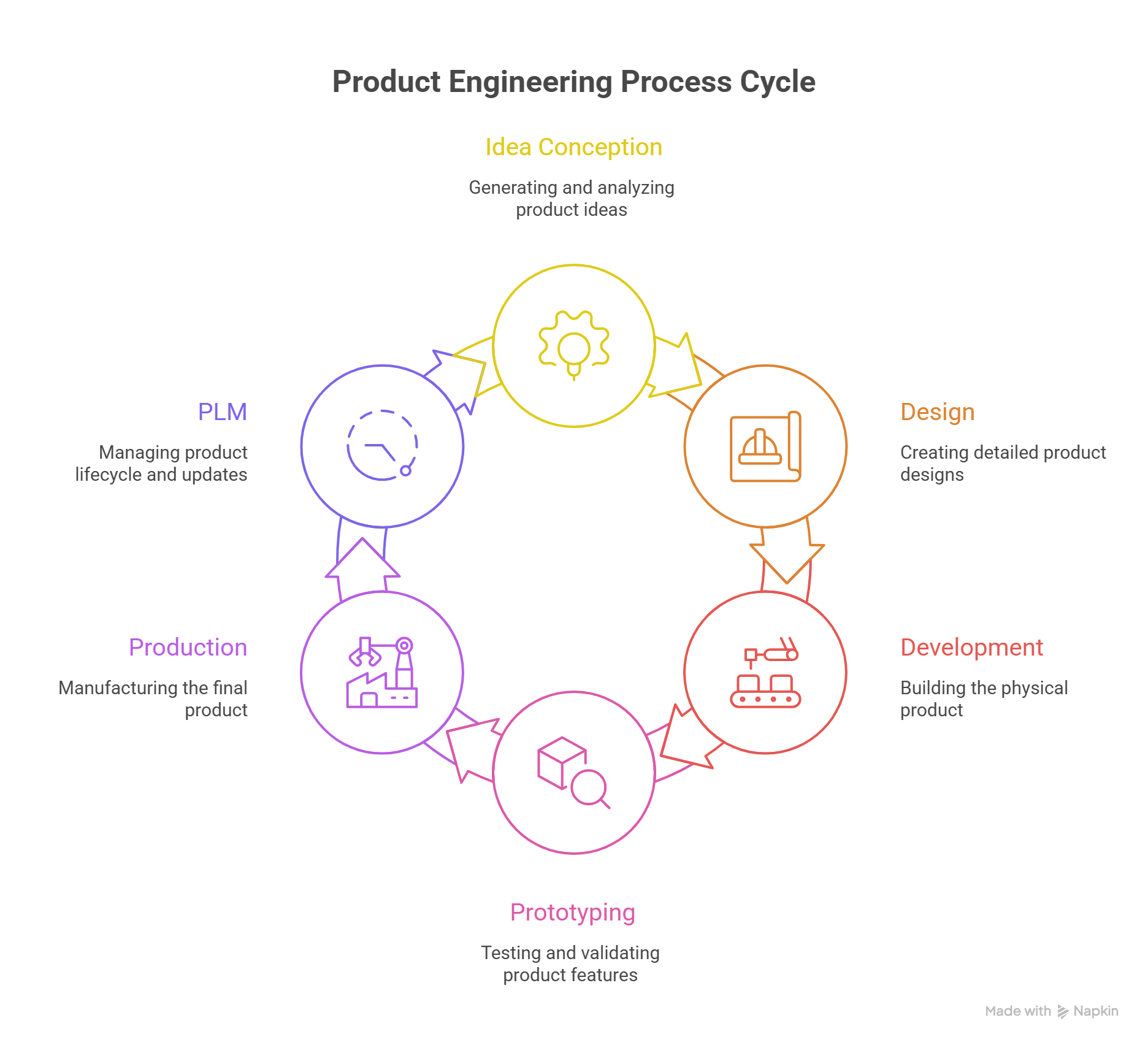
1. The conception of the idea
This is the first stage wherein the idea for a specific product is conceived. It is then described in terms of its specifications and requirements. The idea is then analyzed to check whether it is feasible and worth pursuing. Not every idea that seems exciting in the beginning might be commercially viable.
2. Design
Once an idea has been finalized, the next step is to start designing it so that it can be converted into a commercially viable product. Engineering designs are created keeping in mind the hardware, software, and industrial design specifications. Improvements and changes are made in this phase to create the final product design.
3. Development
The next step is to bring the product idea to physical existence. This is a very significant phase of the product engineering services process. This step includes mechanical computer-aided design (CAD), printed circuit board (PCB) design, system software development, and other processes. The modifications made at the design stage are also implemented in this phase.
4. Prototyping
A prototype is an early sample of a product intended to be produced on a large scale for commercial consumption. Prototypes help test and validate several features envisioned in the earlier phases of product engineering. They are deployed in controlled environments where they are monitored and analyzed. The prototypes are checked for compliance with quality and environmental standards.
5. Production
Once the prototype has been approved and accepted, the product is deemed ready for production. The product engineering services process includes production support to ensure the seamless production and effective release of the final product.
6. Product Lifecycle Management (PLM)
PLM is an important part of any business that deals in physical products. The company has to stay competitive by continuously enhancing the products it supplies to the market. PLM helps in the timely enhancement of the concerned products and is also involved in obsolescence management. Periodic enhancements and updates are mandatory to keep the products relevant in the market.
What are the Benefits of Employing Engineering Services Outsourcing?
Outsourced Product Engineering Services today have evolved to become a strategic part of the product development process. This is because a simple cost vs benefit analysis shows that engineering outsourcing services, when judiciously employed, can be of great benefit to both the organization itself and its clients.
The benefits of ESO are as follows:
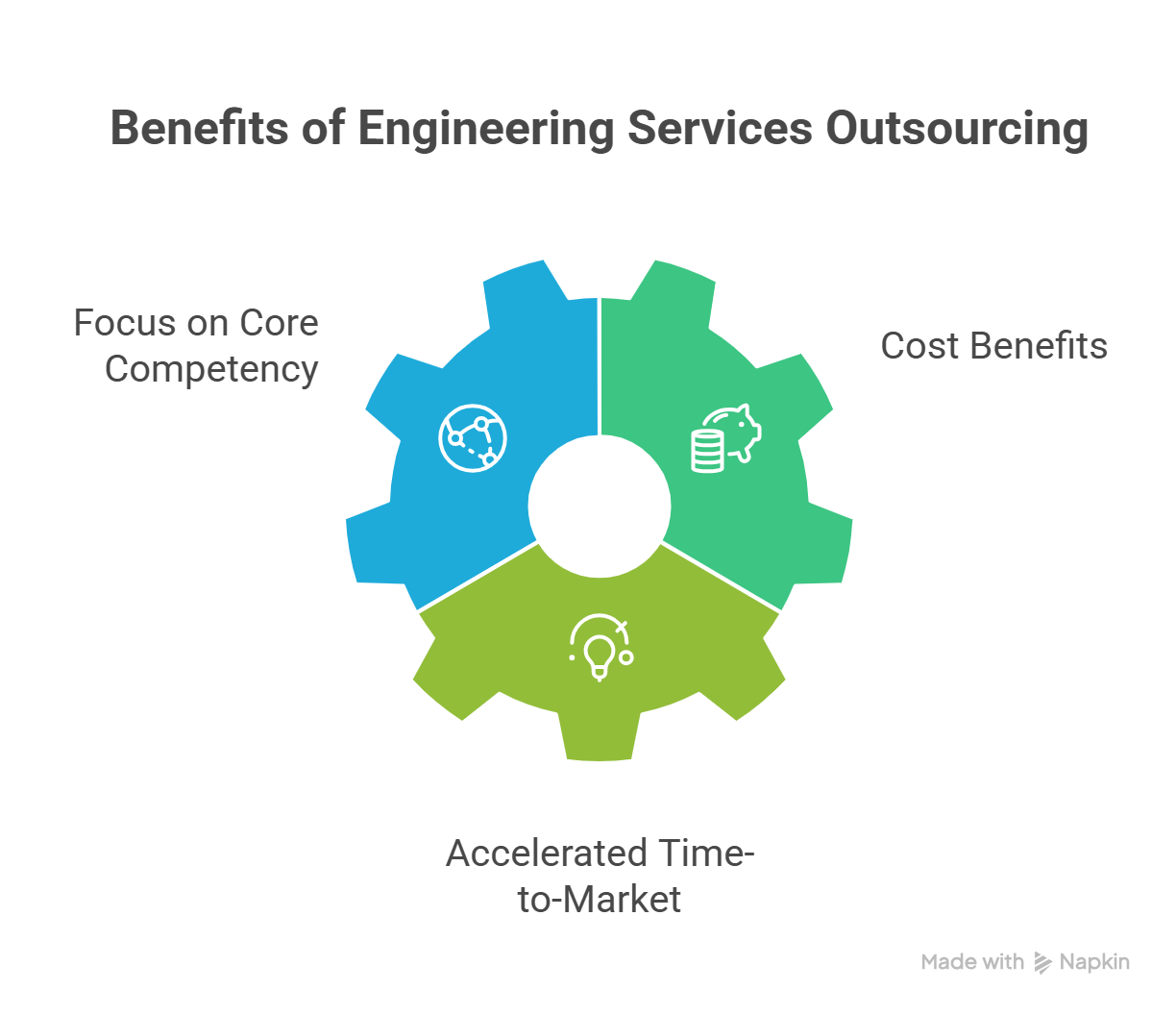
1. Companies can focus on Their Core Competency
The most significant benefit of ESO is that it allows companies to dedicate and pour all their resources into their core competencies or what matters the most. This includes research and development, digital transformation, or a focus on expanding their portfolio.
Imagine automobile manufacturers pouring millions into research and development to develop Infotainment systems in-house and trying to compete with industry leaders with decades of experience behind them. It is an exercise in futility.
The added benefit of ESO is the overall improvement in the quality of your product as you are now tapping into the expertise of global engineering talent who have significantly more domain expertise.
2. ESO Presents Significant Cost Benefits
Outsourced product engineering services can help save companies significant sums of capital expenditures. The principle behind this saving is the conversion from fixed costs to variable costs.
When a company outsources its product engineering services, it converts fixed costs into variable costs. This means that the company only pays for the engineering services that it uses, which can lead to significant cost savings.
In addition to this, companies can further cut costs, such as overheads and taxes, by outsourcing their engineering tasks to low-cost locations. ESO also helps companies achieve economies of scale to increase their profitability.
3. ESO Helps Accelerate Time-To-Market
ESO can help companies speed up their product development cycles by reducing the time spent on designing, prototyping, testing, and launching their products.
Engineering services outsourcing companies can perform all of the above tasks a lot faster and more efficiently, and to a higher standard when compared to companies trying to do it all themselves. The sooner a company brings a new product to market, the higher its competitive advantage, and ESO excels at helping them do just that.
4. The Velocity Advantage
Beyond the balance sheet, the true benefit of ESO today is Elastic Capacity. It allows your in-house team to stay focused on high-level strategy while your partner handles the technical ‘heavy lifting’—from rapid prototyping to complex system integration.
Do You Know? The global engineering services outsourcing market is projected to reach $1.27 trillion by the end of 2026, driven by the rapid digitalization of the manufacturing and automotive sectors.
Best Practices in Product Engineering & Outsourcing
To provide value to your clients and get the most from your outsourcing partnership, it is mandatory to implement certain best practices. Here are a few practices every business must follow:
1. Focus on aspects that matter
Instead of focusing on adding more and more features to your products, figure out what matters to the customers and work on implementing these. A good outsourcing partner can help provide an external perspective on what features are truly valuable.
2. Define clear goals
Defining clear goals is an essential part of product engineering services. Define the target market and set clear, measurable product goals. If the goals are well-defined, the company and its outsourcing partner can prioritize them and effectively allocate resources to achieve them.
3. Focus on continuous re-engineering
Successful companies focus on the continuous re-engineering of their products. Customer preferences are ever-changing, and only those businesses that constantly improve can stay relevant and profitable in the competitive market. An ESO provider can bring new insights and technologies to this ongoing process.
4. Foster a culture of collaboration
Effective product engineering, especially when outsourced, entails collaboration and communication at every stage. Teams often comprise diverse skill sets and are spread across geographies. There must be effective and clear communication between all team members so that everyone’s effort is aligned with the group objective.
5. Use agile methodologies
Agile methodologies involve breaking down a project into phases and focusing on cross-functional collaboration. These methodologies promote quick and flexible product development and allow marketing teams to rapidly improvise product designs based on feedback from the target audience. Businesses and their partners should use agile methodologies for rapid designing, prototyping, testing, and product development.
Conclusion
Engineering Services Outsourcing (ESO) is a powerful solution you should capitalize on to gain a competitive edge in the market. It helps companies gain access to the latest technologies, tools, methodologies, and specialized expertise at a fraction of the cost of building them in-house.
However, ESO is not a one-size-fits-all approach. A careful assessment must be done before deciding which engineering services to outsource and which service provider to partner with. Working with an experienced partner can go a long way in assuring that your business can launch successful products in quick succession while navigating any challenges effortlessly.
If you are looking for a reliable and experienced partner to outsource your engineering services, look no further than Hurix Digital. We are industry leaders in digital engineering and technology solutions with over two decades of experience.
We can help accelerate your product development process with top-notch quality and have an extensive track record of successful projects delivered for clients across various industries, such as automotive, aerospace, industrial, consumer electronics, medical devices, and more.
Contact us today to learn how we can help you achieve your product development goals.
Frequently Asked Questions (FAQs)
Q1: What is the difference between ESO and BPO?
Engineering Services Outsourcing (ESO) is a specialized subset of outsourcing that focuses strictly on high-level technical functions like R&D, product design, and prototyping. Unlike Business Process Outsourcing (BPO), which typically handles back-office tasks like customer service or accounting, ESO requires a workforce with advanced STEM degrees and specialized engineering software expertise. ESO partners are integrated deeper into the product lifecycle, often sharing responsibility for intellectual property and technical innovation.
Q2:Which industries use engineering services outsourcing the most?
While ESO is expanding globally, it is most prevalent in the automotive, aerospace, and medical device sectors. These industries face high regulatory hurdles and rapid technological shifts, such as the transition to electric vehicles (EVs) or the integration of AI into surgical tools. By outsourcing specific engineering functions, companies in these sectors can access “elastic capacity”—scaling their technical teams up or down based on the specific phase of the product development cycle without long-term hiring overhead.
Q3:How do companies protect intellectual property (IP) when outsourcing engineering?
IP protection in ESO is managed through a combination of legal frameworks and secure technical infrastructure. Standard practices include signing robust Non-Disclosure Agreements (NDAs), utilizing secure Virtual Desktop Infrastructures (VDI) so data never leaves the parent company’s servers, and “compartmentalizing” tasks so no single external partner has a complete blueprint of a sensitive product. Leading ESO providers also hold ISO 27001 certifications, ensuring their data security management meets international standards.
Q4:What are the common risks associated with engineering services outsourcing?
The primary risks include communication silos, cultural misalignment on quality standards, and potential “hollowed-out” in-house expertise. If a company outsources too much of its core engineering, it may lose the ability to innovate internally over time. To mitigate these risks, successful firms treat ESO providers as strategic partners rather than simple vendors, maintaining a small, high-level in-house team to oversee technical quality and ensure the outsourced work aligns with the long-term product roadmap.
Q5:Does engineering services outsourcing include physical manufacturing?
No, by definition, ESO refers to the non-physical, knowledge-based engineering functions that occur before mass production. This includes computer-aided design (CAD), simulation, and testing. While some large firms offer both engineering and manufacturing (known as Contract Manufacturing), “Engineering Services Outsourcing” specifically focuses on the intellectual and design labor required to create the specifications that a manufacturer will eventually follow.
Summarize with:

Vice President & SBU Head –
Delivery at Hurix Technology, based in Mumbai. With extensive experience leading delivery and technology teams, he excels at scaling operations, optimizing workflows, and ensuring top-tier service quality. Ravi drives cross-functional collaboration to deliver robust digital learning solutions and client satisfaction